Godzilla Minus Zero – Film Review
Published November 7, 2026

Movie Details

Set in 1949, two years after the devastating events of Godzilla Minus One, the film once again explores a Japan struggling to recover from the consequences of war and unimaginable destruction. However, the country’s fragile recovery faces another catastrophic threat when a mysterious creature known as Ghidorah begins attacking Japanese cities. With conventional military forces unable to stop the increasingly powerful monster, humanity finds itself confronting another seemingly impossible disaster. As Godzilla eventually resurfaces, the possibility of turning two terrifying creatures against one another becomes humanity’s only hope for survival.
One of the most immediately impressive aspects of Godzilla Minus Zero is how confidently it establishes itself as a continuation of its predecessor without becoming overly dependent on nostalgia. The previous film concluded with several unresolved emotional and narrative threads, and Yamazaki demonstrates a genuine understanding of why audiences became invested in these characters. Returning to Kōichi Shikishima, Noriko Ōishi, and the supporting characters provides the sequel with an established emotional foundation, allowing the narrative to explore how people attempt to rebuild their lives after experiencing extraordinary trauma.
Ryunosuke Kamiki once again delivers an excellent performance as Kōichi Shikishima, bringing considerable emotional complexity to a character whose experiences continue to influence his decisions. Kōichi’s journey in Godzilla Minus One was defined by survivor’s guilt, personal responsibility, and his struggle to find a reason to continue living after everything he experienced during the war. Godzilla Minus Zero appropriately recognizes that these feelings do not simply disappear because the immediate threat has been defeated.
Instead, Kōichi’s emotional struggles become an important part of the sequel’s narrative. His responsibilities as a husband and father figure conflict with the lingering psychological consequences of his past, creating an engaging internal struggle that gives the character considerably more depth than simply being another protagonist caught in a monster attack. Kamiki communicates these conflicting emotions exceptionally well, making Kōichi’s personal journey one of the film’s most compelling elements.
Minami Hamabe is equally effective as Noriko, whose relationship with Kōichi remains an important emotional anchor. Their relationship provides the sequel with several genuinely touching moments, particularly as the circumstances surrounding Noriko’s deteriorating condition introduce additional complications. Hamabe brings warmth, vulnerability, and determination to the character, ensuring Noriko remains an active participant in the narrative rather than simply existing as someone Kōichi must protect.
The inclusion of Akiko also strengthens the emotional stakes. Their adopted daughter represents the possibility of a future that is not defined by war, destruction, or tragedy. The family dynamic gives the story something meaningful to fight for, making the consequences of another catastrophic attack feel considerably more personal.
Introducing King Ghidorah as the sequel’s primary antagonist is an inspired creative decision. As one of the most recognizable monsters in the Godzilla franchise, Ghidorah carries enormous expectations, particularly because of its history as one of Godzilla’s most formidable opponents. Yamazaki approaches the character with an understanding of what makes the creature so intimidating while giving it a distinctive presentation appropriate for this particular interpretation of the franchise.
The film’s introduction of Ghidorah is particularly effective. Its mysterious arrival, unusual biological origins, and initial transformation establish an unsettling atmosphere before audiences fully understand the threat they are witnessing. Rather than immediately revealing everything about the creature, the screenplay allows its mythology to develop through scientific investigation and increasingly devastating encounters.
The decision to give Ghidorah an extraterrestrial origin also adds an interesting science-fiction dimension to the story. Its transformation into the familiar three-headed monster provides a satisfying escalation, while its devastating gravity beams establish it as an entirely different challenge from the Godzilla encountered previously.
Importantly, Ghidorah does not simply feel like another enormous creature waiting to destroy buildings. Its presence fundamentally changes the circumstances surrounding humanity’s survival, forcing characters to reconsider their understanding of these creatures and whether Godzilla might represent their only remaining opportunity.
Of course, a Godzilla film ultimately needs to deliver an unforgettable experience whenever its titular monster appears, and Godzilla Minus Zero absolutely understands that responsibility.
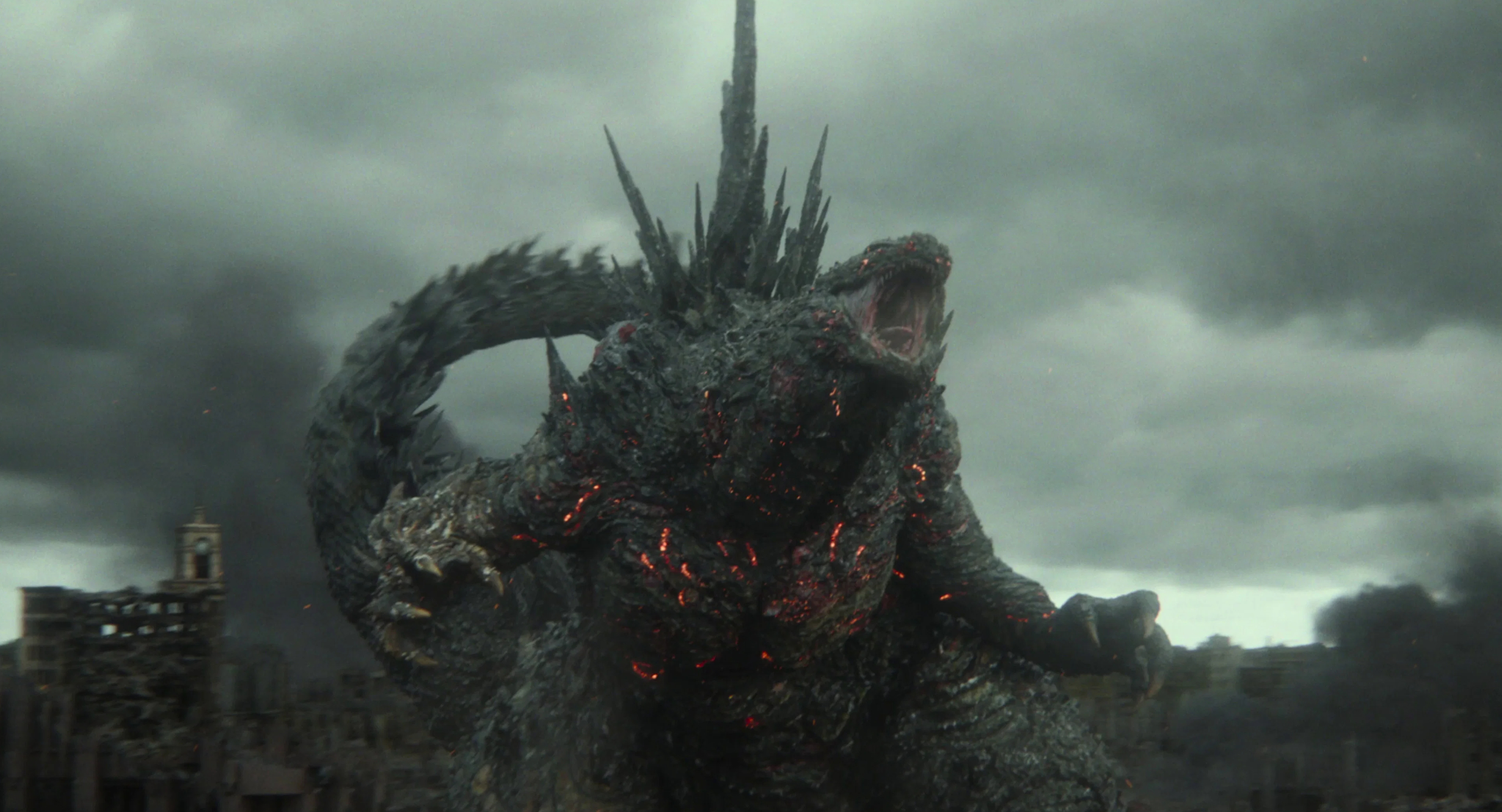
Takashi Yamazaki once again demonstrates an impressive ability to make Godzilla feel genuinely enormous and threatening. His movements carry tremendous weight, his appearance is appropriately intimidating, and the destruction surrounding his emergence communicates the sheer magnitude of his presence. There is an extraordinary sense of scale throughout the monster sequences, particularly when Godzilla is positioned against the surrounding architecture.
The decision to make Godzilla larger and more aggressive following his return also gives the character an interesting evolution. Rather than simply repeating the previous film’s portrayal, Yamazaki presents a creature that feels increasingly dangerous and unpredictable.
The eventual confrontation between Godzilla and King Ghidorah is undoubtedly one of the film’s biggest attractions. Watching these legendary monsters finally share the screen in this particular cinematic universe is tremendously exciting. Their contrasting abilities create several spectacular confrontations, and the filmmakers demonstrate an excellent understanding of how to make their physical encounters feel consequential.
What makes these sequences particularly effective is that they are not simply extended displays of computer-generated destruction. Their outcomes carry genuine narrative significance, and the human characters’ involvement ensures that the confrontation remains connected to the larger story.
From a technical standpoint, Yamazaki delivers another remarkable achievement. His work as both director and visual effects supervisor allows the film to maintain an impressive degree of consistency between its human drama and enormous monster sequences.
The visual effects are frequently spectacular, particularly during the destruction of Japanese cities and the increasingly chaotic encounters involving Ghidorah. The creature designs are imaginative, the environmental destruction feels convincing, and the cinematography consistently emphasizes the overwhelming scale of the devastation.
The historical setting also deserves considerable recognition. By placing the story in 1949, Yamazaki creates an environment that feels appropriately vulnerable. Japan is still recovering from the Second World War, meaning the destruction caused by these monsters carries additional historical and emotional significance.
The production design effectively communicates the difficulties of rebuilding a country that has already experienced so much devastation. The contrast between ordinary citizens attempting to establish normal lives and the extraordinary circumstances surrounding them gives the film an engaging visual identity.
The musical score also contributes considerably to the atmosphere. The music reinforces the emotional moments without overwhelming them, while the more dramatic compositions provide the monster encounters with an appropriate sense of grandeur.
Although Godzilla Minus Zero accomplishes an extraordinary amount, its screenplay is not entirely without shortcomings. One of the film’s more noticeable challenges is balancing its numerous narrative threads. Between Kōichi’s unresolved trauma, Noriko’s condition, Ghidorah’s mysterious origins, the scientific investigation, and the military’s involvement, there is considerable information competing for the audience’s attention.
Some developments consequently feel more complicated than necessary, occasionally interrupting the otherwise excellent pacing. Certain supporting characters also receive less development than they deserve, particularly considering how important their contributions are to the larger conflict.
The introduction of Kanji Murakami is nevertheless an interesting addition. His personal history and motivations introduce another perspective on the consequences of wartime devastation, exploring how deeply rooted resentment can influence someone’s decisions. His storyline provides the film with an additional moral dimension, although some of its developments could have benefited from more breathing room.
The military’s involvement also reinforces one of the franchise’s recurring themes: humanity’s tendency to approach extraordinary threats through power, control, and potential exploitation. Even when confronted with something beyond its understanding, humanity continues searching for ways to turn destructive forces into instruments of its own interests.
These ideas are particularly effective because they connect the monster spectacle to the historical circumstances surrounding the characters.
Ultimately, what makes Godzilla Minus Zero such an impressive achievement is its ability to deliver an enormously entertaining monster movie without abandoning the emotional storytelling that made Godzilla Minus One so memorable.
There is an understandable temptation when creating a sequel to increase the spectacle while sacrificing the smaller character moments that originally connected audiences to the story. Fortunately, Yamazaki demonstrates considerable restraint in this regard. Although the destruction is larger, the mythology is expanded, and the monster encounters are considerably more ambitious, the film never completely loses sight of the people caught in the middle of everything.
Kōichi and Noriko’s relationship remains particularly important, providing the narrative with an emotional foundation that gives the increasingly spectacular developments additional meaning. Their struggles reinforce the idea that surviving a catastrophe is not necessarily the same as recovering from it.
The film also benefits enormously from its willingness to explore the consequences of humanity’s relationship with these enormous creatures. Godzilla is simultaneously a terrifying force of destruction and a potential means of preventing something even worse. That contradiction provides the narrative with an interesting foundation, particularly when considering how quickly military and scientific institutions become interested in controlling something they barely understand.
While the screenplay occasionally struggles to accommodate all its ideas, the overall experience remains tremendously rewarding.
Godzilla Minus Zero is another outstanding achievement from Takashi Yamazaki, delivering spectacular monster action, impressive visual effects, compelling performances, and an emotionally engaging continuation of the characters introduced in Godzilla Minus One. Ryunosuke Kamiki and Minami Hamabe once again provide an excellent emotional foundation, while King Ghidorah’s introduction gives the franchise an exciting new antagonist capable of challenging Godzilla in genuinely spectacular fashion.
It might not quite achieve the same level of narrative perfection as its predecessor, but it comes remarkably close. With its breathtaking creature encounters, thoughtful exploration of postwar trauma, and commitment to character-driven storytelling, Godzilla Minus Zero is an exceptionally entertaining sequel that understands what makes the franchise so enduring.