Fall 2: Deadpoint – Film Review
Published September 3, 2026

Movie Details

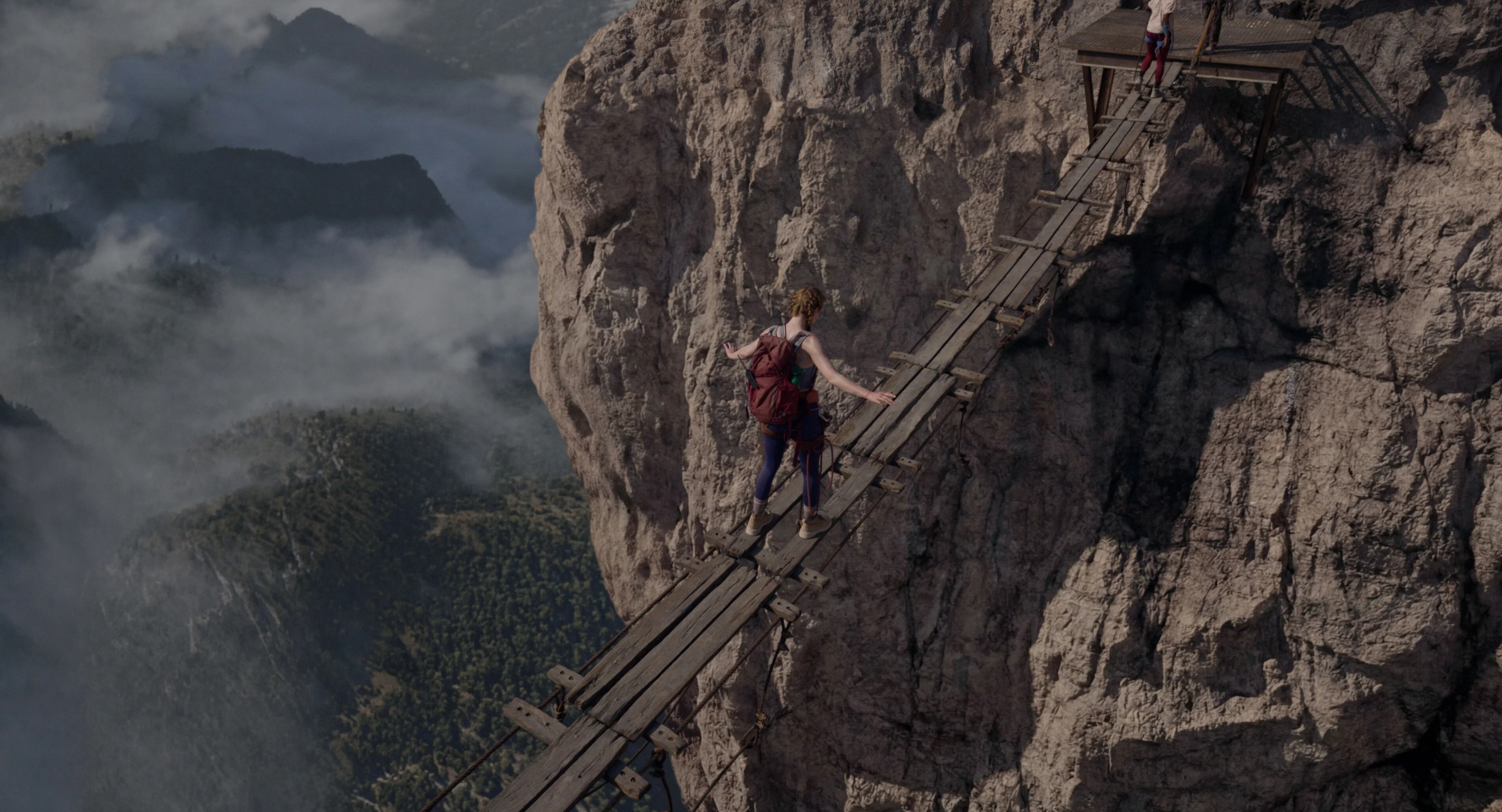
There is something inherently terrifying about being trapped hundreds or thousands of feet above the ground. The original Fall understood that simple premise remarkably well, turning a seemingly straightforward climb up an abandoned television tower into an efficient exercise in sustained anxiety. Its greatest weapon was not an elaborate mythology or complicated plot, but the visceral fear of height itself. Fall 2: Deadpoint attempts to replicate that formula by moving the action to Thailand and replacing the tower with an equally precarious mountain attraction, but the result is a sequel that feels less like an evolution of the original concept and more like a considerably weaker imitation of it.
Directed by Peter and Michael Spierig from a screenplay by Scott Mann and Jonathan Frank, Fall 2: Deadpoint follows Jax Hunter, the older sister of Shiloh Hunter, after Shiloh’s death. Jax agrees to participate in a tribute organized by Shiloh’s daring friend, Luce. Their destination is Thailand, where the pair attempt to conquer a treacherous plank walk on Mount Kwan. Naturally, things go catastrophically wrong. A sudden rockslide strands the women roughly 3,000 feet above the ground, leaving them with nowhere to go and very little hope of getting down safely.
On paper, this is exactly the sort of setup that should work. The original Fall demonstrated how effectively a simple survival scenario can become a cinematic nightmare when the characters have nowhere to run. Unfortunately, Deadpoint repeatedly confuses height with suspense. Simply putting characters in a dangerous location does not automatically make every sequence gripping, and the film struggles to find enough new ideas to sustain its premise.
The biggest problem with Fall 2: Deadpoint is that it feels painfully familiar. The first film established a very specific structure: two people become trapped in an impossibly high location, resources begin to disappear, physical exhaustion sets in, interpersonal tensions emerge, and every attempted solution creates another problem.
Rather than substantially reinventing that formula, Deadpoint mostly rearranges it.
There are certainly differences. The Thai setting gives the film a more expansive visual identity, while the mountain environment allows for different types of hazards than the original tower. The plank walk itself is a visually striking concept, and the rockslide provides an effective inciting disaster. Watching the characters realize that their route back has effectively vanished is uncomfortable in exactly the way a survival thriller should be.
But once the initial disaster occurs, the movie becomes frustratingly repetitive. Jax and Luce spend extended stretches trying to determine how they can survive, communicate, descend, or attract help. The screenplay keeps introducing obstacles, but many of them feel mechanically designed to prolong the running time rather than organically emerging from the situation.
The result is a film where the audience can frequently see the screenwriter’s hand moving the characters from one crisis to another.
Harriet Slater and Arsema Thomas do what they can with Jax and Luce, but the screenplay gives them surprisingly little material with which to work.
Jax is introduced primarily through her connection to Shiloh and the grief surrounding her sister’s death. That could have provided Deadpoint with a strong emotional foundation. Being forced into an extreme survival situation while dealing with unresolved grief is an interesting dramatic idea. Unfortunately, the movie rarely explores that relationship with enough depth.
Instead, Shiloh’s death often feels like a narrative mechanism designed to get Jax onto the mountain.
Luce is similarly underdeveloped. Her adventurous personality provides some contrast with Jax’s more hesitant approach, but their relationship never develops into the compelling partnership the story requires. The film wants their cooperation to become emotionally meaningful, yet it doesn’t spend enough time establishing why these two people should matter to one another beyond their connection to Shiloh.
That makes many of their arguments and reconciliations feel strangely artificial. A survival thriller does not necessarily need deeply complex characters, but it does need characters whose fate matters. Deadpoint struggles to establish that investment.
Where the movie does occasionally succeed is in its cinematography. The enormous scale of Mount Kwan provides some genuinely unsettling images. The filmmakers understand the visual language of vertigo, repeatedly emphasizing the tiny human figures against vast stretches of empty space. Looking down from the plank walk is uncomfortable, and the film makes good use of wide shots to communicate just how insignificant Jax and Luce are compared with the landscape surrounding them.
These moments are easily the strongest parts of the movie. Unfortunately, the visual effectiveness cannot compensate for the increasingly predictable storytelling. Once the audience becomes accustomed to the geography of the location, the sense of discovery disappears. The movie keeps returning to variations of the same visual idea: look down, see the enormous drop, panic, attempt something dangerous, and repeat.
The original Fall benefited from the novelty of its central location. Deadpoint has the disadvantage of following a movie that already demonstrated how this kind of environment could be exploited.
The central weakness is the film’s inability to maintain tension. There are individual sequences that work. A few precarious movements across exposed surfaces generate genuine anxiety, and the rockslide itself is effectively staged. The movie also understands that anticipation can sometimes be scarier than action. Watching a character contemplate an enormous gap is more unnerving than watching them simply jump across it.
But Deadpoint rarely builds these moments into a sustained rhythm.
Instead, tension frequently gives way to exposition, emotional arguments, or increasingly elaborate attempts to solve the problem. The film occasionally seems so determined to manufacture another obstacle that the characters’ predicament stops feeling frightening and starts feeling contrived.
A great survival thriller should make viewers wonder, “How are they possibly going to get out of this?” Too often, Deadpoint makes you wonder, “What new problem is the screenplay going to introduce next?” That distinction is crucial.
The sequel also suffers from comparison with the original. Fall was hardly a masterpiece of character development, but its stripped-down simplicity gave it an immediacy that Deadpoint lacks. There was something brutally straightforward about the original scenario: climb, get trapped, survive.
Deadpoint tries to make its story emotionally larger through grief, family connections, friendship, travel, and the spectacle of a new location. Ironically, those additions make the movie feel less focused.
The Thailand setting is underused dramatically, too. It provides beautiful scenery and a distinctive backdrop, but the film never develops a particularly strong sense of place. The location frequently feels like another enormous stage upon which the same survival scenario from the first movie can play out.
Even the title’s promise of reaching a new “deadpoint” feels more exciting than much of what actually unfolds.
Slater gives Jax enough vulnerability to make the character occasionally sympathetic, particularly when the story allows her grief to surface. Thomas brings energy to Luce and gives the more adventurous character a necessary spark. Their performances are never the main reason the movie fails.
The problem is that neither performer receives a sufficiently nuanced character arc.
The dialogue can be blunt and expositional, particularly when the characters explain their emotions or survival plans. Instead of allowing fear and grief to emerge naturally through behavior, the screenplay frequently has characters verbalize exactly what the audience is supposed to understand. That makes the emotional scenes feel considerably less powerful than they should.
Fall 2: Deadpoint is a disappointing sequel because it takes one of the simplest and most effective thriller concepts imaginable and makes it unnecessarily predictable. The premise remains inherently frightening, the mountain setting produces some impressive imagery, and Harriet Slater and Arsema Thomas are committed to their roles. There are flashes of genuine suspense, particularly whenever the movie remembers that simply looking down can be terrifying.
But those strengths are overwhelmed by a repetitive screenplay, thin characterization, contrived obstacles, and a frustrating lack of fresh ideas.
The biggest problem is not that Deadpoint fails to be as good as Fall. It is that it never gives viewers a compelling reason for this particular survival story to exist. The first film already proved how effective a high-altitude survival thriller could be. A sequel needed to find a new angle, deepen its characters, or dramatically expand the concept. Instead, Fall 2: Deadpoint mostly climbs the same mountain again.
There is enough here to make the occasional sequence genuinely uncomfortable, but not enough to justify the journey. At 3,000 feet, the movie promises an enormous cinematic drop. Unfortunately, the biggest fall is the sequel itself.