Unabomber – Film Review
Published September 27, 2026

Movie Details

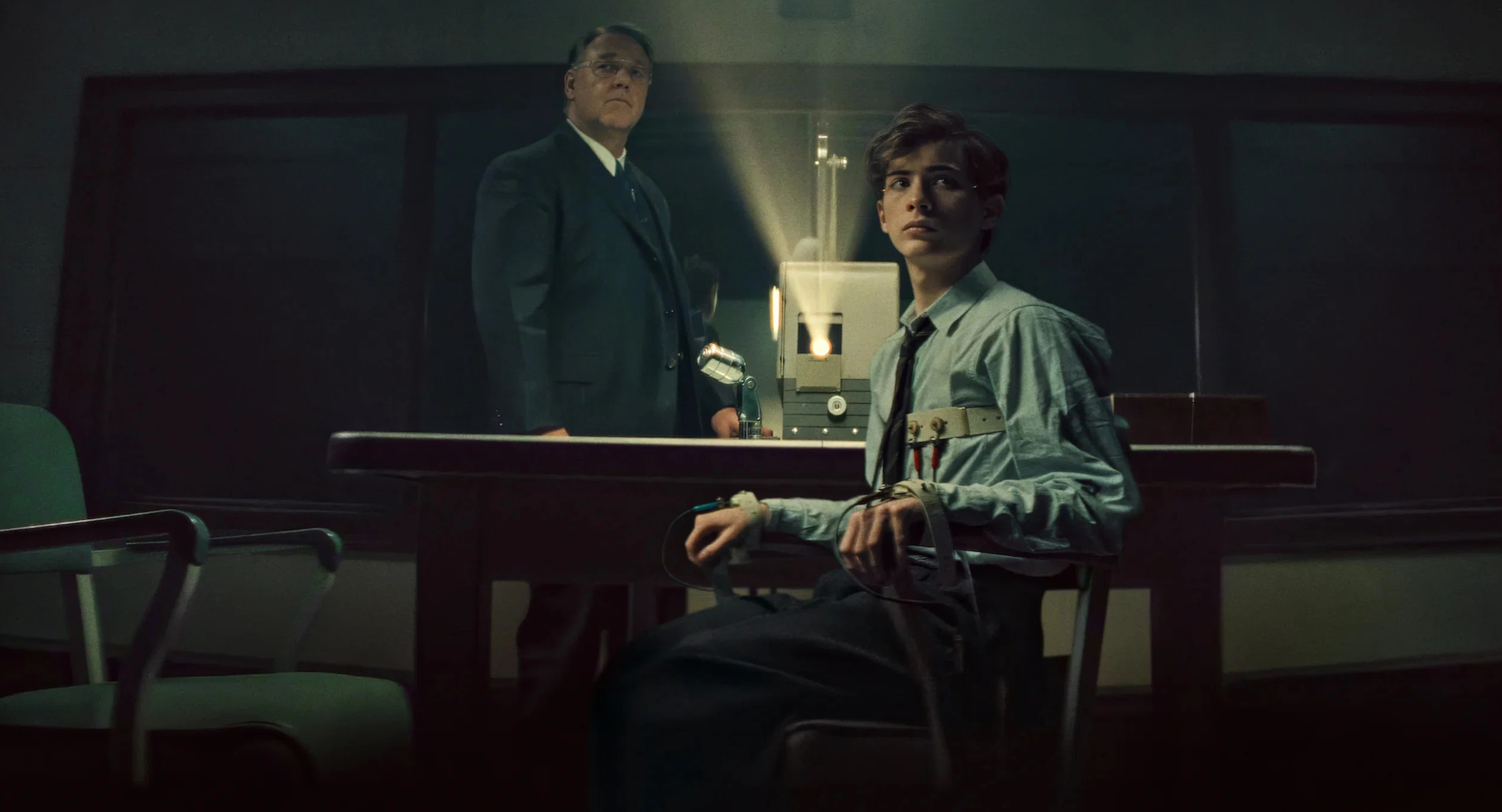
Janus Metz Pedersen’s Unabomber has the ingredients of a gripping psychological crime drama, but the finished film never quite figures out how to make those ingredients cohere into something as compelling as its subject matter demands. Based on the life of Ted Kaczynski and the FBI investigation that eventually led to his arrest, the film attempts to balance two timelines: Kaczynski’s formative years as a brilliant young mathematician and the 1990s investigation into the Unabomber’s campaign of mail bombings. It is an ambitious structure, particularly because it allows the film to explore the relationship between Kaczynski’s intellectual development and the ideology that would eventually drive his crimes. Unfortunately, the execution is surprisingly restrained.
That restraint is not necessarily a problem by itself. There is obvious value in refusing to sensationalize a real-life terrorist, particularly one whose crimes caused enormous suffering. However, Unabomber frequently mistakes restraint for depth. Rather than offering a particularly illuminating examination of Kaczynski’s radicalization, the film moves through significant events with a curious lack of urgency. It introduces major psychological and ethical questions, gestures toward their importance, and then moves on before exploring them with any real complexity. The result is a movie that feels less like a definitive examination of its subject and more like an abbreviated dramatization of events that deserved considerably more room to breathe.
The biggest reason to watch Unabomber is Jacob Tremblay. As the young Ted Kaczynski, Tremblay delivers an impressively controlled performance that avoids turning the character into a caricature of a future criminal. His portrayal captures Kaczynski’s intelligence, social discomfort, emotional detachment, and growing sense of alienation without making the character unnecessarily theatrical. There is a quietness to the performance that works particularly well during the Harvard sequences, where Kaczynski increasingly seems disconnected from the people around him.
Tremblay also understands that the character should not simply be portrayed as an obvious monster from the beginning. The film is interested in showing a young man before the full extent of his criminal identity has emerged, and Tremblay gives that transformation enough subtlety to make the character watchable even when the screenplay itself struggles to explain him. His expressions and physical mannerisms frequently communicate more than the dialogue does. There is a particularly effective sense of discomfort whenever Kaczynski is placed in situations where his intellect is being examined or challenged.
The problem is that Tremblay’s performance is stronger than the material surrounding it. The screenplay gives him some interesting psychological territory but does not consistently develop it. Consequently, the audience is left to infer much of what is happening internally rather than being given a sufficiently detailed portrait of the forces shaping Kaczynski. Tremblay does excellent work with what he has, but the movie needed considerably more from its writing to make that performance truly resonate.
Russell Crowe brings considerable screen presence to Henry Murray, the Harvard professor whose controversial psychological experiments become an important part of the film’s depiction of Kaczynski’s early life. Crowe plays Murray with an intriguing mixture of confidence and uneasiness, particularly as the consequences of the experiments become increasingly apparent. There is an interesting question running through these scenes about where legitimate psychological research ends and potentially harmful manipulation begins.
Annabelle Wallis is similarly effective as Christiana Morgan, particularly because she provides a degree of skepticism toward the methods being used. Morgan’s concerns create an opportunity for the film to examine the ethical implications of the experiments rather than simply presenting them as an important plot point. Unfortunately, these ideas are introduced more thoroughly than they are ultimately explored.
That becomes a recurring problem throughout Unabomber. The film has several fascinating subjects available to it: psychological experimentation, academic pressure, alienation, technological anxiety, family relationships, radicalization, the ethics of behavioral research, and the FBI’s painstaking attempt to understand a criminal through his writing. Yet the movie rarely spends enough time with any of them. Everything feels condensed, as though substantial portions of a longer story have been removed.
Shailene Woodley’s Joanne Miller is perhaps the clearest example. Woodley gives the FBI agent a grounded and capable presence, and the idea of an investigator recognizing that the Unabomber’s writing could provide a psychological fingerprint is inherently fascinating. Nevertheless, Miller never receives enough development to become as memorable as the real investigation warrants. Her work often feels like a narrative function rather than a fully realized character.
One of the strangest things about Unabomber is how short it feels despite dealing with such an enormous period of history. The film covers decades of Kaczynski’s life and a massive FBI investigation, yet the storytelling rarely gives the impression that enough time has passed. Major developments happen rapidly, and relationships that could have been fascinating are established and resolved before the audience has much opportunity to become invested in them.
This is particularly noticeable in the transition between Kaczynski’s Harvard years and the FBI investigation. The earlier material establishes several important ideas about his personality and worldview, but the film does not sufficiently bridge those ideas to the later crimes. The audience understands what happened, but understanding the sequence of events is not the same thing as understanding the person.
The 1990s investigation is somewhat more conventionally entertaining, especially when Joanne Miller begins studying the Unabomber’s writings and searching for clues within his language. There is an inherently compelling detective story buried within this material. The FBI’s attempt to identify an unknown criminal through his manifesto and other writings offers plenty of opportunities for suspense. Unfortunately, the film moves through the investigation so quickly that it never generates the level of tension it should.
The eventual identification of Kaczynski through the recognition of similarities between his writings and the Unabomber manifesto is an extraordinary piece of the story, yet the movie treats it more as an inevitable endpoint than a genuinely suspenseful breakthrough. David and Linda Kaczynski’s involvement is important, but their emotional perspective is similarly underdeveloped.
The biggest disappointment is that Unabomber never fully engages with the complicated questions surrounding its subject. There is an important distinction between examining why someone became radicalized and excusing what they eventually did. A movie about Kaczynski can explore his childhood, education, isolation, ideological development, and psychological experiences without presenting his terrorism as justified. In fact, exploring those factors carefully could make the story more disturbing and informative.
Instead, Unabomber tends to remain on the surface. It presents Kaczynski’s hostility toward technological society and industrialization, but it does not spend enough time examining how those beliefs evolved. Likewise, the Harvard experiments are presented as potentially significant without the film fully establishing how they shaped Kaczynski later in life.
The result is a movie that feels strangely cautious considering the inherently provocative material. It does not need to be graphic or sensationalistic to be powerful. What it needs is patience. More time spent with Kaczynski, his family, Murray, Morgan, and the investigators could have produced a richer examination of how an exceptionally intelligent young man became one of the most notorious domestic terrorists in American history.
The cinematography favors a cold, restrained atmosphere that fits the subject matter, while the remote Montana setting provides an effective contrast to the institutional environments of Harvard and the FBI. However, the film rarely develops a distinctive visual identity beyond its generally austere presentation. The filmmaking is competent without being especially memorable.
Ultimately, Unabomber is a frustrating film because there is clearly a better movie buried inside it. Jacob Tremblay is excellent, and Russell Crowe, Annabelle Wallis, and Shailene Woodley all bring credibility to their respective roles. The central story is undeniably fascinating, and the film contains several compelling ideas about psychology, alienation, technology, family, and criminal investigation.
Unfortunately, those ideas are rarely developed to their full potential. The movie feels strangely tame for such a disturbing and complicated subject, while its relatively short runtime makes the story feel even more compressed. Rather than immersing the audience in Kaczynski’s transformation or the FBI’s lengthy search for him, Unabomber often feels like it is rushing through a much larger story.
That makes the film difficult to outright dismiss, because there is plenty here that works. Tremblay’s performance alone gives the drama some genuine weight, and the psychological material occasionally hints at the fascinating movie this could have been. But hints are not enough. A story this complicated needed more time, greater characterization, and a much deeper exploration of its central ideas.
Unabomber ultimately lands as a decent but underwhelming crime drama: competently made, well acted, and occasionally compelling, but far too restrained and abbreviated to leave an impact.