The Get Out – Film Review
Published July 4, 2026

Movie Details

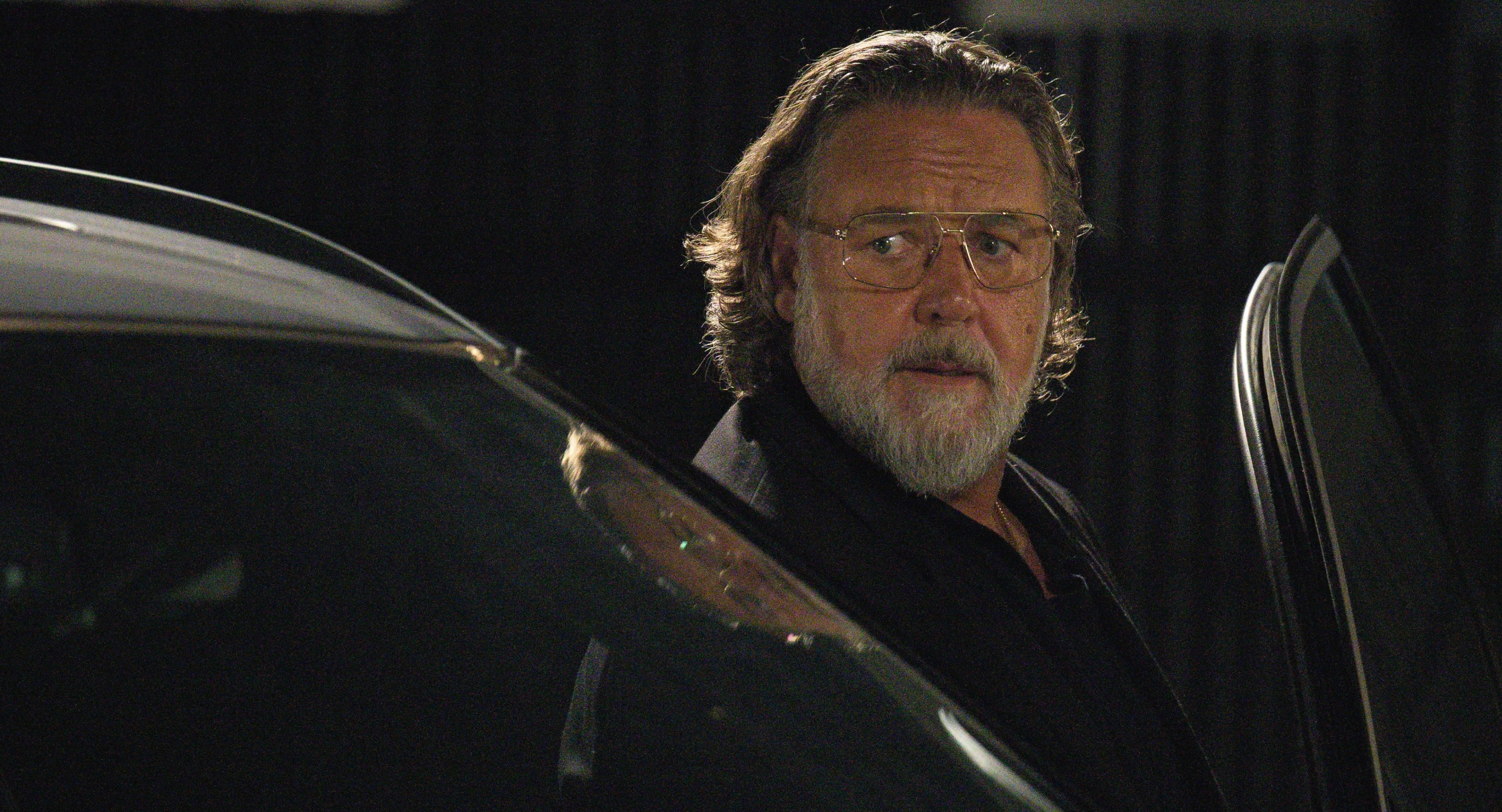
Director Derrick Borte has built a career exploring flawed, morally compromised characters, and The Get Out certainly has no shortage of them. Adapted from Thomas Perry’s novel Strip, the film attempts to blend crime noir, action thriller, and dark comedy into a sprawling story about gangsters, corrupt police officers, desperate thieves, and intersecting betrayals. On paper, it sounds like the kind of pulpy crime caper that could evolve into an entertaining game of double-crosses and escalating tension. With a cast led by Russell Crowe, Luke Evans, Teresa Palmer, Danny Zovatto, Aaron Paul, and Nina Dobrev, there is certainly enough talent assembled to elevate the material.
Instead, The Get Out becomes a frustrating exercise in narrative excess. It constantly introduces new players, subplots, and twists without ever establishing a compelling emotional investment in any of them. While the film clearly wants to evoke the spirit of Elmore Leonard-style crime stories or Guy Ritchie ensemble thrillers, it lacks the wit, pacing, and confidence necessary to pull off such an ambitious balancing act. Rather than feeling intricate, the plot often feels tangled.
The biggest issue is that the screenplay mistakes complexity for intelligence. Nearly every character is hiding an ulterior motive, every conversation hints at another betrayal, and almost every scene introduces another obstacle. Instead of building suspense, the constant barrage of shifting alliances becomes exhausting. There comes a point where the audience stops trying to keep track because the story never pauses long enough to let any development breathe.
Russell Crowe stars as Marco Kapak, an aging nightclub owner hoping to leave his criminal life behind. Crowe delivers exactly the kind of performance audiences expect from him these days—gruff, understated, and occasionally charismatic. His weathered screen presence gives Marco more personality than the script deserves, making him feel like someone who has genuinely survived decades in the criminal underworld. Crowe remains watchable throughout, even when the story surrounding him begins to unravel.
Unfortunately, Marco himself is not written with much depth. The screenplay tells us he wants retirement and peace, but it rarely explores what motivates those desires beyond surface-level dialogue. His internal conflict never becomes particularly engaging because the film continually interrupts his story with the numerous supporting characters fighting over stolen money, criminal organizations, and corrupt law enforcement. Crowe keeps the character grounded, but even he cannot compensate for the lack of meaningful development.
Luke Evans fares somewhat better as Joe Carver, whose calm demeanor provides a welcome contrast to the chaos unfolding around him. Evans possesses the natural screen presence required for these kinds of morally ambiguous thrillers, and he makes Joe feel capable without becoming overly theatrical. Teresa Palmer also delivers a competent performance as Sunny, bringing warmth to one of the film’s few relatively sympathetic characters. Sadly, her role is surprisingly limited considering her importance to Marco’s motivations.
The supporting cast is filled with recognizable faces, yet few leave much of an impression. Danny Zovatto’s Rodriguez is presented as an intimidating crime boss, but he never develops beyond familiar gangster clichés. Josh McConville plays the corrupt detective Slosser with enough menace to remain interesting, although the screenplay often treats him more as a plot device than a believable antagonist. Aaron Paul and Nina Dobrev similarly receive material that never allows their characters to grow beyond functional roles within the increasingly crowded narrative.
One of the film’s greatest weaknesses lies in its pacing. Despite featuring robberies, shootouts, kidnappings, and organized crime, The Get Out often feels strangely sluggish. Scenes drag longer than necessary, while moments that should deliver genuine excitement arrive with surprisingly little impact. The editing struggles to maintain momentum because the film keeps jumping between different storylines without creating meaningful tension between them.
The action sequences themselves are serviceable but largely forgettable. Derrick Borte directs them competently enough to avoid confusion, yet there is very little visual creativity. Shootouts rely heavily on familiar staging, hand-to-hand confrontations lack intensity, and chase sequences never generate much adrenaline. Considering the film markets itself as an action thriller, the lack of memorable set pieces becomes a significant disappointment.
Visually, the film adopts an appropriately grim aesthetic. The nightclubs, abandoned properties, and crime-ridden streets create a believable underworld where violence feels inevitable. Cinematography favors muted colors and dark lighting that reinforce the story’s cynical atmosphere. However, the visual style never evolves into something distinctive enough to leave a lasting impression. It feels polished but anonymous.
The film also struggles with tone. At various points it wants to function as a serious crime drama, a violent action movie, and a darkly humorous satire of criminal incompetence. Those ingredients can coexist successfully when carefully balanced, but here they constantly undermine one another. One scene asks the audience to laugh at absurd criminal behavior, while the next expects emotional investment in tragic consequences. These tonal shifts become increasingly jarring as the film progresses.
Dialogue rarely helps matters. Characters frequently explain their intentions rather than revealing them naturally through behavior. Conversations often exist purely to set up another betrayal or plot revelation instead of developing personalities. There are occasional flashes of clever exchanges, particularly when Crowe’s Marco interacts with rival criminals, but those moments are too infrequent to elevate the overall script.
Perhaps the most disappointing aspect is the adaptation itself. Thomas Perry’s novels are generally praised for intricate plotting and intelligent criminal psychology. While The Get Out retains the complicated framework of intersecting schemes, it neglects the nuanced character work that makes elaborate crime stories satisfying. Without memorable personalities driving the narrative, the twists lose much of their dramatic weight. Surprises arrive simply because the screenplay insists another twist is needed, not because they emerge organically from believable character decisions.
There are occasional glimpses of the film it could have been. Crowe brings enough gravitas to suggest an engaging story about an aging criminal seeking one final escape from a lifetime of violence. Luke Evans hints at a more layered law enforcement subplot that never fully materializes. Even the central premise surrounding multiple competing robberies has the ingredients for an entertaining thriller. Unfortunately, the execution never capitalizes on those strengths.
By the time the story reaches its conclusion, The Get Out feels less like a carefully orchestrated crime saga and more like several unrelated thrillers awkwardly stitched together. Instead of leaving viewers impressed by its intricate plotting, it leaves them trying to remember which subplot mattered most. That’s never a good sign for a movie whose primary appeal rests on suspense and criminal intrigue.
Ultimately, The Get Out wastes an impressive ensemble on an overcomplicated screenplay that mistakes constant movement for genuine momentum. Russell Crowe gives the film its strongest asset, delivering a reliably committed performance that provides occasional flashes of the compelling crime drama hidden beneath the clutter. Derrick Borte directs with professionalism, and the production values remain solid throughout, but those positives cannot overcome the script’s inability to establish emotional stakes or narrative clarity.
For audiences seeking a tightly constructed action thriller, The Get Out is likely to prove more frustrating than thrilling. While crime genre enthusiasts may appreciate isolated performances and moments of competent action, the film never escapes its own convoluted storytelling. What could have been an engaging tale of survival, betrayal, and redemption instead becomes an overly busy thriller that loses sight of its characters amid an avalanche of unnecessary complications.