Stop! That! Train! – Film Review
Published June 14, 2026

Movie Details

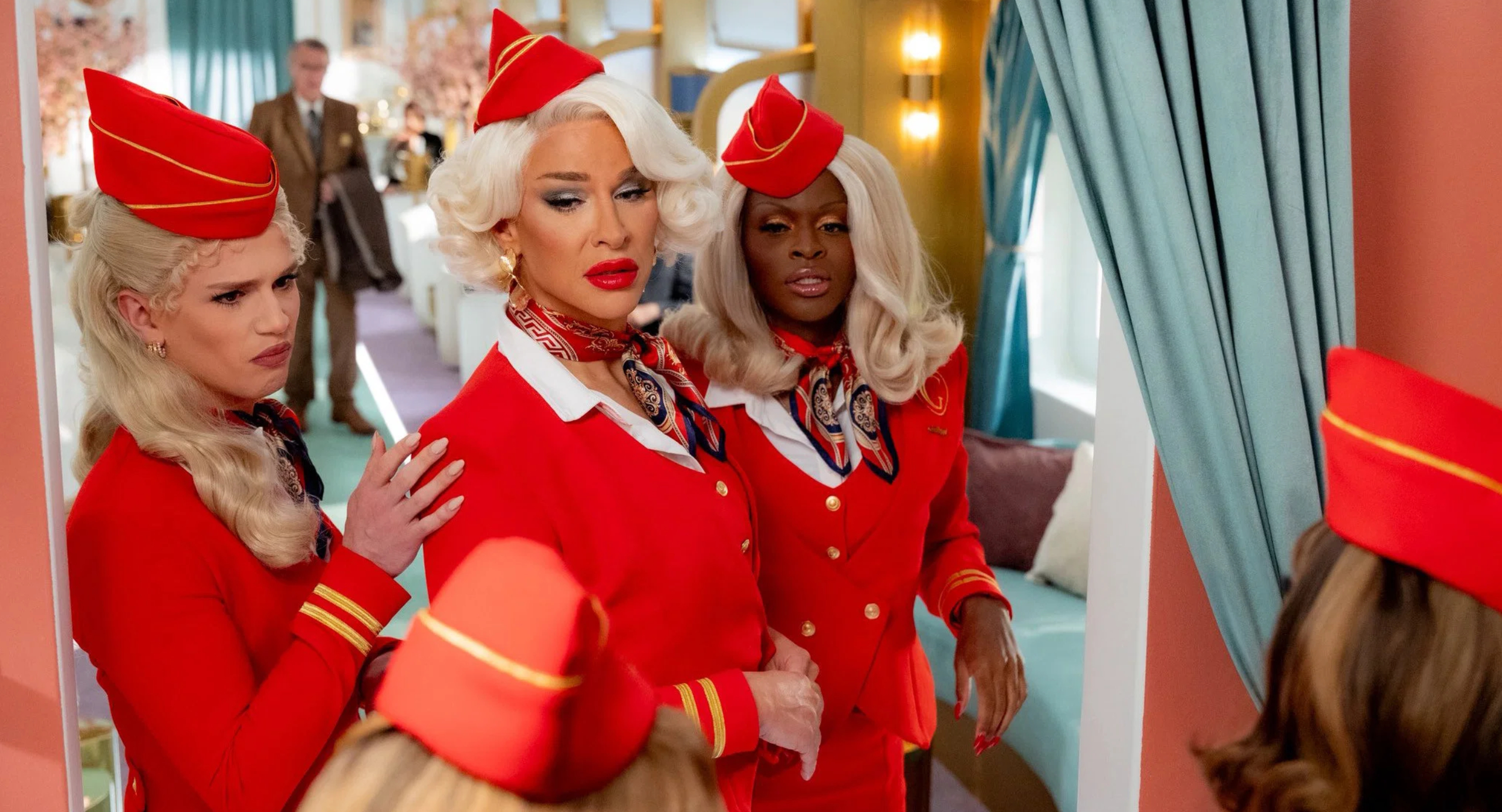
There is a very specific kind of movie that doesn’t care whether every plot point clicks into place so long as the energy never dips. Stop! That! Train! arrives with exactly that mission statement: take an old-fashioned disaster premise, throw in broad comedy, place it aboard a luxury railway, and cast a collection of larger-than-life performers who understand spectacle better than subtlety. Directed and produced by Adam Shankman and written by Christina Friel and Connor Wright, this action-comedy disaster film never pretends to be grounded realism. Instead, it races toward camp excess with enthusiasm, occasionally achieving something genuinely entertaining along the way.
The setup is straightforward enough to support the chaos. Tess (Ginger Minj) and DeeDee (Jujubee) are best friends and longtime train stewardesses trapped in a painfully ordinary railway job. Their fortunes appear to change when they are transferred to the luxurious Glamazonian Express, a high-end route where glamour matters as much as customer service. But what starts as a career upgrade quickly turns into a survival scenario when a massive storm threatens the train’s journey through Florida. Alongside a difficult first-class crew and the flamboyant President Judy Gagwell (RuPaul Charles), the pair must somehow stop catastrophe before the tracks run out.
That premise sounds absurd on paper, and the film wisely understands that trying to make it realistic would have been a mistake. Instead, Stop! That! Train! embraces heightened comedy from its opening scenes. The movie establishes early that its world operates on exaggerated logic and theatrical reactions. People do not merely disagree—they announce their disagreements. Storm warnings arrive with dramatic timing. Crew rivalries resemble reality television confessionals more than workplace tension. The result is uneven but undeniably distinctive.
One of the film’s biggest strengths is its commitment to its central duo. Ginger Minj and Jujubee carry the movie with an easy chemistry that sells years of friendship without needing extensive exposition. Their comedic timing feels natural, and many of the strongest moments come from smaller exchanges rather than the large-scale disaster scenes.
Ginger Minj’s Tess becomes the more proactive of the pair, balancing determination with escalating disbelief as circumstances worsen. She brings a theatrical confidence that fits the film’s exaggerated style. Jujubee’s DeeDee serves as a softer comedic counterbalance, delivering deadpan reactions that often land better than the screenplay’s more obvious jokes.
Together, they create enough goodwill to keep the audience invested even when the narrative starts wandering.
The movie also benefits from understanding the appeal of drag performance without reducing its cast to gimmicks. Rather than treating its performers as novelty casting, the film gives them room to shape their characters. That decision pays off, particularly whenever conversations become more character-driven.
RuPaul Charles appears as President Judy Gagwell and largely delivers exactly what audiences would expect: a performance built around commanding presence, exaggerated confidence, and carefully timed one-liners. The role isn’t especially deep, but depth is clearly not the assignment here. President Gagwell functions less as a realistic political figure and more as an agent of escalating absurdity.
Meanwhile, Brooke Lynn Hytes and Latrice Royale contribute memorable supporting turns. Brooke Lynn’s Amber effectively channels polished first-class superiority before gradually becoming more collaborative, while Latrice’s Barbra supplies some of the movie’s stronger reaction comedy.
Where the film begins losing momentum is in balancing its tones.
Disaster movies traditionally depend on mounting tension and clear stakes. Comedy, especially broad comedy, often depends on deflating tension. Stop! That! Train! struggles to merge those instincts. Whenever the storm sequences start generating suspense, the screenplay interrupts momentum with another joke or side conversation.
There are moments where the train itself barely feels threatening because characters remain unusually relaxed despite conditions becoming increasingly severe. That doesn’t ruin the movie, but it does make the disaster element feel secondary rather than essential.
Visually, Adam Shankman approaches the material with enough energy to compensate for inconsistent effects work. The Glamazonian Express itself is a fun creation—equal parts luxury transport and exaggerated fantasy set. Bright interiors and theatrical costume design create a heightened atmosphere that helps distinguish the film from more traditional disaster stories.
The storm sequences are less convincing.
Some effects shots feel intentionally artificial while others seem unintentionally unfinished, creating an odd visual inconsistency. Occasionally this works in the movie’s favor by adding to the camp aesthetic, but there are stretches where the spectacle simply lacks impact. Pacing also becomes an issue in the middle section.
The first act moves quickly through setup, and the final act embraces escalating absurdity with confidence. The middle, however, gets bogged down in repetitive crew conflict and side jokes that do little to develop the characters or increase tension. Several scenes feel like extended sketches rather than necessary narrative beats.
Ironically, the film becomes strongest once it stops trying to explain itself.
By the climax, Stop! That! Train! fully commits to spectacle, friendship, and increasingly ridiculous solutions to impossible problems. The movie becomes more enjoyable once it abandons realism entirely and focuses on personality. That commitment doesn’t make every joke work, but it gives the film an identity.
There is also something refreshing about a disaster comedy that isn’t cynical. Even when characters clash, the story ultimately leans into cooperation, resilience, and embracing unconventional heroes. Tess and DeeDee are never framed as action icons—they are service workers suddenly forced into extraordinary circumstances, and the movie finds genuine comedy and charm in that idea.
As entertainment, Stop! That! Train! succeeds more often than it fails. As a disaster movie, it never fully reaches the level of suspense or escalation needed to become truly memorable. As a comedy, the hit rate varies. But as a showcase for performers who understand camp, theatricality, and ensemble energy, it offers enough enjoyable moments to justify the ride.
This is a movie that knows exactly what kind of audience it wants: viewers willing to board a luxury train, ignore realism, and enjoy the spectacle.