Signal One – Film Review
Published June 16, 2026

Movie Details

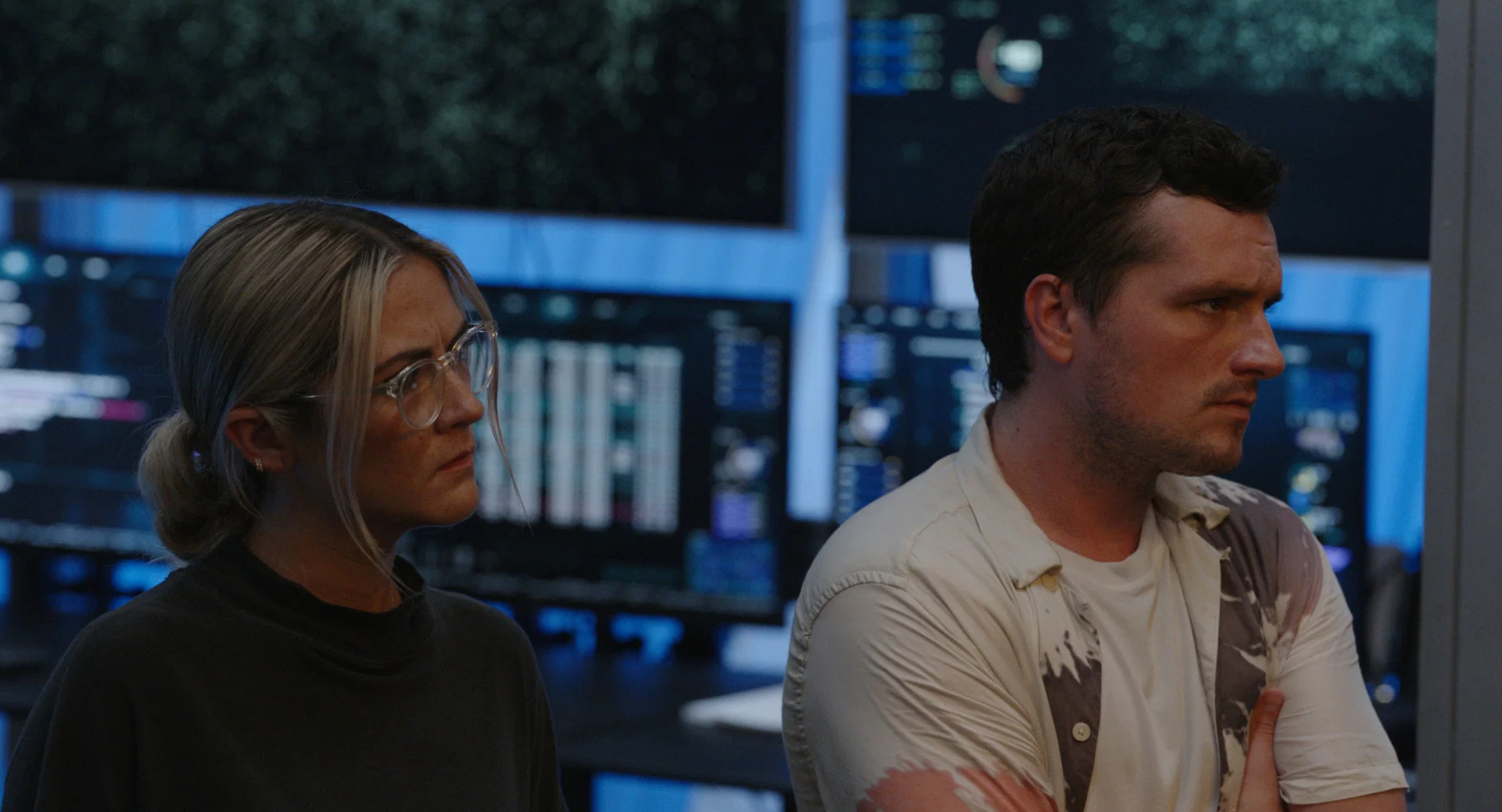
Science fiction thrives on mystery. The greatest entries in the genre invite audiences to ponder humanity’s place in the universe while balancing intellectual curiosity with emotional stakes. Signal One, written and directed by Jonathan Sobol, clearly aims for that lofty territory. With a premise centered on humanity’s first communication with extraterrestrial intelligence, a talented ensemble cast led by Isabelle Fuhrman, Dennis Quaid, David Thewlis, and Josh Hutcherson, and an isolated island setting ripe for paranoia and suspense, the film appears to have all the ingredients necessary for a compelling science-fiction thriller.
Unfortunately, Signal One struggles to transform those ingredients into a satisfying experience. While its ideas are intriguing and its ambition is admirable, the execution frequently feels muddled, resulting in a film that spends too much time discussing fascinating concepts rather than dramatizing them. What should have been an unsettling exploration of alien contact instead becomes a slow-moving and often frustrating exercise in unrealized potential.
The film follows Dr. Annika Kask (Isabelle Fuhrman), a brilliant computer scientist whose groundbreaking work in astrophysics has earned her recognition within scientific circles. She is recruited by billionaire entrepreneur Sam Houston (Dennis Quaid) to join a highly secretive research initiative on a secluded Caribbean island. The project revolves around a machine called LITTLEMOUTH, an experimental device developed by eccentric physicist Perry Glassner (David Thewlis), designed to communicate with extraterrestrial civilizations.
The opening act is arguably the strongest portion of Signal One. Sobol establishes a sense of mystery surrounding the island facility and gradually introduces the scientific theories behind LITTLEMOUTH. The idea of receiving a message from an alien intelligence remains one of science fiction’s most captivating concepts, and the screenplay initially generates genuine intrigue.
The film poses several compelling questions. What would happen if humanity finally received proof that we are not alone? How would scientists react to information originating from an entirely different civilization? Could human minds even comprehend a truly alien form of communication?
These questions provide fertile ground for suspense and philosophical exploration. The problem is that Signal One rarely develops them beyond surface-level discussions. Rather than allowing the audience to experience the implications of first contact alongside the characters, the script repeatedly falls back on exposition-heavy conversations that explain ideas without making them dramatically engaging.
As the signals become increasingly strange and influential, the story hints at psychological horror elements. Researchers begin experiencing unusual behavior, and the facility itself starts feeling unstable. There are moments when the film suggests it may evolve into a tense and unsettling descent into madness. Yet those moments never fully materialize. The narrative continually teases bigger revelations without delivering the emotional or narrative payoff necessary to justify the buildup.
One of the film’s biggest strengths is its cast. Isabelle Fuhrman brings intelligence and credibility to Annika Kask, giving the audience a capable protagonist to follow. Fuhrman works hard to ground the increasingly bizarre developments, and she remains one of the primary reasons the film stays watchable.
Annika is positioned as the audience surrogate, the scientist trying to separate objective reality from the increasingly chaotic events unfolding around her. Fuhrman conveys determination and skepticism effectively, but the screenplay does not provide enough depth to make Annika particularly memorable. She often reacts to events rather than actively driving them.
Dennis Quaid appears to be enjoying himself as Sam Houston, the wealthy visionary funding the project. Houston embodies the familiar archetype of the billionaire convinced he can reshape humanity’s future. Quaid brings charisma to the role, though the character itself remains frustratingly underdeveloped. His motivations never become as nuanced or complex as they need to be.
David Thewlis fares somewhat better as Perry Glassner. Thewlis naturally excels at portraying eccentric intellectuals, and his performance injects occasional energy into scenes that might otherwise feel stagnant. Perry is perhaps the film’s most interesting character, largely because Thewlis embraces the scientist’s obsession with uncovering truths beyond human understanding.
Josh Hutcherson’s Charlie Kaminsky feels particularly underserved. Hutcherson delivers a solid performance, but the character often functions as little more than a narrative device.
For a film centered on extraterrestrial communication and cosmic mystery, Signal One often feels surprisingly small in scale. The island setting provides opportunities for isolation and claustrophobia, but the cinematography rarely capitalizes on the environment’s potential.
Many scenes unfold in sterile laboratories, conference rooms, and dimly lit hallways that lack visual personality. While low-budget science fiction can certainly succeed through atmosphere and creativity, Signal One struggles to establish a distinctive aesthetic identity.
The visual effects are serviceable but unremarkable. Whenever the film attempts to depict the impact of the alien signals, the results feel underwhelming. Rather than inspiring awe or fear, these sequences frequently come across as generic science-fiction imagery that viewers have encountered countless times before.
Perhaps the film’s greatest weakness is its inability to create meaningful emotional investment. Science fiction often succeeds when extraordinary concepts intersect with relatable human experiences. Films about alien contact frequently explore themes of loneliness, curiosity, fear, faith, or the limits of human understanding.
Signal One gestures toward these themes without fully committing to them. The screenplay remains so focused on explaining scientific concepts and teasing mysteries that it neglects the emotional journeys of its characters.
As a result, major revelations arrive with less impact than intended. The audience understands that the stakes are theoretically enormous, but the film never convincingly demonstrates how these discoveries affect the people involved. The emotional distance becomes increasingly noticeable as the narrative progresses.
The pacing also suffers from this imbalance. Long stretches of dialogue slow the momentum, and several sequences feel repetitive as characters debate possibilities without advancing the story. By the time the film reaches its climax, the sense of wonder that fueled the opening act has largely dissipated.
What makes Signal One particularly disappointing is that its flaws stem less from bad ideas and more from unrealized ones. The premise contains genuine promise. The cast is capable. The themes are rich with potential. Yet the film never finds a way to merge those elements into a cohesive and compelling whole.
Jonathan Sobol deserves credit for attempting an intellectually ambitious science-fiction story rather than relying solely on spectacle. There is a clear desire to explore complex questions about communication, consciousness, and humanity’s relationship with the unknown. Unfortunately, ambition alone cannot compensate for uneven pacing, underdeveloped characters, and a narrative that repeatedly hints at profundity without achieving it.
By the end, Signal One feels like a transmission that never quite reaches its destination. It contains flashes of intriguing ideas and solid performances, particularly from Isabelle Fuhrman and David Thewlis, but they are buried beneath a screenplay that struggles to maintain suspense or emotional engagement.
For viewers who enjoy contemplative science fiction, there may be enough here to spark curiosity. However, those hoping for a gripping first-contact thriller or a thought-provoking exploration of extraterrestrial intelligence will likely leave disappointed.
Signal One asks fascinating questions about humanity’s first encounter with alien intelligence, but its sluggish pacing, thin characterization, and lack of emotional resonance leave its strongest ideas drifting aimlessly through space.