Coyote vs. Acme – Film Review
Published August 30, 2026

Movie Details

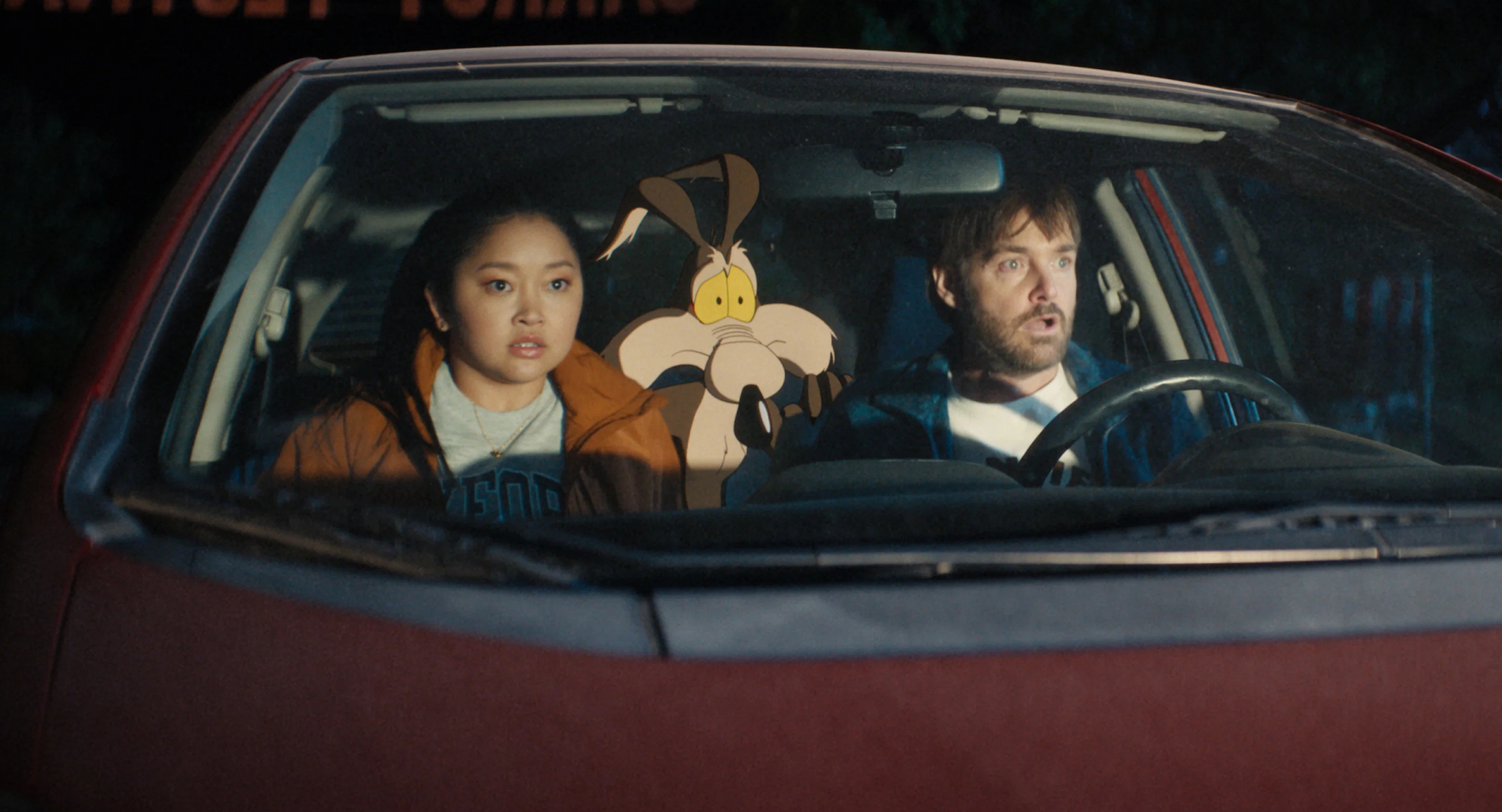
There is something wonderfully fitting about Coyote vs. Acme finally making its way to theaters after enduring a journey almost as absurd as one of Wile E. Coyote’s elaborate schemes. A movie that was once shelved, nearly disappeared from public view, and spent years caught in a strange corporate limbo has finally escaped its own metaphorical portable hole. And thankfully, the finished film proves that all of that patience was not entirely in vain. Directed by Dave Green and written by Samy Burch from a story by James Gunn, Jeremy Slater, and Burch, Coyote vs. Acme is a remarkably charming mixture of live-action comedy, animation, courtroom satire, family adventure, and Looney Tunes lunacy.
Most importantly, it understands something that many legacy-character movies sometimes forget: these characters don’t need to be radically reinvented to be entertaining. They simply need a good story.
The premise is almost irresistible. Wile E. Coyote, eternally tormented by malfunctioning Acme products in his pursuit of the Road Runner, finally decides that enough is enough. Rather than continuing to accept his seemingly endless misfortune, he takes Acme Corporation to court. His attorney is Kevin Avery, a struggling Albuquerque lawyer who is considerably less confident than his client. What follows is a legal battle that expands into something considerably bigger, bringing corporate corruption, family relationships, professional insecurity, and cartoon physics together in a surprisingly coherent package.
The genius of the premise is that Wile E. Coyote’s decades-long suffering is treated as a legitimate legal grievance.
For generations, audiences have watched Wile E. purchase rockets, explosives, catapults, jet-powered devices, giant springs, portable holes, and countless other products from Acme, only for virtually everything to spectacularly backfire. Coyote vs. Acme takes that running joke and asks the most obvious question imaginable: What if Wile E. actually sued?
The screenplay gets tremendous mileage from that idea without stretching it beyond recognition. There are plenty of jokes about cartoon logic, but the movie doesn’t simply bombard viewers with references and expect nostalgia to do all the work. Instead, it builds an actual narrative around the concept.
Will Forte is particularly well cast as Kevin Avery. Forte has a wonderfully awkward comedic presence that allows Kevin to be funny without turning him into a complete caricature. He plays the character as someone who has lost faith in himself professionally, making his unlikely partnership with Wile E. surprisingly compelling. Kevin isn’t merely there to provide exposition for the audience; he has his own insecurities, regrets, and reasons for being hesitant to take on Acme.
That gives the film an emotional dimension that is stronger than expected.
Lana Condor brings plenty of energy to Paige Avery, Kevin’s niece and intern. Paige is the kind of character who could easily have been reduced to the obligatory younger sidekick, but Condor gives her enough personality and determination to make her an important part of the story.
The relationship between Kevin and Paige also provides a nice counterbalance to the broader cartoon chaos. Their professional disagreements and different approaches to the case help make the legal storyline feel like more than an excuse to put animated characters in a courtroom. And then there is John Cena, who seems almost genetically engineered to play an over-the-top corporate attorney.
As Buddy Crane, Cena has an enormous amount of fun playing the smug, polished rival to Kevin. His comedic timing is excellent, particularly because he understands that the funniest version of Buddy is someone who takes himself completely seriously while existing in an inherently ridiculous universe. Cena has become increasingly confident as a comedic performer, and this is another showcase for his ability to embrace silliness without losing the character underneath it.
Rather than making the animated characters feel like intrusive digital creations dropped into a human movie, Coyote vs. Acme builds its world around their existence. Cartoon characters and humans simply coexist. That decision allows the filmmakers to explore all kinds of amusing consequences without constantly stopping to explain the premise. The result is a world that feels heightened but internally consistent.
The physical comedy is equally important. Coyote vs. Acme knows that the appeal of Wile E. Coyote has always been rooted in elaborate setups and spectacular consequences. The film finds clever ways to translate that sensibility into a feature-length narrative while avoiding the feeling that we’re simply watching a series of disconnected Road Runner cartoons.
The legal-comedy component could easily have become tedious, but Burch’s screenplay keeps the proceedings lively. The film pokes fun at corporate doublespeak, legal maneuvering, public relations, and the tendency of powerful companies to treat individual people as disposable inconveniences.
There is also a satisfying David-versus-Goliath quality to the story. Kevin and Wile E. are hardly an intimidating legal team, while Acme has the money, resources, lawyers, and institutional power to overwhelm them. That contrast creates plenty of opportunities for humor while also giving the story something meaningful to say about accountability.
The movie never becomes so serious that it loses its identity, though. Whenever the courtroom material threatens to become too conventional, the Looney Tunes characters bring everything crashing back into cartoon territory.
Perhaps the biggest surprise is how genuinely sweet Coyote vs. Acme can be. Wile E. Coyote has always been defined by failure. He fails over and over again, dusts himself off, and tries again. The film uses that characteristic to explore perseverance without turning him into a generic motivational character.
Kevin’s journey complements Wile E.’s perfectly. Both characters have experienced failure, although they respond to it differently. Kevin has become cautious because of his professional disappointments, while Wile E. stubbornly refuses to stop trying. Their relationship gives the movie an emotional foundation that makes the comedy more effective.
The movie also understands that Wile E.’s relationship with the Road Runner is more interesting when it isn’t reduced to simple hatred. Their decades-long rivalry contains an affection and familiarity that the film is able to explore without destroying what makes their dynamic iconic.
Dave Green deserves considerable credit for balancing the movie’s wildly different ingredients. Live-action actors, animated characters, courtroom drama, corporate satire, family comedy, and traditional slapstick could easily have resulted in tonal whiplash. Instead, the film maintains a consistent personality.
The visual effects are particularly important because the Looney Tunes characters have to feel like genuine inhabitants of this world. Their exaggerated movements and expressions remain intact, allowing them to retain the visual language audiences expect while interacting with real environments and performers.
And the comedy is refreshingly old-fashioned. Coyote vs. Acme isn’t afraid of visual gags, physical comedy, absurd reaction shots, and elaborate setups. In an era where many comedies lean heavily on dialogue and references, there’s something genuinely refreshing about a movie that understands how funny a well-timed cartoon gag can be.
The biggest emotional complication surrounding Coyote vs. Acme is knowing how close audiences came to never seeing it at all. Its shelving in 2023 made it one of the most infamous examples of a completed film becoming caught up in corporate decision-making. The eventual decision to allow the filmmakers to find another distributor, followed by Ketchup Entertainment’s acquisition of the movie, makes its theatrical release feel like a victory in itself.
And I sincerely hope people see this movie in theaters. Not simply because it is entertaining, but because Coyote vs. Acme has had such an unusual and difficult road to the big screen. Supporting the film theatrically is a way of demonstrating that audiences still care about original-feeling studio comedies, animation/live-action hybrids, and movies that have fought remarkably hard just to exist publicly.
After everything this movie has been through, there is something especially satisfying about watching Wile E. Coyote finally get his day in court—and watching the movie itself finally get its day in theaters.
Coyote vs. Acme isn’t perfect. Some of its human characters occasionally feel more familiar than fully developed, and the story sometimes follows the conventions of the underdog legal comedy a little too closely. A few of the jokes also land more predictably than others. But those shortcomings are easy to overlook because the movie is so consistently likable.
It is funny without being cynical, nostalgic without being dependent on nostalgia, and surprisingly heartfelt without becoming overly sentimental. Most importantly, it treats Wile E. Coyote with genuine affection. Rather than merely exploiting a beloved cartoon character for another franchise exercise, Coyote vs. Acme gives him a story that allows audiences to laugh with him, sympathize with him, and ultimately root for him.
After years of uncertainty, corporate complications, and the very real possibility that audiences would never get to see it, Coyote vs. Acme arrives as exactly the kind of crowd-pleasing, good-natured comedy that deserves to be enjoyed with an audience.
It’s a blast, it’s heartfelt, and it’s one of the most pleasant surprises of the Looney Tunes’ big-screen legacy.