Buddy – Film Review
Published September 1, 2026

Movie Details

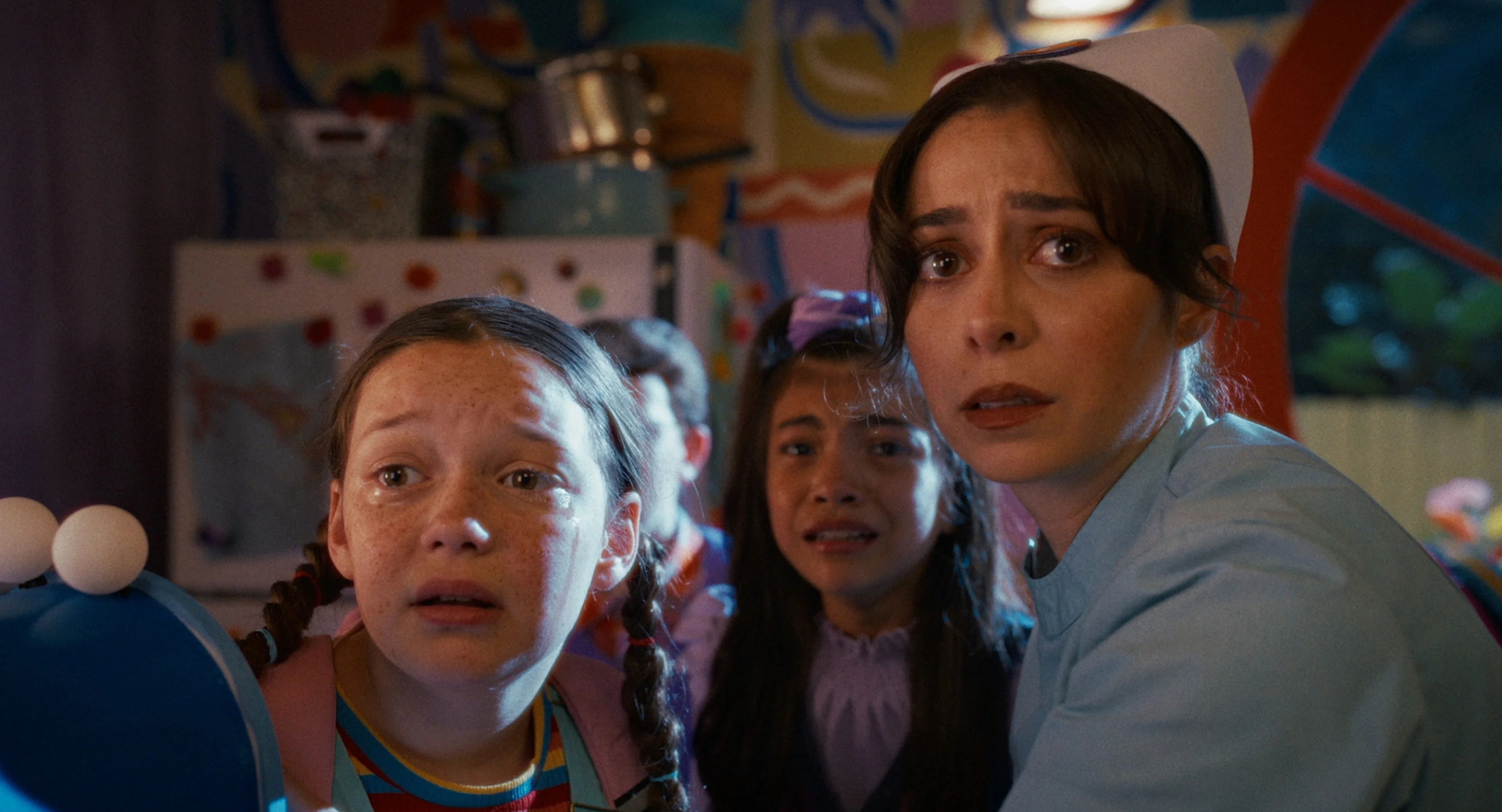
There is something inherently unsettling about children’s television. The bright colors, exaggerated smiles, relentlessly cheerful songs, talking animals, and artificial sets are all designed to create a safe and comforting environment for young viewers. But when those same elements are placed inside a horror movie, the artificiality becomes disturbing. Casper Kelly’s Buddy understands that contradiction extremely well, transforming the aesthetics of a forgotten 1990s children’s program into the foundation for a surprisingly inventive supernatural horror-comedy.
Kelly, making his feature directorial debut, co-writes the film with Jamie King, and the result is an uneven but frequently inspired mixture of black comedy, surreal horror, nostalgic television imagery, and dark fantasy. Buddy follows a group of children trapped inside the strange world of It’s Buddy!, a fictional children’s show hosted by a gigantic, bright-orange unicorn. What initially appears to be an innocuous world of songs, games, talking objects, and colorful adventures gradually reveals something much more sinister lurking underneath.
The premise is easily the film’s greatest strength. Rather than simply using an evil children’s-show character as a conventional monster, Buddy explores what happens when the artificial rules of children’s television become a prison. The characters are surrounded by exaggerated positivity, but that positivity eventually feels oppressive. Everything exists to serve the show, and the show’s cheerful logic becomes increasingly threatening as the story progresses.
The production design deserves enormous credit for making It’s Buddy! feel like a genuine television program from the late 1990s. The sets are deliberately artificial, colorful, and slightly cheap-looking in exactly the right way. The world feels like something that could have existed on children’s television decades ago, complete with oversized props, bright backgrounds, goofy characters, and environments that seem designed primarily for visual stimulation rather than realism.
That authenticity makes the horror more effective. Kelly doesn’t simply create a generic fantasy world and add a few children’s-TV references. He builds an entire visual language around the genre. The film understands how children’s programming often relies on repetition and exaggerated simplicity, and it gradually twists those familiar conventions into something uncomfortable.
The costume design is similarly effective. The characters’ outfits and mascot-like appearances contribute to the impression that this is a real television production rather than a horror movie pretending to be one. Buddy himself is particularly striking. His enormous orange appearance initially resembles the kind of colorful mascot that would be completely harmless to a child watching television. The disconnect between his appearance and his increasingly threatening behavior becomes one of the movie’s most entertaining ideas.
The cast is consistently strong, especially Cristin Milioti. As Grace, Milioti gives the movie an emotional anchor that it desperately needs. Her performance balances confusion, fear, determination, and genuine emotional vulnerability without turning Grace into a generic horror protagonist. Milioti has an unusual ability to make heightened material feel believable, which is particularly valuable in a movie this strange.
Delaney Quinn also makes a strong impression as Freddy. Quinn gives the character enough personality to make her feel like an actual child rather than merely a horror-movie survivor. The young performers generally handle the unusual premise well, particularly considering how much of the film requires them to react seriously to deliberately ridiculous surroundings.
The supporting adult cast is equally entertaining. Patton Oswalt, Michael Shannon, Topher Grace, and Keegan-Michael Key all bring recognizable personalities to an intentionally exaggerated world. Key’s vocal performance as Buddy is particularly important because the character’s voice needs to sell both his artificial cheerfulness and his menace. The contrast is one of the movie’s most effective comedic devices.
The black comedy works best when Buddy allows its absurdity to coexist naturally with the horror. The movie recognizes that there is something inherently funny about an enormous talking unicorn behaving like the antagonist of a nightmare, and it doesn’t shy away from that absurdity.
Yet the film is not simply a parody. Kelly takes the horror seriously enough that the strange world retains an atmosphere of genuine danger. The juxtaposition between cheerful children’s entertainment and supernatural violence gives Buddy a distinctive identity.
Unfortunately, the horror itself can sometimes feel less intense than the premise promises. The kills are imaginative enough, but many of them aren’t as brutal or visually impactful as they could have been. Considering the film’s darker tone and its willingness to embrace grotesque ideas, there are moments when the movie seems to pull its punches.
This is especially noticeable because the concept offers enormous potential for inventive horror. A supernatural children’s-show host who controls an entire artificial world could produce practically limitless nightmare scenarios. Buddy occasionally reaches that potential, but not consistently enough.
The biggest problem is the pacing, particularly during the first thirty minutes. The movie takes a very long time to establish its premise and settle into its horror-comedy rhythm. Some setup is necessary because the audience needs to understand the rules of It’s Buddy!, but the film could have accomplished this much more efficiently.
The opening stretch frequently feels like it is waiting for the movie to begin. There are intriguing details scattered throughout, and the atmosphere is strong, but the narrative momentum is limited. Because the central premise is so immediately interesting, the slow build becomes increasingly frustrating.
Once Buddy begins escalating its horror, however, the pacing improves considerably. The movie becomes stranger, more unpredictable, and more entertaining as its world expands. The latter half demonstrates how much more effective the film can be when it fully commits to its bizarre premise.
The third act is easily the strongest portion of the film. Without spoiling what happens, this is where Kelly brings together the movie’s various ideas and allows the horror to become substantially more surreal and energetic.
The escalation feels appropriately nightmarish without completely abandoning the black-comedy sensibility. The imagery becomes more memorable, the stakes become clearer, and the film’s central ideas about entertainment, identity, childhood, and manufactured happiness become more apparent.
Most importantly, the third act demonstrates that Buddy has a much bigger imagination than its relatively slow opening suggests. It becomes increasingly unpredictable, and the final stretch contains several sequences that genuinely feel like they could only exist in this particular movie.
The conclusion also leaves the audience with an unsettling sense that the nightmare may be larger than the characters initially understood. Rather than wrapping everything up in a conventional fashion, Kelly uses the ending to broaden the implications of his premise.
Buddy isn’t completely successful, but it is certainly memorable. Its biggest accomplishments come from its production design, costume design, convincing recreation of 1990s children’s television, strong performances, and willingness to combine genres that shouldn’t work together as easily as they do here.
Milioti is particularly excellent, giving the movie the emotional grounding necessary to keep its stranger elements from becoming completely detached. The young cast also performs admirably, while the adult supporting players add personality and comedic energy.
The film’s shortcomings are mostly structural. The first thirty minutes are far too slow, and the violence doesn’t always deliver the visceral impact suggested by the premise. There are also moments when the movie’s ambitious ideas seem more interesting than their execution.
Still, Buddy represents an unusually confident feature debut from Casper Kelly. It takes a wonderfully strange concept and surrounds it with a convincing visual world, an eccentric sense of humor, and enough unsettling imagery to make the experience worthwhile. It isn’t quite the fully realized nightmare it could have been, but when it clicks, Buddy is wonderfully bizarre.