Backrooms – Film Review
Published May 30, 2026

Movie Details

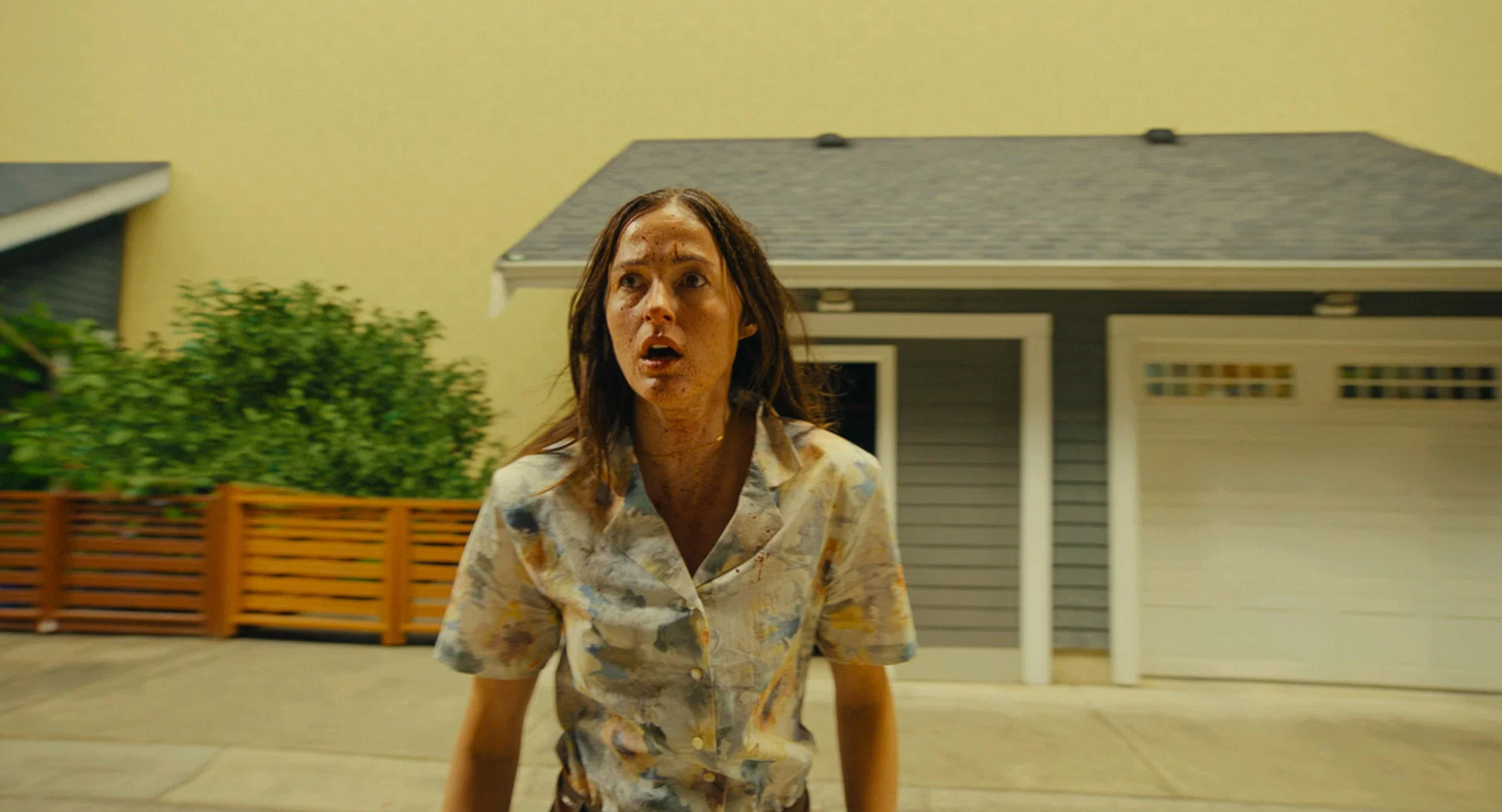
For more than a decade, the Backrooms concept has occupied a unique place in internet horror culture. What began as a simple image and a short piece of creepypasta fiction evolved into a sprawling mythology built around endless yellow hallways, impossible architecture, and the unsettling feeling of existing somewhere reality was never meant to reach. Kane Parsons, whose online Backrooms videos became a viral sensation thanks to their convincing analog-horror aesthetic and inventive world-building, now makes the leap to feature filmmaking with Backrooms. The result is an ambitious, unnerving, and surprisingly emotional science-fiction horror film that expands the mythology while preserving the mystery that made the original concept so compelling.
Parsons’ transition from YouTube creator to feature director could have easily resulted in a project that felt stretched beyond its limits. Instead, Backrooms demonstrates a filmmaker who understands precisely what made his short-form work effective and how to adapt those strengths into a larger narrative. The film remains deeply rooted in atmosphere and visual storytelling, but it also introduces compelling human drama that gives audiences something tangible to hold onto amid the endless corridors and existential dread.
The story follows Clark (Chiwetel Ejiofor), a struggling furniture store owner dealing with alcoholism, financial difficulties, and the emotional fallout of a divorce. When mysterious electrical abnormalities lead him to a hidden passage in his store’s basement, he discovers a vast extradimensional realm known as the Backrooms. What initially appears to be an impossible curiosity soon reveals itself as something far more dangerous and psychologically corrosive. As Clark becomes increasingly obsessed with the place, his therapist, Dr. Mary Kline (Renate Reinsve), finds herself pulled into a mystery that threatens both reality and sanity.
One of the film’s greatest strengths is its decision to treat the Backrooms as more than a haunted maze. Parsons and screenwriter Will Soodik build an elaborate mythology around the environment while carefully avoiding excessive exposition. The audience receives enough information to understand the stakes without having every mystery explained away. This balance allows the Backrooms to retain their terrifying unpredictability.
The production design deserves enormous praise. The Backrooms themselves become the film’s true star. Every room feels simultaneously familiar and alien, evoking the strange sensation of remembering a dream that never happened. Endless office corridors, malformed furniture displays, cavernous pools, and distorted domestic spaces create a visual landscape unlike anything else currently appearing in mainstream horror cinema.
What makes these environments so effective is the way Parsons photographs them. His camera frequently lingers on empty spaces just long enough to make viewers question whether they actually saw something moving in the distance. The film understands that anticipation can be more frightening than revelation. Rather than relying on constant jump scares, it weaponizes uncertainty.
The visual style also benefits from Parsons’ experience in analog horror. Grainy footage, surveillance imagery, and documentary-style sequences blend seamlessly with traditional cinematic storytelling. The result feels authentic rather than gimmicky, creating the impression that the audience is witnessing fragments of a larger nightmare rather than a neatly packaged horror story.
Chiwetel Ejiofor delivers one of the strongest performances of his career as Clark. The character could have easily become a one-dimensional tragic figure consumed by obsession, but Ejiofor finds layers of vulnerability, frustration, and desperation beneath the surface. Clark’s emotional collapse feels believable because it grows naturally from his existing struggles. The Backrooms do not create his problems; they amplify wounds that were already there.
As Clark becomes increasingly fascinated by the impossible world he has discovered, Ejiofor captures the dangerous allure of obsession. There is a tragic quality to his performance that makes even his worst decisions understandable. Viewers may not agree with his choices, but they will recognize the emotional impulses driving them.
Renate Reinsve proves an equally strong presence as Mary. Rather than functioning solely as a voice of reason, Mary emerges as a fully realized character with her own unresolved trauma and emotional baggage. Reinsve brings intelligence and humanity to the role, grounding the film whenever its concepts threaten to become overwhelmingly abstract.
The chemistry between Ejiofor and Reinsve gives the narrative a surprisingly emotional center. Their therapist-patient relationship evolves in fascinating ways as the situation spirals beyond conventional understanding. The screenplay uses their dynamic to explore themes of personal responsibility, self-destruction, and the stories people tell themselves to avoid confronting painful truths.
The supporting cast also contributes significantly. Mark Duplass brings quiet intrigue to Phil, a figure connected to the mysterious Async Research Institute. His understated performance hints at layers of hidden knowledge without becoming overly theatrical. Finn Bennett and Lukita Maxwell make memorable impressions despite more limited screen time, helping establish the human cost of venturing into the unknown.
Perhaps the film’s most impressive accomplishment is how effectively it translates internet horror into feature-length storytelling. Many adaptations of online phenomena struggle because the concepts work better in short bursts than sustained narratives. Parsons avoids this trap by continually expanding the scope of the mystery while maintaining a strong focus on character psychology.
The horror itself is remarkably varied. Sometimes the film relies on creature encounters, presenting terrifying entities that emerge from the darkness with startling effectiveness. Other moments derive fear from the environment itself. The possibility of becoming lost forever in an endless maze proves just as frightening as any monster.
Several sequences rank among the most unsettling horror scenes of the year. Parsons demonstrates exceptional control over pacing, allowing tension to build gradually before unleashing moments of genuine terror. The film rarely feels rushed, instead embracing a slow-burn approach that rewards patience.
Equally impressive is the sound design. Strange mechanical hums, distant footsteps, electrical interference, and barely audible voices create a constant sense of unease. Parsons’ work as co-composer further strengthens the atmosphere, delivering a score that feels eerie and melancholy without overwhelming the visuals.
Thematically, Backrooms explores isolation, regret, addiction, memory, and identity. The endless corridors become reflections of the characters’ internal struggles. The film suggests that people can become trapped within emotional labyrinths just as easily as physical ones. These ideas never feel forced, emerging naturally through character interactions and environmental storytelling.
The final act expands the mythology in intriguing ways while preserving the ambiguity that makes the concept effective. Parsons resists the temptation to explain every mystery, trusting audiences to engage with unanswered questions. Some viewers may desire more concrete resolutions, but the film’s commitment to uncertainty ultimately strengthens its impact.
If there is a notable weakness, it lies in the occasional uneven pacing during the middle section. Certain exploratory sequences, while visually fascinating, sometimes linger longer than necessary. A handful of supporting characters could also have benefited from additional development. These issues are relatively minor, however, and do little to diminish the overall experience.
What remains most impressive is how confidently Backrooms establishes Kane Parsons as a filmmaker to watch. Making the leap from viral internet creator to successful feature director is notoriously difficult, yet Parsons accomplishes it with remarkable assurance. He demonstrates a sophisticated understanding of visual language, atmosphere, and suspense that many veteran filmmakers spend years trying to master.
Backrooms succeeds because it understands that true horror comes from uncertainty. The film does not merely show audiences a frightening place; it immerses them in a world where logic breaks down and familiar spaces become alien. Combined with strong performances, haunting imagery, and surprisingly thoughtful themes, the result is one of the year’s most distinctive horror films.
By transforming an internet legend into a compelling cinematic experience, Kane Parsons proves that the Backrooms have plenty of unexplored territory left to discover. Creepy, imaginative, and emotionally resonant, Backrooms is a chilling journey into the unknown that lingers long after the lights come back on.