Insidious: Out of the Further – Film Review
Published August 22, 2026

Movie Details

The Insidious franchise has always been at its strongest when it treats the supernatural as something intimate and unnerving rather than simply throwing monsters at the audience. Insidious: Out of the Further, the sixth installment in the long-running horror series, occasionally captures that eerie quality. Written and directed by Jacob Chase, the film introduces a new protagonist and a new mythology surrounding the Further while still maintaining connections to the larger mythology established throughout the franchise. The result is a moderately effective supernatural horror film with some genuinely creepy ideas, impressive atmosphere and strong performances, but it is also a frustratingly uneven experience that takes too long to get moving and eventually collapses beneath the weight of its own increasingly elaborate climax.
The story follows Gemma, a young dental hygienist and single mother who lives with her daughter, Maya. Their seemingly ordinary lives are disrupted when Gemma begins experiencing increasingly disturbing supernatural encounters. Her connection to her deceased mother and the house she inherited from her creates an emotional foundation for the story, while Maya’s unusual experiences suggest that the family’s relationship with the supernatural extends further back than Gemma realizes. Without getting into the film’s major revelations, Gemma soon discovers that she possesses an extraordinary ability connected to the Further, putting both her and her daughter in the sights of something much more dangerous.
One of the most interesting things about Out of the Further is how it expands the franchise’s mythology without simply repeating the same basic premise. The concept of Gemma being able to interact with spirits and transport objects between the Further and the living world gives the film a different supernatural mechanism to work with. The idea of someone functioning as a kind of bridge between two realms opens up some intriguing possibilities, particularly because the ability is connected to Gemma’s family history. Chase clearly wants this movie to feel like more than another haunted-house story, and the mythology gives the narrative a refreshing sense of purpose.
Unfortunately, the film takes a while to properly capitalize on those ideas.
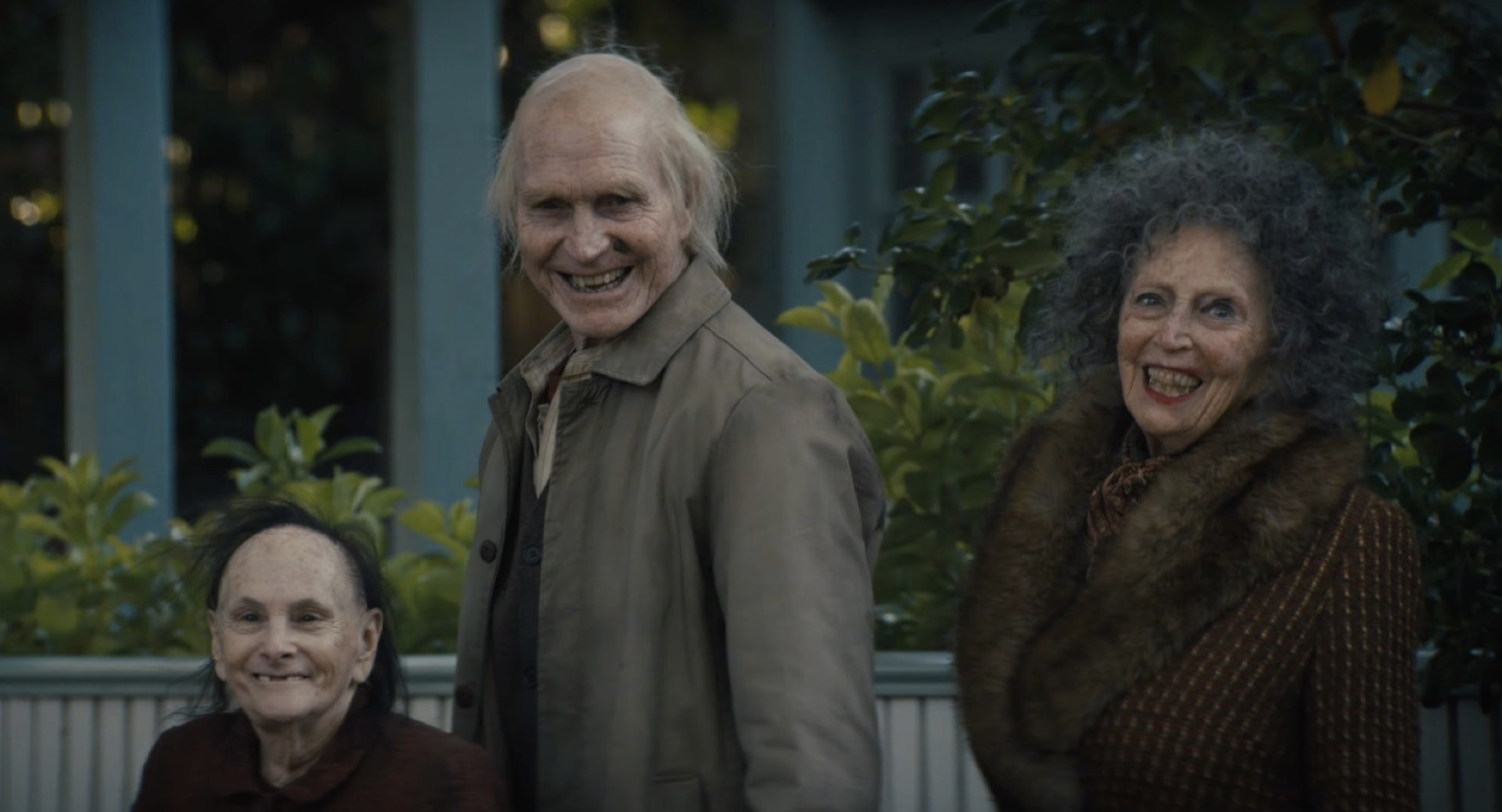
The biggest problem with Insidious: Out of the Further is its pacing. The first half is deliberately slow, but the deliberate approach doesn’t always translate into effective suspense. There are long stretches devoted to establishing Gemma’s personal life, her relationship with Maya, her boyfriend Nick and the elderly neighbors before the supernatural mythology really begins to take shape. Character development is important, especially in a franchise that has occasionally struggled to make its protagonists feel like more than horror-movie victims, but the movie sometimes confuses quietness with tension.
That doesn’t mean the early sections are unsuccessful. In fact, some of the movie’s best scares come from its patience. Chase understands that a strange object sitting in the wrong place or an unsettling figure appearing in the distance can be more effective than immediately resorting to loud musical stings. Gemma’s nightmares have a particularly oppressive quality, making the Further feel less like a conventional haunted location and more like an impossible psychological landscape. The atmosphere frequently does the heavy lifting.
The cinematography deserves considerable credit for that. The film makes excellent use of darkness, shadow and unsettling compositions to create a world that feels vaguely wrong even when nothing overtly supernatural is happening. The Further itself is presented with a suitably dreamlike visual language, while the real-world sequences retain a gloomy, uneasy quality. There is a pleasing contrast between familiar domestic spaces and the distorted supernatural environments Gemma encounters. Even when the screenplay loses focus, the visual storytelling generally remains confident.
The performances are another major strength. Amelia Eve gives the movie a solid emotional center as Gemma, portraying her as someone whose fear is inseparable from her responsibilities as a mother. She isn’t simply frightened by what is happening; she is frightened by the possibility that whatever is happening to her could also affect Maya. That gives the supernatural material a human dimension.
Island Austin is also appealing as Maya, bringing enough warmth and personality to make the mother-daughter relationship believable. Brandon Perea gives Nick a likable presence as someone trying to help Gemma navigate circumstances that become increasingly difficult to understand. Maisie Richardson-Sellers also makes an impression as Claire, bringing an appropriately mysterious energy to a character who becomes increasingly important to the supernatural investigation.
And then, of course, there is Lin Shaye. Her return as Elise Rainier is one of the film’s biggest pleasures. Even when her appearance is limited, Shaye brings an unmistakable sense of familiarity and authority to the franchise’s supernatural mythology. Elise’s presence reminds viewers that this is still an Insidious movie, while also helping bridge the new story with what came before.
The biggest disappointment is the film’s central villain. Cyrus is presented as a sinister supernatural figure with an elaborate history and a frightening objective, but the character never becomes as intimidating as the movie clearly wants him to be. The mythology surrounding him is considerably more interesting than the character himself.
Part of the problem is the design. Cyrus is supposed to be terrifying, but his appearance can be unintentionally funny, and he frequently looks like Ozzy Osbourne wandered into the wrong horror movie. It’s difficult to remain completely terrified of a supernatural villain when his appearance occasionally inspires more amusement than dread.
The character also lacks the psychological dimension that made some of the franchise’s earlier supernatural threats memorable. Cyrus has a recognizable motivation, but he largely functions as a conventional evil force driving the plot forward. The more we learn about him, the less mysterious he becomes. A villain who should have represented the terrifying possibilities of the Further instead feels like an excuse for the film to escalate its mythology.
That escalation eventually becomes the movie’s biggest problem.
The third act goes dramatically bigger than the preceding material, and not necessarily for the better. What began as a relatively intimate story about a mother, daughter and family trauma eventually expands into a chaotic supernatural confrontation involving increasingly large stakes. The ideas aren’t inherently bad, but the execution becomes cluttered.
The movie throws so many supernatural concepts, characters and plot mechanics into its climax that the emotional simplicity established earlier starts to disappear. The result is less frightening than it should be. Horror thrives on uncertainty, and once the third act starts explaining and escalating everything, much of the mystery evaporates.
There are still entertaining moments, and the cinematography remains impressive, but the climax feels like it belongs to a different, louder movie. The intimate supernatural horror of the opening chapters gives way to something much more bombastic. It isn’t necessarily boring, but it is considerably less effective.
The post-credits scene also continues the film’s tendency toward dark humor, providing a cheeky final punctuation mark rather than a genuinely frightening last image.
Insidious: Out of the Further is an uneven but reasonably entertaining addition to the franchise. Its most successful elements are its performances, atmospheric cinematography and willingness to introduce new mythology rather than simply recycle previous Insidious stories. The concept of Gemma as someone capable of moving between the living world and the Further is genuinely interesting, and the family connection gives the supernatural story a meaningful emotional component.
Unfortunately, the movie is dragged down by slow pacing, an underwhelming villain and an overblown third act that sacrifices some of its earlier atmosphere for spectacle. Cyrus never becomes the memorable antagonist the film needs, and his Ozzy Osbourne resemblance doesn’t exactly help matters.
Still, there is enough here to recommend to dedicated Insidious fans. Chase demonstrates a strong visual sense, the cast commits to the material, and the film occasionally finds the eerie, dreamlike quality that made the franchise so appealing in the first place. It simply doesn’t sustain that quality consistently enough.
Insidious: Out of the Further isn’t a disastrous sequel, nor is it a particularly frightening one. It’s a competent supernatural horror film with several worthwhile ideas that ultimately gets overwhelmed by its own mythology.