Her Private Hell – Film Review
Published July 23, 2026

Movie Details

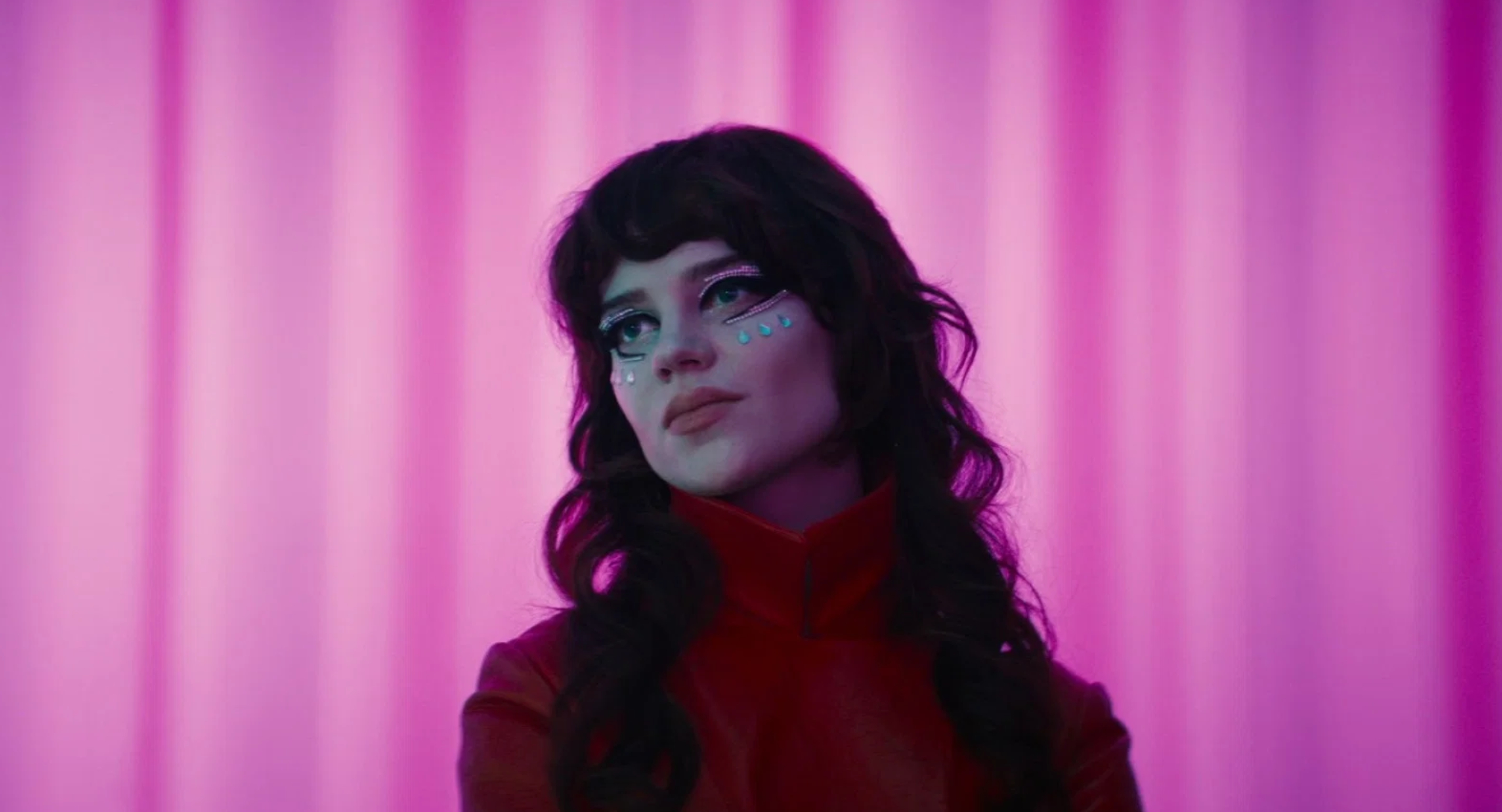
Nicolas Winding Refn has built a career on hypnotic imagery, glacial pacing, and stories that blur the line between beauty and brutality. Films like Drive and The Neon Demon proved that his distinctive aesthetic could elevate familiar narratives into unforgettable cinematic experiences. With Her Private Hell, however, Refn pushes his artistic instincts so far into abstraction that the film becomes almost impossible to emotionally engage with. Despite an intriguing premise, an exceptional ensemble cast, and moments of striking visual imagination, this science fiction horror thriller collapses under the weight of its own ambitions. It is a film that desperately wants to be profound, but more often feels frustratingly empty.
Set within a futuristic metropolis swallowed by an unnatural mist, Her Private Hell introduces a fascinating concept. The mysterious fog conceals a deadly, almost supernatural entity while simultaneously transforming the city into an endless labyrinth. Meanwhile, Elle (Sophie Thatcher) searches for her missing father as her journey intersects with Private K (Charles Melton), an American soldier desperately trying to rescue his daughter from what is repeatedly described as Hell. The ingredients are all there for a tense blend of psychological horror, dystopian science fiction, and emotional survival drama.
Instead, Refn delivers an experience that prioritizes atmosphere over storytelling to an exhausting degree. Nearly every scene feels designed as a visual installation rather than a meaningful progression of the narrative. Characters wander through neon-lit corridors, abandoned skyscrapers, and crimson-soaked alleyways while exchanging cryptic dialogue that rarely clarifies their motivations or the film’s mythology. Ambiguity can be a powerful storytelling tool, but Her Private Hell mistakes confusion for sophistication.
Visually, there is no denying that Her Private Hell is stunning. Every frame looks meticulously composed, with Refn and his cinematographer Magnus Nordenhof Jonck creating an unforgettable blend of cyberpunk architecture, oppressive shadows, and saturated colors. The mysterious mist becomes a character in itself, swallowing entire city blocks while transforming ordinary locations into surreal dreamscapes. Whether illuminated by electric blues or drenched in violent reds, the production design consistently delivers images that linger long after the credits roll.
Unfortunately, beautiful cinematography cannot compensate for a screenplay that feels emotionally detached. Written by Refn and Esti Giordani, the script continuously withholds information without providing satisfying payoffs. The rules surrounding the mist, the monstrous entity, and the so-called Hell remain frustratingly vague throughout the film. Rather than encouraging viewers to interpret symbolism, the screenplay often leaves them struggling to understand basic plot mechanics.
The horror elements are equally underwhelming. The unseen creature lurking within the mist initially creates genuine suspense, with clever sound design suggesting an unstoppable force hiding just beyond visibility. As the film progresses, however, the threat becomes increasingly repetitive. Long stretches of silence punctuated by sudden bursts of violence lose their impact after several repetitions, and the monster itself never develops into a memorable antagonist. Instead of escalating terror, the film settles into a predictable rhythm of waiting for the next cryptic encounter.
The strongest reason to watch Her Private Hell is Sophie Thatcher. Continuing to establish herself as one of the most compelling young performers working today, Thatcher fully commits to Elle’s emotional journey even when the screenplay gives her remarkably little to work with. She communicates grief, fear, determination, and exhaustion almost entirely through subtle facial expressions and physical performance. Even during the film’s most opaque sequences, Thatcher remains believable and captivating.
Charles Melton also delivers a committed performance as Private K. His desperate search for his daughter provides what should have been the emotional backbone of the narrative, yet the script never fully explores his trauma or his relationship with his child. Melton injects sincerity into scenes that often feel overwritten with philosophical monologues, but there is only so much an actor can accomplish when the emotional stakes remain abstract.
The supporting cast is almost criminally underutilized. Havana Rose Liu brings quiet charisma to Dominique, while Kristine Froseth creates an intriguing sense of mystery as Hunter. Shioli Kutsuna, Aoi Yamada, Dougray Scott, Diego Calva, and Hidetoshi Nishijima all make memorable impressions whenever they appear, but most of them disappear for extended stretches or exist primarily to deliver exposition wrapped in symbolism. Considering the sheer talent assembled here, it feels like an enormous missed opportunity.
One recurring issue throughout the film is its refusal to allow characters to behave like actual people. Conversations rarely resemble natural dialogue. Instead, nearly everyone speaks in philosophical riddles or fragmented observations about identity, memory, death, and destiny. Individual personalities begin to blur together because everyone sounds like they’re speaking through the same poetic filter. This stylistic choice creates emotional distance precisely when the audience should be growing more invested.
Refn has never been interested in conventional storytelling, and that willingness to challenge audiences has often resulted in fascinating cinema. Here, however, the balance between artistic experimentation and narrative engagement is completely lost. The film repeatedly hints at grand themes involving trauma, inherited guilt, religious symbolism, and personal redemption, yet rarely develops these ideas beyond visually striking metaphors. Every answer raises three more questions, and by the conclusion, many viewers may realize they were searching for meaning that simply isn’t there.
The pacing only magnifies these problems. Clocking in at well over two hours, Her Private Hell often feels considerably longer. Entire scenes linger far beyond their dramatic purpose, with extended tracking shots and prolonged silences replacing character development. There are moments where the deliberate pacing successfully builds dread, but they become increasingly rare as the film progresses. Instead, momentum continually stalls just as tension begins to emerge.
The climax epitomizes both the strengths and weaknesses of Refn’s filmmaking. On a purely visual level, the final act is breathtaking. The combination of practical effects, surreal production design, haunting music, and striking color palettes creates images worthy of an art gallery. Narratively, however, the ending feels frustratingly incomplete. Major character arcs receive ambiguous conclusions, central mysteries remain unresolved, and emotional payoffs never materialize with the impact they deserve. Rather than leaving audiences haunted, the finale is more likely to leave them puzzled.
There is certainly an audience for Her Private Hell. Admirers of highly experimental, dreamlike cinema may appreciate its willingness to reject traditional structure in favor of mood and symbolism. Refn’s uncompromising artistic vision remains fully intact, and no one could accuse the film of lacking confidence or originality. It refuses to resemble mainstream science fiction horror, which deserves some admiration in an era filled with formulaic blockbusters.
Yet originality alone is not enough to sustain an emotionally satisfying film. Beneath the extraordinary visuals lies a story that never fully connects, populated by compelling actors trapped inside underdeveloped characters. The result is a beautiful shell surrounding an unexpectedly hollow experience. For every unforgettable image, there is an equally frustrating narrative decision that distances viewers from the human drama unfolding on screen.
Her Private Hell ultimately feels like a filmmaker becoming so fascinated by atmosphere and symbolism that he forgets audiences need something tangible to hold onto. Sophie Thatcher’s excellent performance and Refn’s remarkable visual craftsmanship prevent the film from becoming a complete disaster, but they cannot overcome a screenplay that consistently values obscurity over clarity. This is a gorgeous nightmare that never becomes genuinely frightening, emotionally moving, or intellectually rewarding.