Thrash – Film Review
Published April 11, 2026

Movie Details

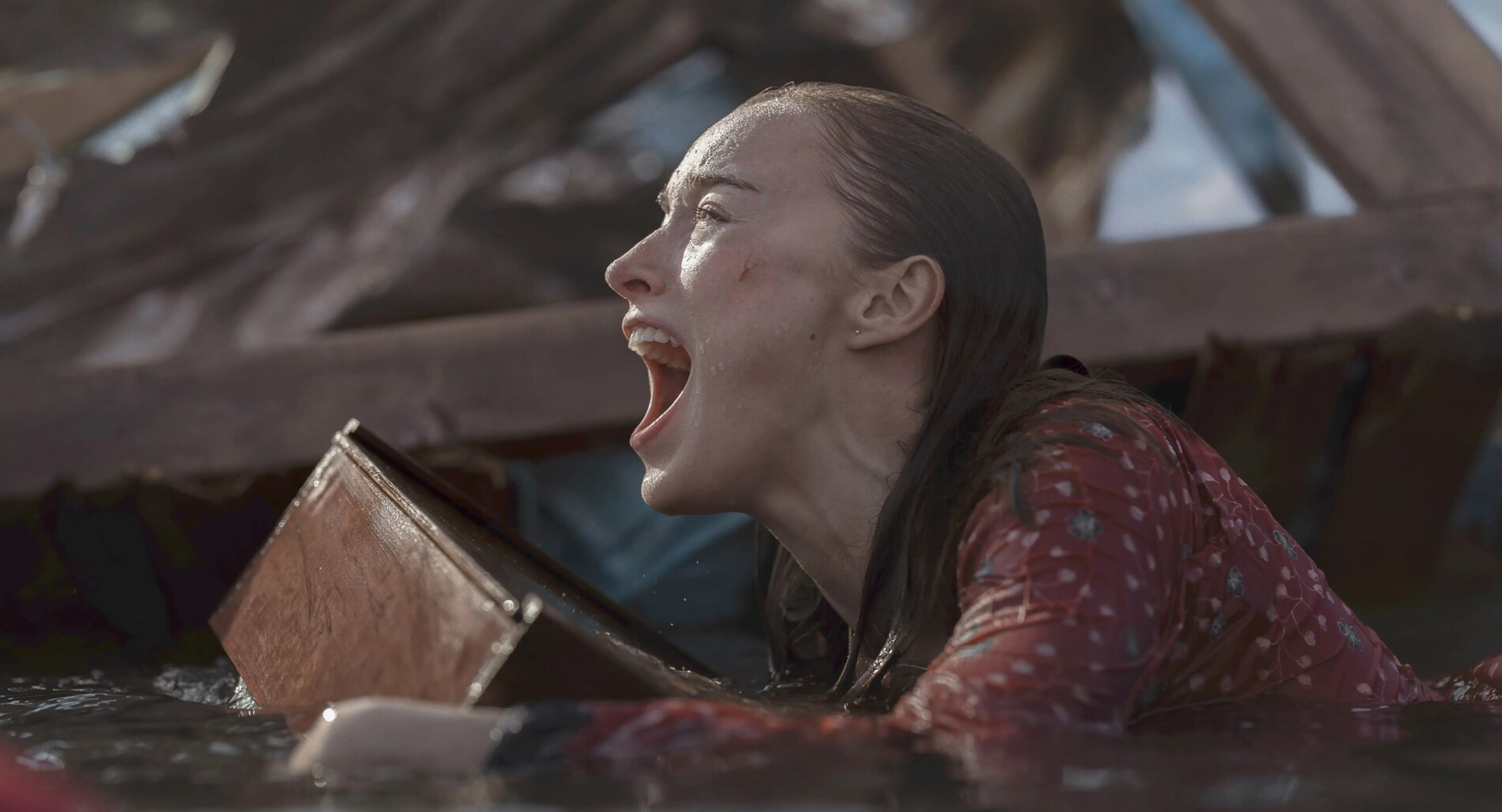
There’s a pulpy, irresistible premise at the heart of Thrash: a Category 5 hurricane slams into a coastal town, only to unleash a feeding frenzy of sharks drawn inland by blood-soaked floodwaters. It’s the kind of high-concept setup that practically sells itself, blending disaster spectacle with creature-feature chaos. Directed by Tommy Wirkola and produced by Adam McKay alongside Kevin Messick, the film has the pedigree and ambition to deliver a wild ride. Unfortunately, what should have been a gleefully unhinged survival thriller instead sinks under the weight of uneven execution, tonal confusion, and frustratingly underdeveloped characters.
Wirkola, known for his flair for genre mashups and over-the-top violence, seems like a natural fit for this kind of material. And to be fair, Thrash occasionally delivers flashes of that gonzo energy. There are sequences that lean into the absurdity of sharks prowling through suburban streets and flooded homes, evoking the spirit of B-movie classics while attempting to scale things up with modern production values. But those moments are scattered, struggling to rise above a film that too often feels unsure of whether it wants to be a tense survival drama, a satirical disaster movie, or a full-blown creature-feature spectacle.
The biggest issue lies in the script, which never quite finds a compelling throughline. The film juggles multiple storylines—Dakota trapped by her agoraphobia, Lisa’s desperate situation as a pregnant woman caught in the storm, and a group of siblings dealing with their unstable foster parents—but it fails to weave them into a cohesive emotional narrative. Each thread has potential, particularly Dakota’s psychological struggle and Lisa’s vulnerability, yet the film rarely invests enough time to make their journeys feel meaningful. Instead, the characters often come across as narrative devices, shuffled from one perilous scenario to the next without much development.
Whitney Peak does what she can with Dakota, bringing a sense of fragility and determination to a role that could have been far more compelling with stronger writing. Her agoraphobia is introduced as a central trait, but it’s handled in a surface-level manner that feels more like a plot convenience than a deeply explored condition. The film gestures toward emotional depth without committing to it, leaving Peak to fill in the gaps with a performance that’s more nuanced than the script deserves.
Similarly, Phoebe Dynevor brings a grounded presence to Lisa, but her storyline is reduced to a series of escalating dangers rather than a fully realized arc. The idea of a pregnant woman navigating a flooded, shark-infested town during a hurricane is inherently tense, yet the film relies heavily on contrived scenarios and predictable beats. Dynevor’s performance suggests a more human story beneath the chaos, but the film rarely slows down long enough to let those moments breathe.
The most compelling presence in the film is Djimon Hounsou as Dale, a marine researcher with a personal connection to the unfolding disaster. Hounsou brings gravitas and a sense of urgency that elevates his scenes, even when the dialogue veers into exposition-heavy territory. His subplot, involving a tagged great white shark and a rescue mission, hints at a more focused and engaging narrative that the film never fully embraces. Instead, it becomes just another thread in an already overcrowded tapestry.
The hurricane sequences are occasionally impressive, with swirling winds and collapsing structures creating a convincing sense of chaos. The flooded town setting offers a unique playground for the film’s action, turning familiar suburban spaces into unpredictable danger zones. However, the CGI sharks are inconsistent at best. Some shots convey real menace, while others look distractingly artificial, undermining the tension the film is trying to build. In a genre that relies heavily on the believability of its creatures, this inconsistency proves to be a significant drawback.
The action set pieces, while plentiful, often lack the clarity and escalation needed to make them truly memorable. There’s a tendency to rely on quick cuts and chaotic camerawork, which can make it difficult to follow what’s happening on screen. Instead of building suspense, these sequences frequently devolve into noisy, disorienting spectacles that prioritize volume over impact. It’s a surprising misstep for Wirkola, whose previous work has demonstrated a stronger grasp of how to stage kinetic, engaging action.
Another issue is the film’s tonal inconsistency. At times, Thrash seems to embrace its own absurdity, leaning into the inherent ridiculousness of its premise with moments of dark humor and over-the-top violence. But just as often, it attempts to play things straight, emphasizing the emotional stakes and human drama. This push-and-pull creates a disjointed viewing experience, where it’s never entirely clear how seriously the film wants to be taken. The result is a movie that feels caught between two identities, never fully committing to either.
The supporting cast, including the younger actors playing the siblings, are given little to work with beyond broad character traits and predictable conflicts. Their storyline, which involves family tension and survival against the odds, has the potential to add a different dimension to the film. Instead, it feels like filler, occasionally intersecting with the main plot but never contributing in a meaningful way. The interpersonal drama often comes across as forced, lacking the authenticity needed to make the stakes feel real.
Even the film’s attempts at social commentary—touching on themes of disaster preparedness, economic disparity, and environmental vulnerability—are underdeveloped. These ideas are introduced but not explored in any depth, serving more as background noise than as integral components of the story. It’s another example of the film reaching for more than it can effectively handle, resulting in a narrative that feels cluttered rather than layered.
Despite its many shortcomings, Thrash isn’t entirely without merit. There are moments of genuine tension, particularly in sequences that isolate characters in confined, flooded spaces. The concept itself remains compelling, and there’s a certain guilty pleasure in watching the film embrace its more outrageous elements. For viewers willing to overlook its flaws, there’s some entertainment to be found in its chaotic energy and occasional bursts of creativity.
Still, those moments are not enough to elevate the film as a whole. Thrash ultimately feels like a missed opportunity—a film with a great premise and a capable cast that never quite comes together. It lacks the narrative focus, character development, and tonal clarity needed to make its high-concept idea truly work. What could have been a standout entry in the disaster-thriller genre instead ends up as a forgettable, uneven effort.
In the end, Thrash is a storm that makes a lot of noise but leaves little lasting impact. It thrashes around with ambition and spectacle, but without a strong foundation to support it, the film is quickly swept away, leaving behind only the faint memory of what might have been.