The Odyssey – Film Review
Published July 18, 2026

Movie Details

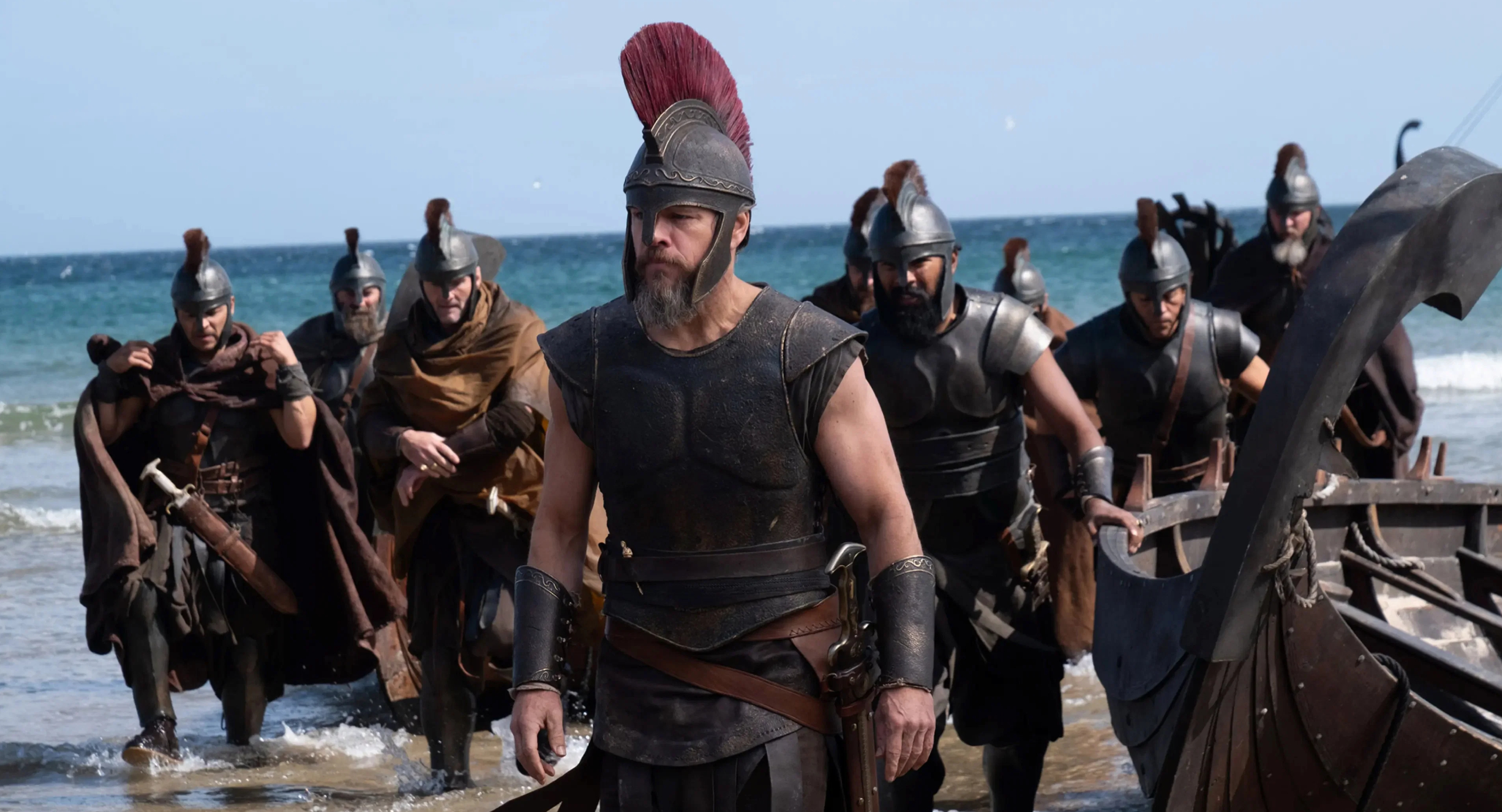
Christopher Nolan has spent his career exploring time, memory, identity, sacrifice, and humanity’s relentless desire to push beyond impossible boundaries. Whether through the dreamscapes of Inception, the cosmic wonder of Interstellar, or the historical intensity of Dunkirk and Oppenheimer, every film has felt like another step toward something grander. With The Odyssey, Nolan finally arrives at what feels like the culmination of those ambitions: a breathtaking fantasy epic that balances spectacle, philosophy, mythology, and deeply personal emotion with astonishing confidence.
Rather than treating Homer’s legendary poem as simply another sword-and-sandals adventure, Nolan transforms it into an intimate meditation on survival, guilt, destiny, and the meaning of home. It is enormous in scale yet surprisingly restrained in emotion, allowing the mythology to enhance the humanity rather than overwhelm it. The result is one of the most visually staggering films ever made while simultaneously becoming one of Nolan’s most heartfelt.
For a filmmaker often criticized for prioritizing concepts over characters, The Odyssey may silence those criticisms for good. This is a film driven not by puzzles or timelines but by people. Every impossible obstacle serves the emotional journey rather than distracting from it, making this perhaps Nolan’s richest and most rewarding story to date.
One of the film’s greatest accomplishments is how respectfully it approaches its source material while never feeling trapped by it. Anyone familiar with Homer’s epic will recognize many iconic moments, but Nolan reshapes the ancient narrative into something that feels remarkably modern without sacrificing its timeless qualities.
Instead of presenting mythology as fantasy for fantasy’s sake, every monster, god, and supernatural encounter reflects Odysseus’ psychological state. The mythical creatures never feel like disconnected action set pieces designed to impress audiences. Each challenge carries thematic weight, reinforcing the film’s exploration of guilt, perseverance, leadership, and redemption.
Even viewers unfamiliar with the original poem will have no trouble following the story. Nolan’s screenplay carefully balances political intrigue, character relationships, and mythical adventure, ensuring that the narrative remains emotionally accessible despite its enormous scope.
Perhaps most impressively, the screenplay refuses to reduce ancient mythology into simplistic good-versus-evil storytelling. Every major character operates within shades of moral complexity, making the emotional stakes feel authentic even amid gods, monsters, and impossible journeys.
Matt Damon gives what may very well be the finest performance of his already remarkable career. His Odysseus isn’t presented as an invincible mythical hero. Instead, Damon portrays him as an exhausted leader carrying the unbearable weight of every decision he has ever made. His intelligence remains his greatest weapon, but every victory leaves another emotional scar.
Damon communicates tremendous depth through quiet expressions and restrained dialogue. The physical journey across oceans and impossible landscapes mirrors an equally powerful internal struggle, and Damon never loses sight of the humanity beneath the legendary figure. The supporting cast is equally exceptional.
Tom Holland delivers one of his strongest dramatic performances as Telemachus, capturing both youthful uncertainty and growing courage without ever becoming overshadowed by Damon’s towering lead performance. Anne Hathaway brings warmth, resilience, and emotional intelligence to Penelope, making her far more than simply someone waiting at home. Her performance grounds the entire film emotionally.
Robert Pattinson is quietly mesmerizing, creating one of Nolan’s most fascinating antagonists. Rather than portraying straightforward villainy, Pattinson imbues every scene with unsettling charisma and unpredictability. Samantha Morton also leaves a lasting impression, bringing mystery and unexpected emotional complexity to her role.
Despite the enormous ensemble—including Lupita Nyong’o, Zendaya, Charlize Theron, and numerous supporting players—the film never feels overcrowded. Every character contributes meaningfully to the larger story.
If there was ever a filmmaker suited to adapting Greek mythology on the biggest possible canvas, it was Christopher Nolan. Every frame feels monumental. The cinematography transforms oceans into living characters, making every voyage feel simultaneously beautiful and terrifying. Massive practical environments blend seamlessly with visual effects that emphasize realism rather than digital excess.
The mythical creatures possess genuine scale and presence because Nolan wisely avoids turning them into weightless CGI spectacles. Instead, every encounter feels tactile, dangerous, and physically grounded. The production design deserves equal praise. Ancient Greece feels lived-in rather than romanticized, with kingdoms, islands, temples, and coastlines possessing extraordinary historical texture. The costumes similarly avoid fantasy clichés, embracing authenticity while still maintaining mythic grandeur.
The action sequences are astonishing not because of their size alone, but because Nolan never loses sight of geography, tension, or emotional consequence. Every confrontation feels earned, making even the largest set pieces intensely personal.
The technical craftsmanship borders on flawless. The score ranks among the finest of Nolan’s career, blending sweeping orchestral grandeur with haunting intimacy. Rather than overwhelming scenes, the music enhances both the epic scale and emotional vulnerability of the story.
The sound design is equally extraordinary. Crashing waves, creaking ships, distant storms, whispering winds, and supernatural voices immerse audiences completely in Odysseus’ world. The editing maintains remarkable momentum throughout an expansive runtime. Although the journey spans numerous locations and encounters, the pacing rarely falters because each chapter builds naturally upon the emotional evolution of its protagonist.
Even moments of silence become powerful storytelling tools, allowing audiences to absorb the weight of Odysseus’ experiences before the next chapter unfolds.
While Interstellar may have previously held the title as Nolan’s most emotionally resonant work, The Odyssey arguably surpasses it. Beneath its breathtaking fantasy lies an incredibly intimate story about family, regret, forgiveness, and the search for peace after unimaginable hardship.
The film constantly asks whether anyone can truly return home unchanged after experiencing war, loss, and violence. Rather than providing simplistic answers, Nolan embraces emotional ambiguity in ways that feel mature and profoundly moving. Perhaps most importantly, the film examines the difference between being remembered as a legend and living as a flawed human being. That tension becomes the emotional heartbeat of the entire story.
Without revealing any major plot developments, the final act achieves an emotional payoff that feels both deeply satisfying and surprisingly reflective. Rather than simply celebrating heroism, the film invites audiences to consider the cost of becoming one. Those quieter philosophical moments ultimately elevate The Odyssey beyond traditional blockbuster entertainment. This is a film that rewards reflection long after the credits roll.
Christopher Nolan has created something extraordinary.
The Odyssey succeeds simultaneously as an epic fantasy adventure, a deeply human drama, a visually groundbreaking cinematic experience, and a thoughtful adaptation of one of history’s greatest stories. It respects Homer’s timeless narrative while confidently establishing its own artistic identity.
The performances are exceptional from top to bottom, with Matt Damon delivering a career-defining portrayal that anchors the film’s enormous ambition with genuine emotional honesty. Every technical department operates at the highest possible level, from the breathtaking cinematography and immersive sound design to the awe-inspiring production values and unforgettable musical score.
More importantly, the film remembers that even the grandest legends begin with ordinary human emotions: love, regret, hope, fear, and the longing to find one’s way home.
In an era dominated by franchise filmmaking and spectacle-first storytelling, The Odyssey proves that blockbuster cinema can still be intellectually ambitious, emotionally rich, and artistically daring. Christopher Nolan has once again expanded the possibilities of large-scale filmmaking while delivering what may ultimately stand as his crowning achievement.
It’s not simply one of the year’s best films—it’s one of the defining cinematic epics of its generation.