School Spirits – Season 3 Review
Published March 5, 2026

Movie Details

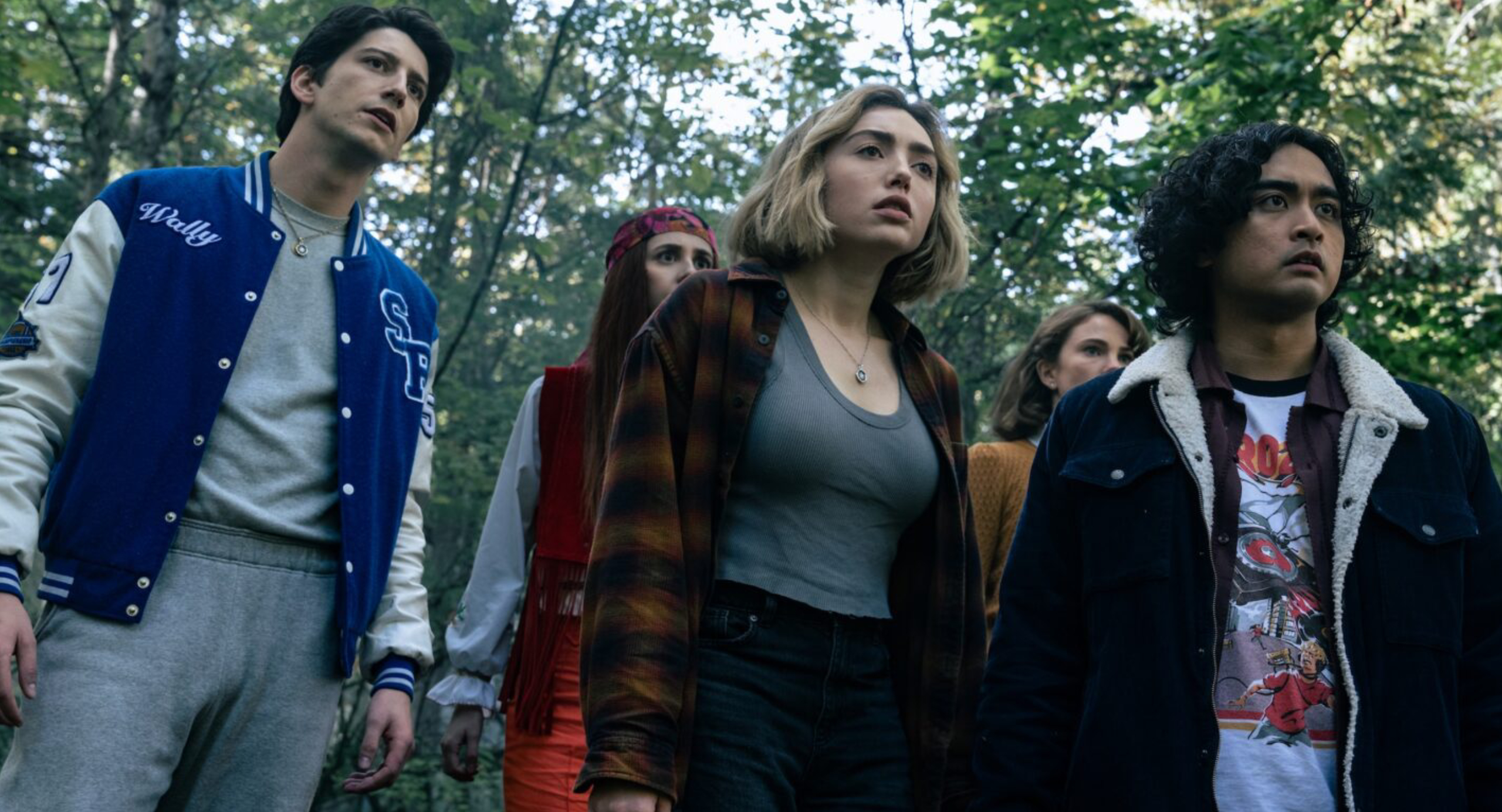
When School Spirits premiered on Paramount+ on March 9, 2023, it quickly carved out a niche in the supernatural teen drama space with its clever blend of ghostly mystery and emotional coming-of-age storytelling. Created by Megan Trinrud and Nate Trinrud and adapted from their graphic novel with Maria Nguyen, the series has steadily expanded its mythology over two strong seasons. Season three doesn’t reinvent the show’s formula, but it deepens it—raising emotional stakes, widening the supernatural rulebook, and pushing its central mystery into darker, more morally complex territory.
Set once again in the fictional Split River, Wisconsin, the series continues to follow Maddie Nears, played with aching vulnerability by Peyton List. Still trapped in the afterlife and investigating her own disappearance, Maddie finds that the answers she seeks are far more destabilizing than she ever imagined. Season three operates less like a simple whodunit and more like an existential reckoning, examining what justice means when the living and the dead are equally unreliable narrators.
The premiere, “It’s a Wonderful Afterlife,” reorients viewers by showing how much the spectral status quo has shifted. Maddie is no longer the confused newcomer to the afterlife halls of Split River High. She’s a reluctant veteran, hardened by betrayal and frustrated by the limits of her ghostly existence. The episode cleverly mirrors the Capra classic in structure while subverting its optimism. Instead of learning that her life mattered, Maddie confronts the unsettling possibility that her absence may have rearranged the world in irreversible ways.
As the season unfolds through episodes like “Mean Ghouls” and “The Halls Have Eyes,” the writers escalate both tension and paranoia. Surveillance—both supernatural and technological—emerges as a recurring theme. Ghosts observe the living, the living hunt for digital clues, and neither side fully grasps the consequences of their interference. The show’s horror elements are more pronounced this season, leaning into eerie visual motifs: flickering hallway lights, distorted announcements over crackling PA systems, and the unsettling stillness of classrooms frozen in time.
“The Bereftest Club” stands out as one of the season’s strongest entries, offering a poignant exploration of grief from multiple perspectives. The episode cleverly parallels a student support group for bereaved teens with the afterlife’s own informal gathering of lingering spirits. It’s here that School Spirits demonstrates its most compelling strength: its refusal to treat death as a mere plot device. Every ghost carries unfinished business, and the show gives those stories weight.
Kristian Ventura continues to be an understated force, bringing warmth and subtle humor to Simon, whose loyalty to Maddie becomes increasingly complicated. This season tests Simon’s resolve in painful ways, particularly as he faces mounting skepticism from the living and mounting risk from forces he barely understands. Ventura plays these beats with grounded sincerity, ensuring Simon never feels like a sidekick but rather a co-protagonist navigating his own unraveling reality.
Milo Manheim and Spencer MacPherson are also given richer material this year. Wally’s arc, especially in “Raiders of the Lost Scar,” peels back layers of bravado to reveal unresolved trauma tied to his past life. The episode balances humor and melancholy beautifully, using a seemingly trivial object as a gateway to deeper emotional scars. Meanwhile, Xavier’s storyline in the living world becomes more morally ambiguous. MacPherson leans into this uncertainty, portraying a young man torn between guilt, love, and self-preservation.
But it is List who carries the emotional weight of the season. Her performance evolves in subtle but significant ways. Maddie is no longer simply scared or confused; she is angry, determined, and sometimes reckless. In “Children of the Scorned,” when long-buried secrets surface about the origins of certain spirits in Split River High, List allows flashes of rage and despair to break through Maddie’s typically composed exterior. The effect is electric and heartbreaking.
Season three smartly broadens the show’s supernatural rules without drowning viewers in exposition. “Midsomester” is a bold, tonally daring episode that uses a school festival as a backdrop for temporal glitches between the living and the dead. The editing becomes more fragmented, scenes overlapping in disorienting ways that mirror Maddie’s fraying understanding of the afterlife’s boundaries. It’s one of the series’ most visually inventive hours.
“Dawn of the Deb,” the finale, delivers on the slow-burn tension the season has cultivated. Without spoiling specifics, the episode reframes key assumptions about Maddie’s disappearance while leaving enough threads dangling to propel a potential fourth season. The resolution feels earned rather than convenient. The show resists the temptation to tie everything into a neat bow, understanding that ambiguity can be more haunting than clarity.
Thematically, this season wrestles with agency. Are the ghosts truly stuck, or have they internalized their own limitations? Can the living change outcomes that seem predestined? By complicating the binary between life and death, the Trinruds elevate the narrative beyond high school melodrama into something more philosophically resonant.
While School Spirits has always incorporated horror elements, season three sharpens them. The scares are less about jump moments and more about existential dread. The idea of being forgotten—of fading not because of violence but because of time—hangs heavily over several episodes. The sound design deserves particular praise; whispers echo just slightly off-beat, lockers slam with uncanny resonance, and silence is weaponized with chilling precision.
Yet the show never loses sight of its teen drama DNA. Friendships fracture. Romantic tensions simmer. Jealousies flare on both sides of the mortal divide. What distinguishes this season is how seamlessly it weaves those familiar tropes into its supernatural framework. The high school setting doesn’t feel like a gimmick; it’s a pressure cooker where identity is already in flux, making the added complication of death all the more destabilizing.
There are minor shortcomings. A few subplots—particularly involving secondary spirits—feel underdeveloped, introduced with intriguing hints only to fade into the background. At times, the pacing in the middle stretch lags, with exposition-heavy conversations slowing the momentum established in the early episodes. However, these issues are relatively small compared to the season’s overall ambition and cohesion.
By its third outing, School Spirits demonstrates a confidence in its tone and storytelling that many genre shows struggle to achieve. It trusts its audience to sit with discomfort. It allows characters to make messy, frustrating choices. And it understands that the scariest revelations are often emotional rather than supernatural.
Season three doesn’t just advance the central mystery—it reframes it. Maddie’s journey becomes less about solving her disappearance and more about understanding who she was, who she is now, and what it means to move forward when “forward” may not be an option. That existential tension gives the show its staying power.
With strong performances, sharpened horror elements, and a mythology that grows more intriguing with each episode, this latest chapter is well worth the watch. If earlier seasons were about discovery and shock, season three is about consequence. The halls of Split River High have never felt more haunted—or more alive.