Pizza Movie – Film Review
Published March 14, 2026

Movie Details

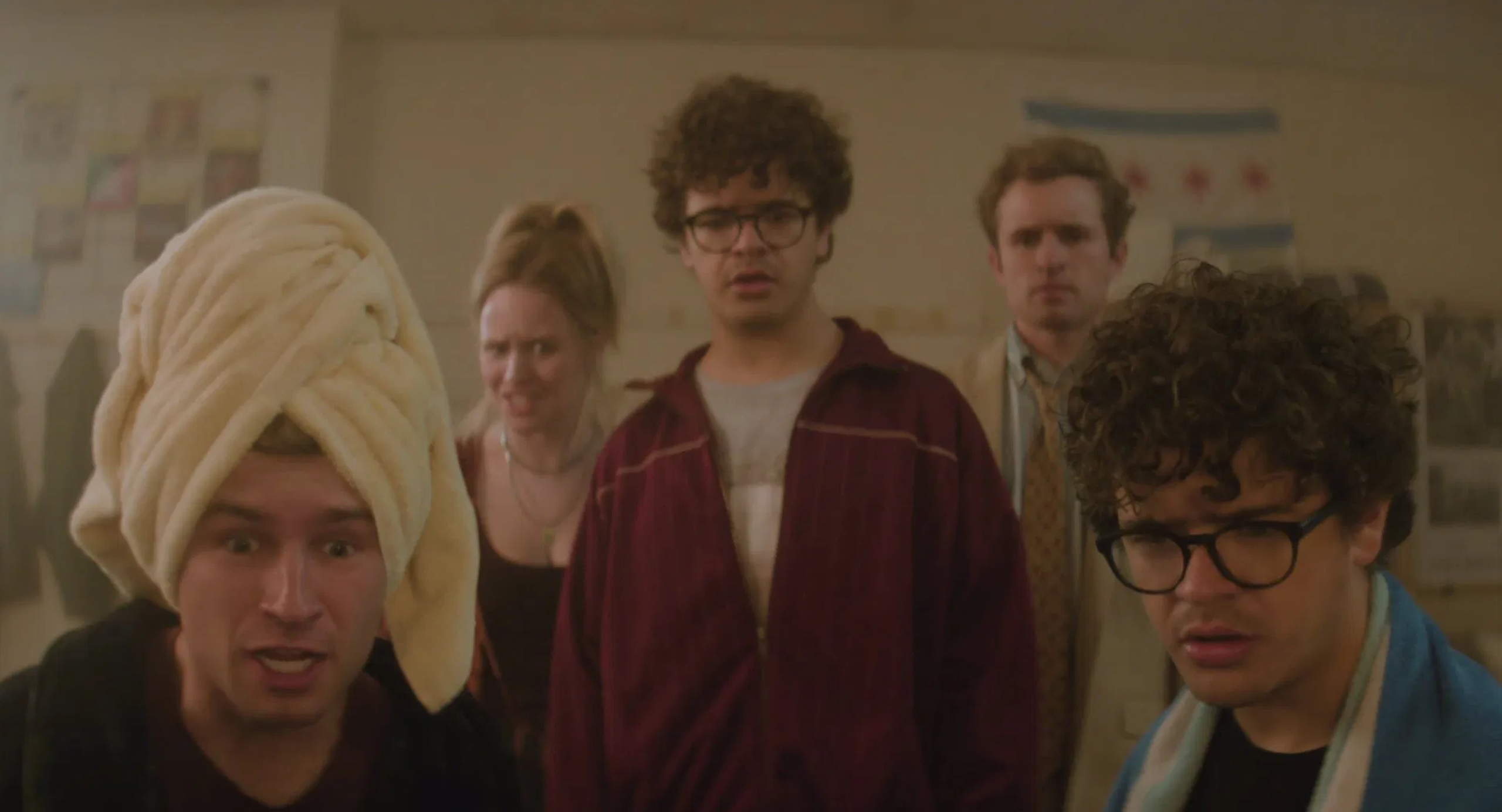
In an era where high-concept comedies often lean into surrealism and improvisational chaos, Pizza Movie attempts to carve out its own niche with a premise that feels both nostalgic and unpredictably bizarre. Written and directed by Brian McElhaney and Nick Kocher, the film follows two college students whose late-night pizza run spirals into a strange odyssey fueled by experimental drugs, hallucinations, and a barrage of eccentric encounters. Led by performances from Gaten Matarazzo and Sean Giambrone, the film strives to balance grounded character comedy with increasingly absurd scenarios. The result is a mixed but intermittently entertaining experience.
From the opening scenes, Pizza Movie establishes a loose, hangout-style vibe. Jack (Matarazzo) is introduced as a socially awkward college student trying to keep his life on track, while his roommate Montgomery (Giambrone) functions as a chaotic catalyst for trouble. Their friendship feels authentic, and the film wisely invests time in showing the small, relatable moments that define their dynamic. It is a familiar setup — the straight man paired with an unpredictable instigator — but the performers breathe enough life into their roles to keep the formula engaging.
The narrative kicks into motion once the duo inadvertently consumes an experimental drug during their quest for a slice of pizza. What follows is an episodic structure filled with hallucination sequences, bizarre side characters, and escalating comic mishaps. The film’s simplistic yet chaotic nature becomes one of its defining traits. It does not overcomplicate its storyline; instead, it embraces the randomness of its premise, allowing each encounter to function almost like a sketch. While this approach creates some undeniably funny moments, it also contributes to uneven pacing that prevents the film from maintaining consistent momentum.
One of the film’s biggest strengths lies in the chemistry between Matarazzo and Giambrone. Their comedic timing is sharp, and they demonstrate an intuitive understanding of how to play off one another’s rhythms. Matarazzo excels at portraying Jack’s mounting anxiety and bewilderment as the night spirals further out of control. His performance grounds the film emotionally, even when the surrounding events become increasingly ridiculous. Giambrone, on the other hand, thrives in the role of Montgomery, injecting manic energy into nearly every scene he inhabits. Together, they form a comedic duo that feels natural rather than forced, giving the audience a reason to stay invested even when the script falters.
Supporting performances add varying degrees of charm. Lulu Wilson brings a playful edge to Lizzy, whose unpredictable behavior complements the film’s hallucinatory tone. Peyton Elizabeth Lee lends warmth to Ashley, offering brief but welcome moments of sincerity amid the chaos. Meanwhile, Marcus Scribner and Sarah Sherman inject bursts of eccentric humor into their supporting roles.
Pizza Movie adopts a deliberately scrappy aesthetic. The cinematography by Bella Gonzales embraces neon lighting, handheld camerawork, and stylized dream sequences that mirror the characters’ altered states. This approach works best during the film’s more experimental moments, particularly in scenes that blur the line between reality and hallucination. However, the visual style can occasionally feel repetitive, especially when the narrative lingers too long on similar gags without advancing the story.
Among the film’s standout comedic set pieces is a long, drawn-out swearing scene that pushes the boundaries of absurdist humor. What begins as a minor argument between characters gradually escalates into an extended exchange of increasingly elaborate insults and profanity. The scene’s comedic power lies in its commitment to escalation; it becomes funnier precisely because it refuses to end when logic dictates it should. This willingness to stretch a joke beyond its expected limits exemplifies the film’s broader comedic philosophy — sometimes to great effect, and sometimes to diminishing returns.
Despite these highlights, Pizza Movie struggles with pacing issues that undermine its overall impact. The episodic structure results in noticeable lulls between the film’s more inspired sequences. Certain scenes feel as though they exist solely to fill runtime, and the lack of a strong narrative throughline makes the story feel disjointed at times. Viewers may find themselves laughing one moment and checking their watches the next, a fluctuation that prevents the film from fully capitalizing on its comedic potential.
Another drawback is the uneven quality of the humor. While some jokes land with impressive precision, others fall flat or feel overly reliant on shock value. The film’s improvisational tone occasionally leads to sequences that seem underdeveloped, as though they were conceived on set rather than carefully constructed in the script. This inconsistency can be frustrating, especially when contrasted with the genuinely clever moments that demonstrate what the film is capable of achieving.
Perhaps the most significant criticism leveled at Pizza Movie is its resemblance to the cult comedy Harold & Kumar Go to White Castle. The similarities are difficult to ignore: two friends embark on a late-night food quest, encounter a parade of eccentric characters, and experience increasingly surreal adventures along the way. While homage can be an effective storytelling tool, Pizza Movie occasionally crosses the line into feeling derivative. Its attempts to differentiate itself through hallucinatory visuals and Gen-Z humor are partially successful, but they do not fully dispel the sense that audiences have seen this type of story before.
Even so, the film possesses an undeniable charm that prevents it from becoming entirely forgettable. Its willingness to embrace silliness, coupled with the likability of its central performances, makes it an enjoyable — if flawed — viewing experience. There is something refreshing about a comedy that prioritizes spontaneity and character chemistry over tightly plotted storytelling. When Pizza Movie is firing on all cylinders, it captures the unpredictable joy of a night gone wildly off the rails.
Ultimately, Pizza Movie is a modestly entertaining comedy that thrives on its performances and bursts of inspired absurdity while faltering in its pacing and originality. It may not reinvent the genre, but it offers enough laughs and memorable moments to justify a casual watch, particularly for fans of offbeat, drug-fueled misadventures. With sharper editing and a more distinct narrative identity, it could have been something truly special. As it stands, it remains a chaotic slice of comedic escapism — messy, occasionally delicious, and best enjoyed without overthinking the ingredients.