Michael – Film Review
Published April 26, 2026

Movie Details

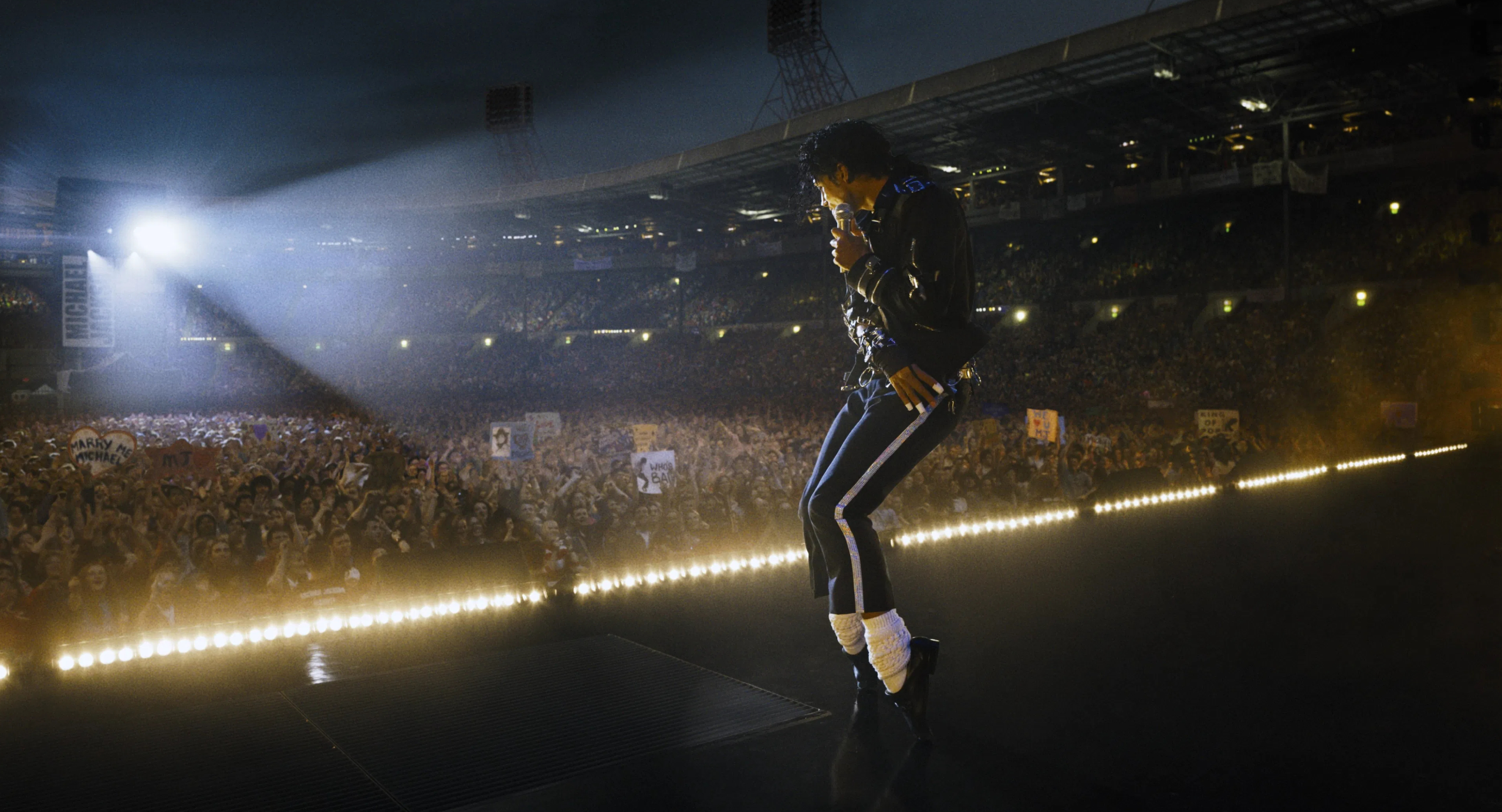
Few musical icons loom as large—or as complicated—as Michael Jackson, making any attempt to dramatize his life an inherently daunting task. Directed by Antoine Fuqua and written by John Logan, Michael sets out to chronicle the formative decades of Jackson’s life, from his childhood stardom with the Jackson 5 through the cultural domination of the Bad era. The result is a visually engaging and musically electrifying film that captures the energy of Jackson’s rise, even as it struggles to fully reckon with the deeper complexities of the man behind the legend.
The film opens in 1966 in Gary, Indiana, where Joseph Jackson—played with stern intensity by Colman Domingo—shapes his sons into the The Jackson 5. From the outset, Michael doesn’t shy away from depicting the grueling rehearsals and harsh discipline that defined the group’s early years. The young Michael, portrayed by Juliano Krue Valdi, emerges as both prodigy and prisoner, his extraordinary talent matched only by the pressure placed upon him. These early scenes are some of the film’s most effective, grounding the spectacle in a sense of emotional urgency and highlighting the cost of greatness.
As the narrative transitions into the group’s meteoric rise under Berry Gordy and Motown Records, the film leans into its most crowd-pleasing instincts. Concert sequences burst with color and movement, recreating the frenzy that surrounded the Jackson 5’s ascent. These moments showcase Fuqua’s ability to handle large-scale musical set pieces, blending choreography, camera movement, and archival-inspired aesthetics into sequences that feel alive. The energy is infectious, even if the storytelling occasionally prioritizes momentum over nuance.
The transition into Michael’s solo career marks a shift in tone, with Jaafar Jackson stepping into the role of his uncle. It’s a remarkable performance, not just for its physical resemblance but for the uncanny ability to capture Jackson’s voice, mannerisms, and stage presence. Jaafar doesn’t simply imitate; he channels. Whether performing tracks from Off the Wall or embodying the creative spark behind Thriller, he commands the screen with a charisma that feels authentic rather than rehearsed.
Much of the film’s second act centers on Michael’s collaboration with Quincy Jones, portrayed here as both mentor and creative partner. Their work on Off the Wall and Thriller is depicted as a series of inspired bursts rather than a detailed exploration of artistic process. While the film touches on key moments—like the creation of “Beat It” or the struggle to name Thriller—it often glosses over the intricacies of Jackson’s musical genius. For viewers hoping for a deeper dive into how these groundbreaking works came to life, the film may feel frustratingly surface-level.
Still, when Michael commits to its musical sequences, it’s undeniably compelling. The recreation of the “Thriller” era, in particular, is a highlight, capturing both the ambition and cultural impact of the album. The film’s sound design and choreography elevate these scenes beyond mere reenactment, turning them into immersive experiences. Fuqua understands that Jackson’s music is inseparable from his visual identity, and these sequences reflect that synergy with impressive precision.
Supporting performances add texture, even if the script doesn’t always give them room to breathe. Nia Long brings warmth and quiet strength to Katherine Jackson, offering a counterbalance to Joseph’s severity. Miles Teller injects a slick professionalism into John Branca, while KeiLyn Durrel Jones lends Bill Bray a grounded, reassuring presence. These characters function more as narrative anchors than fully realized individuals, but the performances themselves remain consistently strong.
One of the film’s more emotionally charged sequences involves the 1984 Pepsi commercial accident, where a pyrotechnic malfunction leaves Michael with severe burns. Fuqua stages the incident with intensity, emphasizing both the physical trauma and its aftermath. Yet even here, the film’s tendency toward restraint becomes apparent. The long-term impact of the حادث—both physically and psychologically—is acknowledged but not deeply explored, reinforcing the sense that Michael is more interested in maintaining a polished image than confronting uncomfortable truths.
This sense of sanitization permeates much of the film. While it touches on Michael’s insecurities, his strained relationship with his father, and his desire for independence, it avoids delving into the more controversial or complex aspects of his life. The decision to end the narrative around the Bad tour further contributes to this feeling, effectively sidestepping the later chapters that might have complicated the film’s portrayal. As a result, Michael often feels like a carefully curated highlight reel rather than a fully realized biography.
Even within the timeframe it covers, the film occasionally rushes through pivotal moments. Michael’s decision to part ways with Joseph, for instance, is handled with surprising brevity, given its significance. Similarly, the creative breakthroughs that defined his career are presented more as inevitable milestones than hard-won achievements. This lack of depth doesn’t diminish the film’s entertainment value, but it does limit its emotional resonance.
Where Michael truly excels is in capturing the sheer spectacle of Jackson’s performances. The climactic sequence at Wembley Stadium during the Bad tour is a fitting culmination, showcasing the scale and precision that defined his live shows. Jaafar Jackson’s performance here is particularly striking, embodying not just the technical brilliance but the magnetic presence that made Michael a global phenomenon. It’s in these moments that the film feels most alive, embracing the artistry that made Jackson unforgettable.
Visually, the film is polished and dynamic, with cinematography that shifts seamlessly between intimate close-ups and grand stage vistas. The production design effectively recreates multiple eras, from the modest beginnings in Gary to the opulence of Encino and beyond. Costume design, in particular, deserves praise for its attention to detail, capturing the evolution of Michael’s iconic style without veering into caricature.
Ultimately, Michael is a film that succeeds in celebrating the music and the myth, even as it hesitates to fully interrogate the man himself. It’s an engaging and often exhilarating watch, anchored by a standout lead performance and a series of electrifying musical numbers. However, its reluctance to dig deeper leaves it feeling incomplete, as though it’s only telling part of the story.
For fans of Michael Jackson, the film offers plenty to enjoy, particularly in its recreation of his most iconic moments. But for those seeking a more comprehensive or unflinching portrait, Michael may come across as overly cautious. It’s a tribute that dazzles on the surface, even if it rarely ventures beneath it.