Mabel – Film Review
Published April 16, 2026

Movie Details

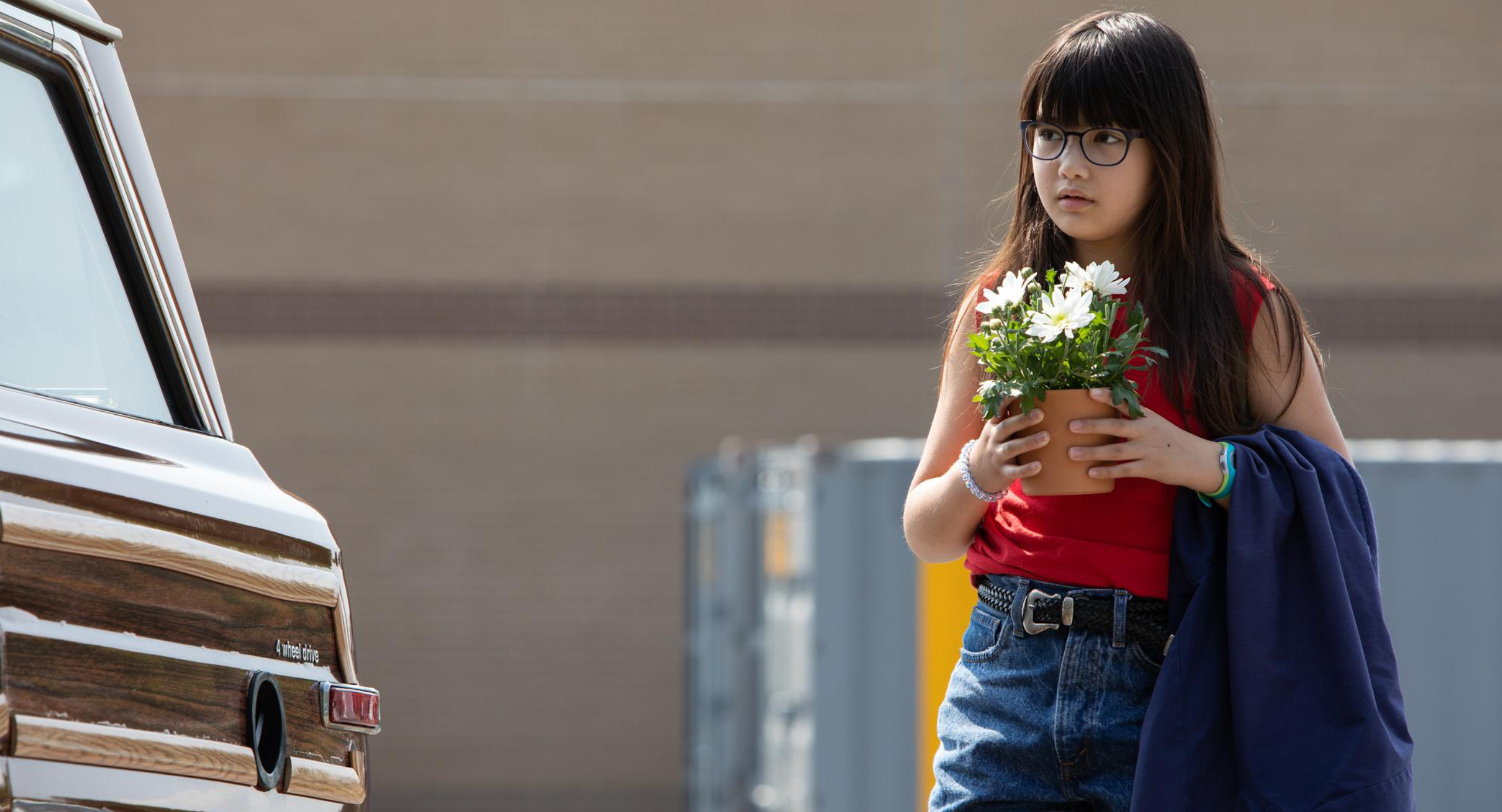
Nicholas Ma’s Mabel is a quiet, contemplative drama that risks being misunderstood by audiences expecting conventional coming-of-age storytelling. Instead of offering a tidy emotional arc or overt narrative propulsion, the film settles into something far more delicate: a portrait of loneliness seen through the fragile imagination of a child. Anchored by a remarkable debut performance from Lexi Perkel, Mabel thankfully doesn’t overwhelm the viewer, but slowly and thoughtfully draws them into its introspective world.
The premise is deceptively simple. Callie (Perkel), a young girl uprooted by her father’s job, finds herself transplanted into a sterile suburban neighborhood that feels devoid of warmth or personality. Her only companion becomes Mabel—a potted plant she treats as her best friend. What could easily veer into quirkiness or sentimentality instead becomes a deeply empathetic study of emotional displacement, filtered through a child’s perspective.
Perkel’s performance is the film’s beating heart. There is an unpolished authenticity to her portrayal of Callie that makes every moment feel lived-in rather than performed. She doesn’t overplay the character’s loneliness; instead, she internalizes it, allowing it to surface in subtle ways—hesitation in speech, avoidance of eye contact, or the careful way she tends to Mabel. It’s a performance built on restraint, which is particularly impressive given the character’s emotional vulnerability. Perkel communicates volumes with minimal dialogue, making her scenes alone with the plant strangely compelling.
The decision to frame Mabel as a silent confidant is one of the film’s boldest choices. There’s no magical realism here—Mabel doesn’t talk or move—but the way Callie projects emotion onto it becomes a window into her inner life. Through these interactions, the film explores how children cope with isolation, crafting companionship out of whatever is available to them. It’s both endearing and quietly heartbreaking.
Nicholas Ma’s direction leans heavily into stillness and atmosphere. The suburban setting is depicted as almost oppressively clean, with wide shots that emphasize empty streets, identical houses, and a lack of human connection. The cinematography reinforces Callie’s emotional state, using negative space to make her appear small and adrift. Interiors are similarly sparse, often bathed in neutral tones that strip warmth from what should feel like a home. This visual language works effectively, though at times it borders on being overly deliberate.
Where the film occasionally stumbles is in its pacing. Mabel unfolds at a deliberately slow rhythm, which will test the patience of some viewers. Certain scenes linger longer than necessary, and the narrative can feel thin in stretches. However, this pacing also allows the film to breathe, giving weight to moments that might otherwise feel insignificant. It’s a trade-off that won’t work for everyone, but those willing to meet the film on its terms will likely find it rewarding.
Christine Ko delivers a grounded performance as Angela, Callie’s mother. Her role is less showy but no less important. Angela is portrayed as someone juggling her own adjustment to the move, often unaware of the depth of her daughter’s isolation. Ko brings nuance to the character, avoiding the trope of the neglectful parent. Instead, she presents a woman who cares deeply but struggles to bridge the emotional gap between herself and her child. The scenes between Ko and Perkel are some of the film’s strongest, capturing the quiet disconnect that can exist within families.
Judy Greer’s Mrs. G serves as a subtle counterpoint to Callie’s isolation. While her screen time is limited, she introduces the possibility of connection beyond Callie’s insular world. Greer brings her characteristic warmth to the role, though the character feels somewhat underdeveloped. One can’t help but wish the film spent more time exploring this dynamic, as it hints at a broader emotional landscape that remains largely untouched.
The screenplay, co-written by Ma and Joy Goodwin, is both the film’s strength and its limitation. Its minimalist approach allows for a deeply personal exploration of Callie’s psyche, but it also results in a narrative that occasionally feels undernourished. There are moments where additional context or development could have enriched the story, particularly regarding the family’s transition and the father’s absence, which is more implied than explored.
Despite these shortcomings, Mabel succeeds in capturing the texture of childhood loneliness with remarkable sensitivity. It understands that isolation isn’t always loud or dramatic; often, it’s quiet, creeping into the spaces between interactions. The film doesn’t resort to melodrama, instead trusting its audience to engage with its understated emotional beats.
Another notable aspect is the film’s sound design—or, more accurately, its restraint in using sound. Silence plays a crucial role, punctuated only by ambient noises that heighten the sense of emptiness. This choice reinforces the feeling of isolation, making even small sounds—like the rustle of leaves or the hum of household appliances—feel significant. The score, when it appears, is sparse and unobtrusive, complementing rather than dictating the film’s emotional tone.
Mabel also touches on the idea of imagination as both a refuge and a limitation. For Callie, Mabel represents a safe space where she can express herself without fear of rejection. Yet, the film subtly suggests that this reliance on imagined companionship can also prevent her from seeking real connections. It’s a delicate balance, handled with care, and it adds a layer of complexity to what might otherwise be a straightforward narrative.
The film’s ending is particularly effective, avoiding the temptation to provide easy answers. It doesn’t resolve every thread or offer a neatly packaged emotional payoff. Instead, it leaves the audience with a sense of quiet evolution—small changes that hint at growth without overstating their significance. This restraint feels true to the film’s overall ethos.
In the end, Mabel is not a film that demands attention through spectacle or dramatic twists. It asks for patience, empathy, and a willingness to sit with discomfort. While its slow pacing and minimal narrative may not resonate with everyone, its emotional authenticity and strong central performance make it a worthwhile experience.
Nicholas Ma has crafted a film that feels deeply personal, almost intimate in its focus. It’s a reminder that stories don’t always need grand gestures to be impactful; sometimes, the smallest, quietest moments carry the most weight. Mabel may not fully bloom in every aspect, but it remains a thoughtful and affecting exploration of loneliness, connection, and the fragile ways we navigate both.