Lydia and the Mist Rider – Film Review
Published April 26, 2026

Movie Details

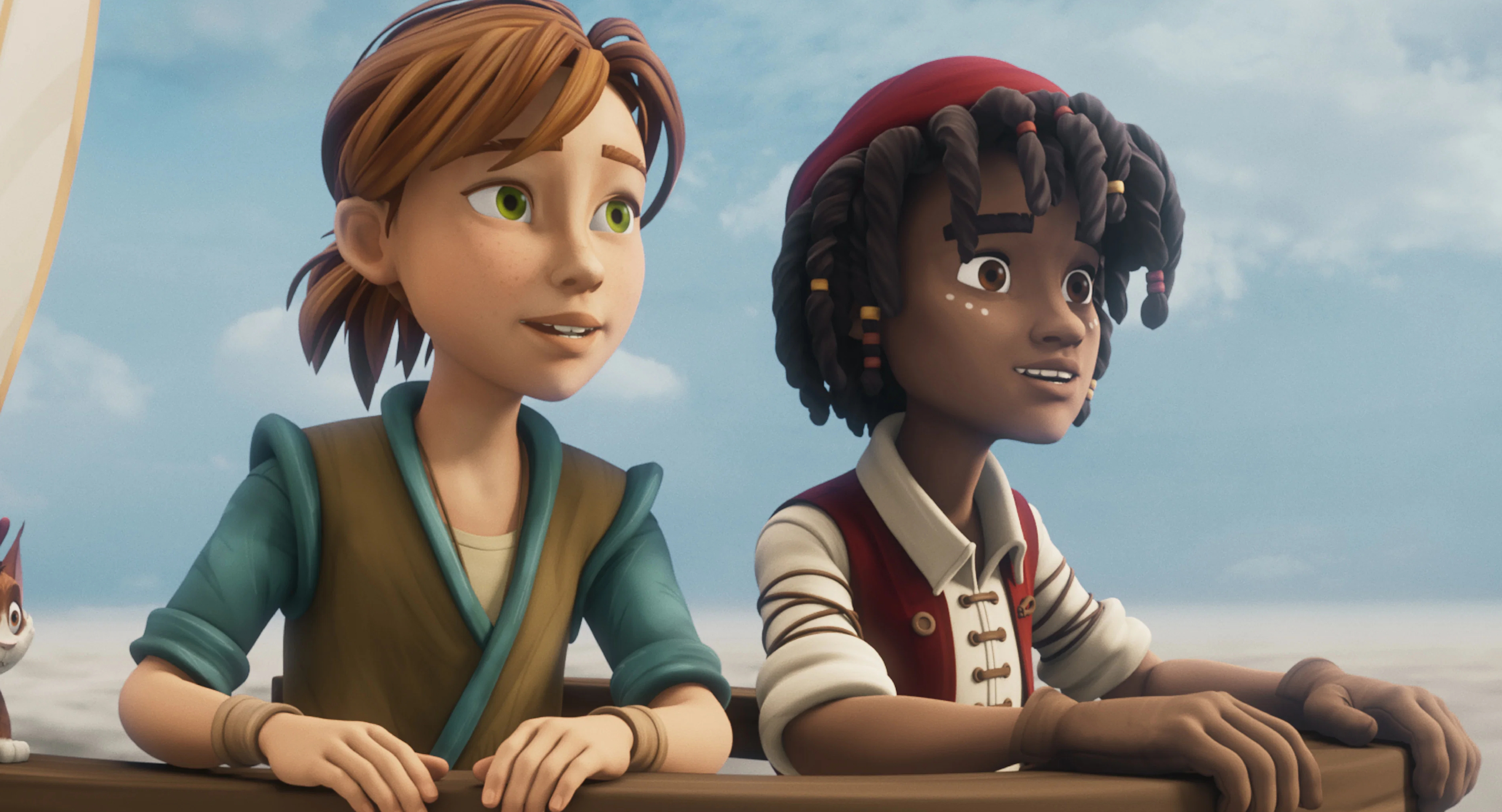
Canadian indie animation has always occupied an interesting space—often rich in imagination and sincerity, even when constrained by budget and scale. Lydia and the Mist Rider, directed by Nancy Florence Savard, Emilie Rosas, and Philippe Arseneau Bussières, fits comfortably within that tradition. It’s a film that clearly aims for emotional resonance and mythic wonder, and while it frequently achieves both, it’s equally held back by its limitations. The result is a pleasant, occasionally moving fantasy adventure that never quite escapes the gravitational pull of predictability.
The story follows 11-year-old Lydia, voiced by Sophie Nélisse, whose older brother Thaddeus is kidnapped by a mysterious figure known as the Spellbinder. Driven by equal parts fear and determination, Lydia ventures into the enigmatic Misty Sea, where she is taken aboard a flying ship called the Dolphin. There, she becomes an apprentice to Ambrosia, an Astromancer searching for her own missing child while unraveling the broader mystery of disappearing children. What unfolds is a journey of growth, magic, and emotional reckoning, framed through a classic coming-of-age structure.
From a narrative standpoint, the film is undeniably accessible. It leans into familiar fantasy tropes—an innocent protagonist thrust into a larger world, a wise but wounded mentor, and an overarching mystery tied to a shadowy antagonist. While these elements are competently assembled, they rarely surprise. The beats are predictable, often telegraphed well in advance, which diminishes some of the tension the story strives to build. Still, there’s a certain comfort in its straightforwardness, especially for younger audiences or those less concerned with narrative innovation.
What helps elevate the film above its more formulaic tendencies is its emotional sincerity. Lydia’s relationship with her brother serves as the story’s emotional anchor, and the film takes care to establish that bond early on. Even in its brief runtime, those moments resonate, giving her journey a clear emotional throughline. Similarly, Ambrosia’s subplot involving her missing son adds a layer of poignancy that deepens the film’s thematic weight. The parallels between Lydia and Ambrosia are obvious but effective, reinforcing the film’s focus on loss, hope, and perseverance.
Sophie Nélisse’s performance as Lydia is a standout. She brings a grounded vulnerability to the character, capturing both the fear of a child in over her head and the quiet strength that emerges as Lydia grows. Her voice work carries much of the film’s emotional burden, and she handles it with impressive nuance. Even when the script veers into more conventional territory, Nélisse keeps Lydia feeling authentic and engaging.
The supporting cast offers solid contributions as well. Sarah Booth imbues Ambrosia with a weary wisdom, balancing authority with underlying grief. Mizinga Mwinga‘s Chadio provides moments of levity, though his humor occasionally feels out of sync with the film’s tone. Hasani Freeman’s Lucas, Lydia’s best friend, is somewhat underutilized, serving more as a narrative device than a fully realized character. Meanwhile, Nico DeCastris‘ Thaddeus exists primarily as a motivation for Lydia’s journey, with limited presence beyond that role.
Visually, Lydia and the Mist Rider presents a mixed bag. There are flashes of creativity in its world-building—the concept of a mist-covered sea, floating ships, and astromagic offers plenty of imaginative potential. Certain sequences, particularly those involving celestial navigation and magical training, hint at a more visually striking film that occasionally breaks through. However, these moments are sporadic.
More often than not, the animation feels generic, lacking the distinct visual identity that could have set it apart. Character designs are serviceable but unremarkable, and environmental details sometimes feel sparse. The Misty Sea, which should evoke a sense of wonder and danger, often comes across as visually flat. It’s clear that budget constraints played a role here, but the end result is a film that struggles to fully realize its own imaginative ambitions.
The pacing is another area where the film falters. At just 80 minutes, the runtime feels extremely short for a story of this scope. Key developments occur too quickly, and certain emotional beats don’t have the space they need to fully land. Lydia’s training in astromagic, for instance, is condensed to the point where her progression feels rushed. Similarly, the central mystery surrounding the Spellbinder unfolds with a speed that undercuts its potential intrigue.
This brevity also affects the film’s climax, which arrives abruptly and resolves even more quickly. The confrontation with the Spellbinder lacks the sense of escalation and payoff that the story builds toward. While the emotional resolution is present, it feels somewhat compressed, as though key moments were sacrificed for the sake of keeping the runtime tight.
Despite these shortcomings, the film’s emotional beats largely succeed. There’s a genuine warmth to Lydia’s journey, and the themes of resilience and connection are handled with care. The bond between Lydia and Ambrosia, in particular, develops into one of the film’s stronger elements, offering a surrogate familial dynamic that complements the central narrative. These quieter, character-driven moments often resonate more than the larger plot mechanics.
The score and sound design contribute effectively to the film’s atmosphere, even if they don’t leave a lasting impression. The music underscores the emotional highs and lows without overpowering them, and the use of sound helps bring the world to life, compensating slightly for the visual shortcomings.
Ultimately, Lydia and the Mist Rider is a film that feels caught between ambition and limitation. It has a heartfelt story, strong central performance, and moments of genuine emotional impact, but it’s weighed down by its generic animation, predictable storytelling, and notably short runtime. It’s easy to imagine a more expansive version of this film—one with richer visuals, more developed characters, and a longer runtime—that could have fully realized its potential.
As it stands, it’s an enjoyable but modest entry in the fantasy genre. It doesn’t reinvent the wheel, nor does it leave a particularly lasting impression, but it offers enough charm and sincerity to make the journey worthwhile.
