Keeper – Film Review
Published November 15, 2025

Movie Details

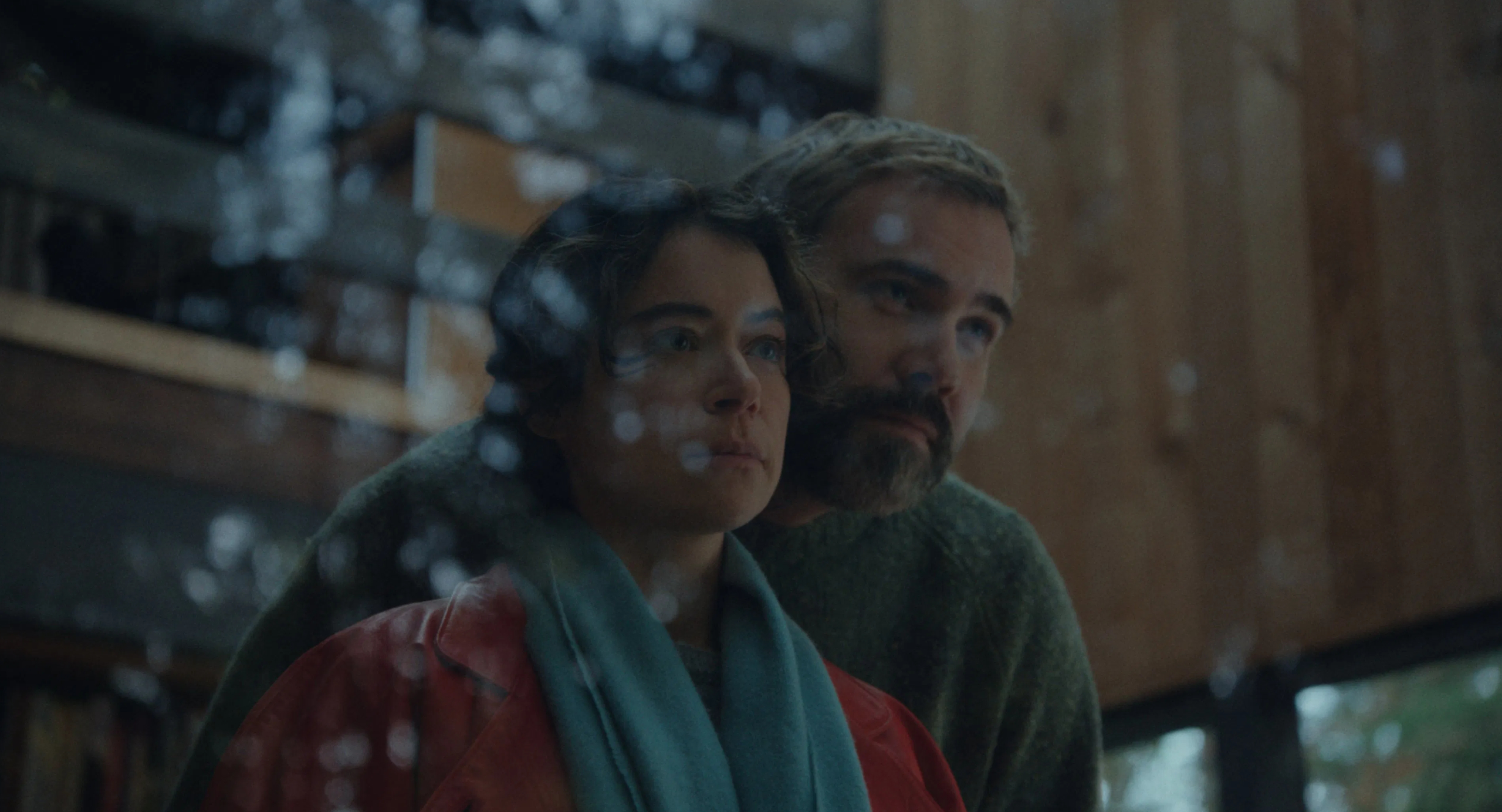
Osgood Perkins has carved a distinct niche for himself in modern horror: moody, cerebral, and visually icy, his films often aim for slow-burn dread rather than visceral shocks. Keeper, written by Nick Lepard and starring Tatiana Maslany and Rossif Sutherland—who also serve as executive producers—fits neatly into that lineage. The film blends folk horror with psychological isolation, wrapping its narrative in a remote-woods setting and a creeping sense that something buried refuses to stay hidden. Yet despite its intriguing ingredients, Keeper falters under the weight of its own ambitions. It’s a film that tries very hard to be unnerving, but its sluggish pacing, predictable twists, and emphasis on visual flair over emotional substance prevent it from leaving a lasting impact.
The premise is immediately engaging: Liz (Tatiana Maslany) and Malcolm (Rossif Sutherland) head to a secluded cabin for an anniversary weekend, but their retreat is cut short when Malcolm abruptly returns to the city, leaving Liz alone in the woods. The isolation that follows opens the door—literally and figuratively—for an evil entity drawn to the cabin’s dark history. This setup has all the makings of tight, paranoid folk horror: a mysterious building, a fraying relationship, and a protagonist spiraling into something she can’t explain.
But the film’s pacing undercuts this momentum early. Scenes stretch on long after their purpose is clear, with Liz performing mundane tasks as though they are meant to accumulate tension. Instead, they feel like padding. Perkins’ style typically thrives on stillness, but here the stillness too often becomes stagnation. What should feel suffocating instead feels empty, and the dread never tightens its grip with the intensity the genre demands.
The arrival of Darren (Birkett Turton) and his girlfriend Minka (Eden Weiss) temporarily shakes things up, offering hints of long-buried family secrets and unresolved tensions within Malcolm’s lineage. But even their presence is more suggestive than substantive. The narrative keeps circling the same beats—cryptic conversations, eerie disturbances, whispered warnings—without escalating the stakes. By the midpoint, viewers may feel like they’re waiting for the film to begin in earnest.
If Keeper survives as long as it does, it’s because of Maslany’s unshakeable ability to anchor a character in realism, even when the script around her wavers. Her Liz is grounded, exhausted, and subtly unraveling from the moment she’s left alone. Maslany conveys fear with layered nuance: she’s not just terrified of whatever stalks her, but of what solitude might reveal about her own emotional fractures. It’s a performance that deserves a more finely tuned story to support it.
Rossif Sutherland, though given limited screen time, makes Malcolm’s detachment feel both suspicious and human. The film hints that he harbors guilt, avoidance, and a discomfort with the cabin that goes beyond marital tension. His scenes spark curiosity about his connection to the cabin’s past, even if the script ultimately handles those revelations clumsily.
Birkett Turton and Eden Weiss round out the core cast with solid, if more straightforward, performances. Turton’s Darren mixes charm and evasiveness in a way that fits the film’s themes of buried truths, while Weiss gives Minka a wary energy that suggests she understands more than she’s allowed to say. Their dynamic adds some charge to the story, but the writing never fully capitalizes on it.
Cinematographer Jeremy Cox delivers Keeper’s most consistent strength: the images. The film is visually cold and sharply framed, with crisp contrasts between the dense forest darkness and the warm but claustrophobic interior of the cabin. Long lingering shots of trees, frost, and water aim to cultivate a sense of being watched, and on a purely aesthetic level, they succeed.
Yet the film’s overreliance on these beautiful images reinforces its biggest weakness: it’s so focused on mood that it forgets to move. Scenes of Liz wandering the property or staring into the woods pile up, each intended to thicken the atmosphere, but the effect becomes repetitive. The visuals are striking, but they lack narrative weight, turning into a kind of stylistic loop that traps the film rather than propels it.
The film also positions itself for a shocking third-act turn. Unfortunately, the twist is foreseeable from nearly the moment Liz is left alone. The breadcrumbs are too obvious, and the narrative strings the viewer along for far too long before confirming what most will have guessed early on. When the revelation does arrive, it feels less like a punch and more like a delayed acknowledgment of the inevitable.
This predictability drains the climax of both suspense and emotional impact. Folk horror works best when its mysteries feel both ancient and unsettlingly unknowable, but Keeper reduces its mythology to something familiar every step of the way.
Perkins and Lepard clearly aim for a textured psychological descent, but the script does too little to explore Liz’s interior world beyond her surface fear. Themes of trust, abandonment, and generational secrecy flicker at the edges, yet the film never digs deeply enough to make them compelling. Every time the story introduces an intriguing idea—about Malcolm’s past, about Darren’s involvement, about the cabin’s history—it treats that idea like décor instead of building material.
The result is a film that relies heavily on mood and implication, hoping the atmosphere alone can sustain engagement. But without narrative escalation, without meaningful character development beyond Maslany’s efforts, and without surprises that enrich the experience, Keeper becomes the very thing its title evokes: something boxed up, contained, and unable to evolve.
Keeper has the skeleton of a compelling folk horror story: a terrific lead performance, a chilling location, and a visual language that understands the allure of rural menace. But those strengths can only carry it so far. The sluggish pacing leaves the film feeling twice as long as it is, the central twist telegraphs itself early, and the emphasis on stylization overshadows storytelling at key moments. What remains is a handsomely photographed but emotionally hollow film that frustrates more than it frightens.
For viewers who appreciate atmospheric horror and admire Maslany’s work, Keeper may still offer moments of engagement. But as a complete piece, it never fully grasps the dread it’s striving to conjure. Instead, it stands as a reminder that mood alone cannot sustain a horror narrative without momentum, surprise, or emotional depth.