Forbidden Fruits – Film Review
Published March 29, 2026

Movie Details

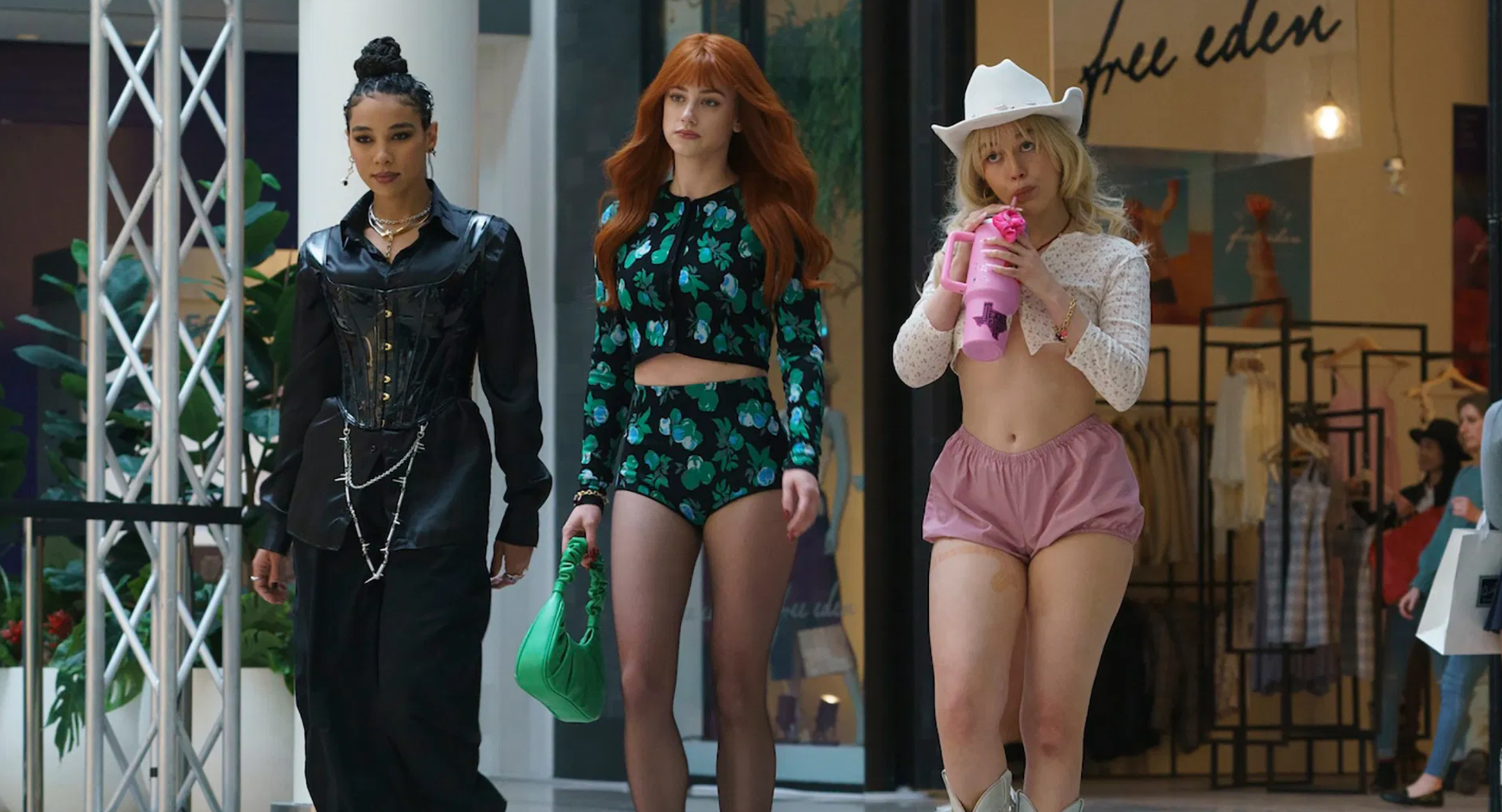
There’s something instantly intriguing about a horror-comedy that sets its chaos inside the fluorescent purgatory of a mall retail store. Forbidden Fruits, directed by Meredith Alloway and co-written with Lily Houghton, takes that premise and pushes it into stranger, darker territory. Adapted from Houghton’s stage play, the film blends witchcraft, satire, and psychological unraveling into a messy—but often compelling—exploration of toxic sisterhood and identity performance.
Set within the pastel walls of Free Eden, a vaguely Goop-inspired retail chain, the film introduces Apple (Lili Reinhart), a seemingly mild-mannered employee who secretly leads a clandestine, ritualistic “femme cult” in the store’s basement. Alongside her are Cherry (Victoria Pedretti) and Fig (Alexandra Shipp), two equally committed disciples who embody different facets of the group’s ideology. Their late-night gatherings are equal parts bonding ritual, self-help seminar, and occult ceremony—steeped in aestheticized empowerment language that feels both sincere and deeply hollow.
The dynamic shifts dramatically with the arrival of Pumpkin, played with grounded skepticism by Lola Tung. Pumpkin is not immediately seduced by the group’s curated mystique, and her resistance becomes the catalyst that exposes the fractures beneath the group’s carefully constructed unity. What begins as passive tension soon escalates into something far more dangerous, as the cult’s rituals begin to blur the line between metaphor and literal horror.
Reinhart delivers one of her most interesting performances to date as Apple, a character who oscillates between vulnerability and manipulation. She’s not a traditional horror antagonist, nor is she a sympathetic protagonist; instead, she exists in a morally gray space that the film wisely refuses to simplify. Reinhart plays Apple with a brittle intensity, suggesting that her need for control stems from deep insecurity rather than pure malice. It’s a performance that anchors the film, even when the narrative veers into more surreal territory.
Pedretti, as Cherry, continues her streak of excelling in psychologically complex roles. There’s a quiet volatility to her performance that makes Cherry feel like a ticking time bomb. Shipp’s Fig, meanwhile, provides a more outwardly confident presence, though her character’s arc reveals the fragility beneath that confidence. Together, the trio forms a compelling portrait of a friendship built on shared delusion rather than genuine connection.
Tung’s Pumpkin serves as the audience’s entry point into this strange world, and her grounded performance is essential in keeping the film from drifting too far into abstraction. She challenges the group not through confrontation alone, but through her refusal to participate in their performative rituals. This resistance forces the other characters to confront the emptiness of their beliefs, leading to some of the film’s most uncomfortable—and effective—moments.
The supporting cast adds texture to the film’s offbeat tone. Emma Chamberlain, as the oddly named Pickle, brings a deadpan humor that cuts through the film’s darker moments, while Gabrielle Union lends a brief but memorable presence that adds a layer of generational contrast to the story’s themes of empowerment and self-definition.
Visually, Forbidden Fruits leans heavily into contrast. The bright, artificial aesthetic of the mall setting clashes with the dim, candlelit rituals of the basement, creating a sense of duality that mirrors the characters’ internal conflicts. Alloway’s direction emphasizes this divide, using tight framing and disorienting camera movements during the ritual scenes to evoke a sense of unease. The film doesn’t rely heavily on traditional jump scares; instead, it builds tension through atmosphere and character dynamics, which proves far more effective.
The horror elements, while not always consistent, are at their best when they feel like extensions of the characters’ ფსychological states. The film suggests that the real danger isn’t the supernatural itself, but the willingness of these women to lose themselves in an identity that promises empowerment but delivers isolation. When the horror does turn more overtly violent in the third act, it feels earned, even if the tonal shift is somewhat jarring.
Where Forbidden Fruits truly stands out is in its thematic ambition. The film takes aim at the commodification of feminism and the ways in which empowerment can be co-opted into something exclusionary and performative. The cult’s rituals are filled with buzzwords and affirmations that sound empowering on the surface but ultimately serve to reinforce a rigid, hierarchical structure. It’s a sharp critique that feels particularly relevant, even if the film occasionally leans too heavily on its metaphors.
That said, the screenplay isn’t without its flaws. The dialogue can sometimes feel overly stylized, with characters speaking in a way that prioritizes thematic resonance over naturalism. While this works in certain scenes, it can also create a sense of distance that makes it harder to fully invest in the characters’ emotional journeys. Additionally, some of the film’s subplots—particularly those involving the broader Free Eden environment—feel underdeveloped, as if they were carried over from the stage play without being fully adapted for the screen.
Despite these issues, the film’s willingness to embrace its own weirdness ultimately works in its favor. Alloway doesn’t shy away from the more uncomfortable aspects of the story, allowing the characters to be flawed, contradictory, and, at times, deeply unlikable. This commitment to complexity gives the film a sense of authenticity that elevates it above more conventional entries in the genre.
The pacing is another area where the film both succeeds and struggles. The first half builds a strong sense of intrigue, gradually revealing the dynamics of the group and the nature of their rituals. The second half, however, moves at a much faster pace, with events escalating quickly toward a chaotic climax. While this shift can feel abrupt, it also adds to the sense of unraveling that defines the film’s final act.
Ultimately, Forbidden Fruits is not a film that aims to provide easy answers or clean resolutions. Its ending is messy, ambiguous, and likely to divide audiences, but it feels true to the story being told. Rather than offering a clear moral, the film leaves viewers with a lingering sense of discomfort—and perhaps a few questions about the nature of belonging and identity.
Thanks to a sharp and campy script and some killer performances, Forbidden Fruits stands out as something distinctly its own. It’s not perfect, but its bold performances, striking visual style, and sharp thematic focus make it a memorable and thought-provoking experience. For those willing to embrace its strangeness, it offers a darkly funny and unsettling ride that lingers long after the credits roll.