Finding Emily – Film Review
Published June 25, 2026

Movie Details

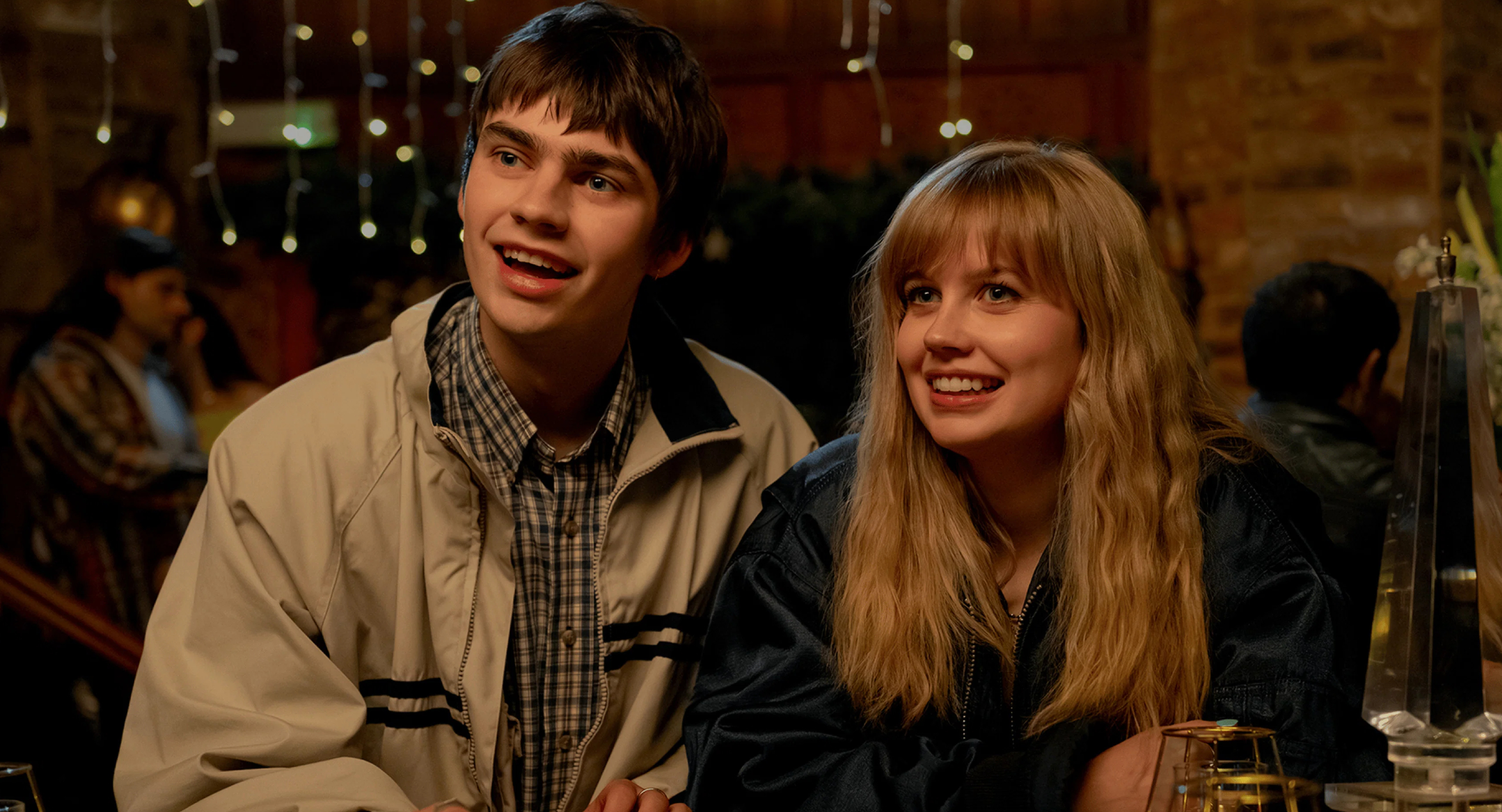
Romantic comedies often live or die by one question: do you believe these two people should end up together? Finding Emily succeeds because it understands that chemistry alone is never enough. Director Alicia MacDonald and writer Rachel Hirons build something smarter, warmer, and more emotionally observant than the average modern rom-com, creating a film that begins as a frantic campus farce before quietly becoming a thoughtful look at identity, obsession, vulnerability, and the uncomfortable difference between idealized love and the real thing.
Set against the backdrop of a fictional Manchester university, the premise initially sounds almost aggressively chaotic. Twenty-three-year-old Owen Brompton works sound at a student union bar and experiences what feels like instant connection with a girl who leaves after giving him only her first name—Emily—and a phone number that turns out to be incorrect. Determined to find her, Owen launches a university-wide search. Enter Emily Raine, a psychology student writing her thesis on the idea that love resembles a form of temporary madness. Seeing Owen’s increasingly irrational mission as perfect research material, she inserts herself into his life under false pretenses.
That setup could have easily become exhausting or overly quirky. Instead, Finding Emily walks a surprisingly delicate line. The film never fully mocks Owen’s romantic optimism, but it also refuses to endorse it unquestioningly. Likewise, Emily’s academic cynicism isn’t portrayed as intellectual superiority. Hirons’ screenplay gives both characters enough emotional credibility that their opposing views feel human rather than symbolic. One of the film’s biggest strengths is how naturally it shifts tone.
For a good stretch of its runtime, Finding Emily operates almost like a university comedy of errors. Owen’s increasingly elaborate attempts to locate the mystery woman escalate into absurd public situations, culminating in campus-wide consequences that spiral beyond anything he intended. The anonymous email campaign, the accidental notoriety, the bizarre celebrity status that follows—it all has a heightened comic energy that feels recognizably modern. Yet the movie never loses emotional grounding.
There is an underlying sadness to Owen’s search that Spike Fearn captures beautifully. Owen is not presented as some grand romantic hero. He feels lost, directionless, and desperate for something meaningful to happen to him. Fearn gives him an awkward sincerity that prevents the character from becoming annoying even when his choices become increasingly questionable. There’s something painfully believable about how intensely young adulthood can magnify a brief encounter into something life-changing.
Angourie Rice delivers what may be one of her strongest performances to date as Emily Raine. Her character could have become difficult to root for given the ethical problems baked into her actions, but Rice plays Emily with enough intelligence and visible self-awareness that the audience understands her even when disagreeing with her. Emily isn’t cruel; she’s detached. She studies emotion because she’s uncomfortable experiencing it directly. Watching that certainty slowly unravel becomes the film’s emotional engine.
Rice also has excellent comedic timing. Much of the humor comes not from punchlines but from Emily’s increasingly unsuccessful attempts to maintain objectivity while becoming emotionally invested. The screenplay repeatedly places her in situations where her carefully structured worldview starts collapsing in small, funny, and quietly painful ways. The chemistry between Rice and Fearn is exceptional because it doesn’t rely on immediate attraction.
Their relationship develops through conversation, irritation, accidental honesty, and shared embarrassment. They don’t feel written to complement each other perfectly; they feel like two people who slowly realize they understand each other more than expected. That distinction matters because the movie is constantly interrogating whether love is destiny, projection, habit, or choice. This thematic focus elevates Finding Emily above many contemporary romantic comedies.
The film repeatedly asks whether falling for someone says more about the person being loved or the person doing the loving. Owen falls for an idea. Emily studies emotions from a safe distance. Both characters eventually have to confront whether connection means accepting reality instead of chasing fantasies. What’s impressive is that the movie handles these ideas without becoming self-important.
MacDonald directs with a light touch, allowing scenes to breathe rather than turning every emotional beat into a dramatic declaration. There are long stretches of awkward conversations, lingering looks, and moments of hesitation that feel authentic to university life. Manchester itself becomes part of the atmosphere—not romanticized, but textured and lived in.
Supporting performances also deserve recognition. Minnie Driver brings authority and warmth to the Dean, grounding some of the more heightened academic material. Sadie Soverall leaves an impression despite limited screen time, and Ella Maisy Purvis adds an understated sense of realism to Emily’s personal life and relationships. Even smaller characters feel distinct rather than existing purely as joke delivery systems. The film’s depiction of internet virality is another pleasant surprise.
Many modern comedies struggle to portray online culture without feeling dated immediately. Finding Emily avoids this by focusing less on the mechanics of going viral and more on what public attention does to people emotionally. Owen’s accidental notoriety becomes less about fame and more about losing ownership over something personal.
Some supporting relationships can sometimes feel underexplored, particularly as the story approaches its final act. A few emotional transitions arrive a little quicker than earlier scenes suggest. Still, those are minor complaints against a film that consistently understands its characters.
Most importantly, Finding Emily earns its emotional payoff. Rather than rewarding obsession or presenting love as magical inevitability, it arrives at something gentler and more mature. It suggests that real connection begins when people stop performing versions of themselves and allow another person to see the uncomfortable parts. That message lands because the film never abandons its sense of humor.
Finding Emily is funny, observant, occasionally chaotic, and unexpectedly moving. It captures the strange intensity of being young enough to believe every decision might define your life and old enough to realize people—and feelings—rarely fit neat theories.
By the time the credits roll, what remains isn’t the mystery, the comedy, or the campus antics. It’s the feeling that maybe love isn’t madness after all. Maybe it just looks irrational until someone finally understands you. And Finding Emily understands that better than most romantic comedies do.