Cold Storage – Film Review
Published February 15, 2026

Movie Details

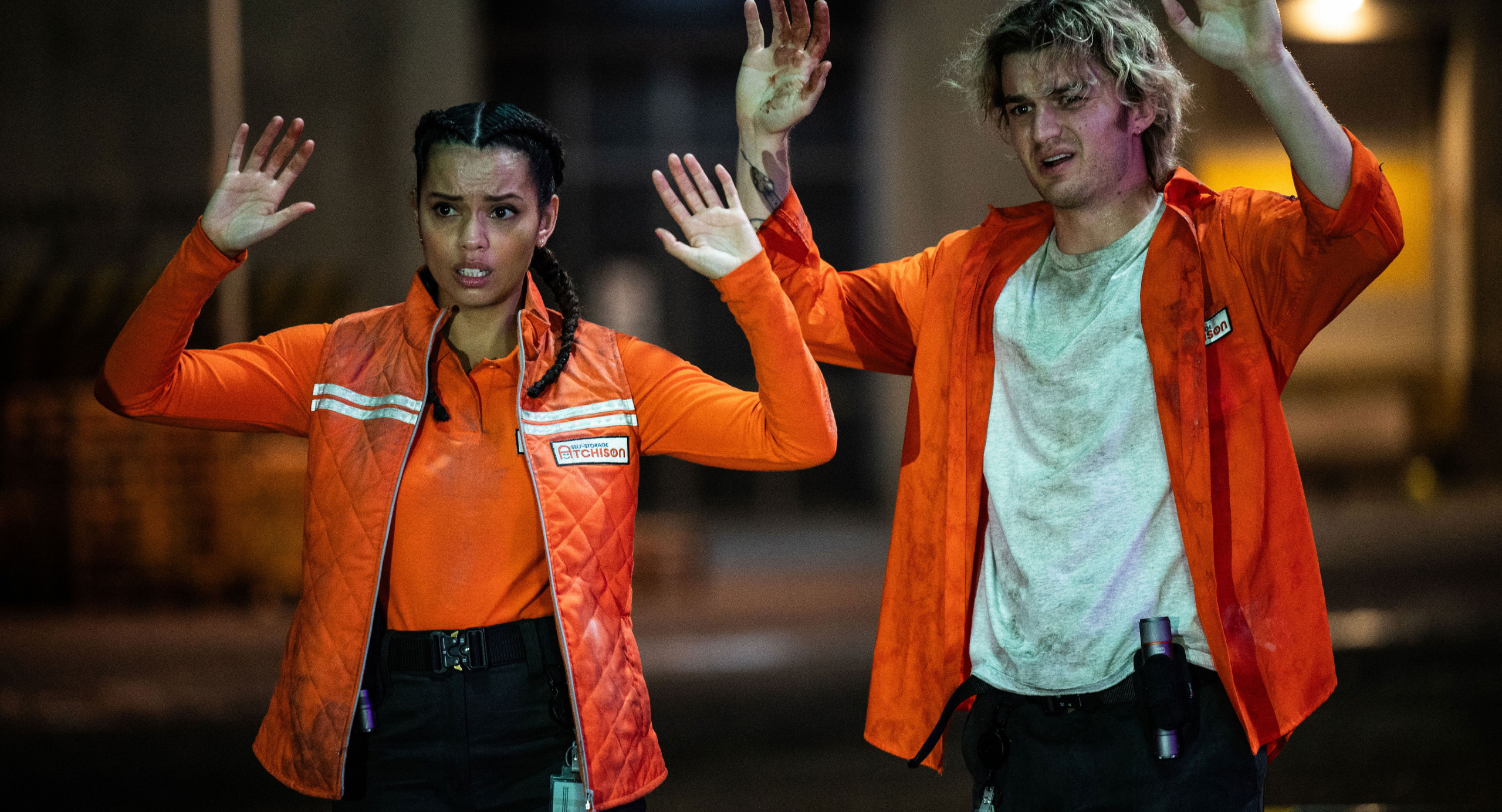
Directed by Jonny Campbell and adapted by David Koepp from his own 2019 novel, Cold Storage arrives with a promising blend of sci-fi horror and offbeat comedy. With a cast led by Joe Keery, Georgina Campbell, Sosie Bacon, Vanessa Redgrave, Lesley Manville, and Liam Neeson, the film seems primed for cult appeal: parasitic fungus, government cover-ups, self-storage chaos, and an eccentric ensemble. On paper, it has the makings of a lean, irreverent creature feature in the tradition of Gremlins or Tremors. In execution, however, the film proves surprisingly inert—more stale than thrilling, more awkward than funny.
The premise alone suggests pulpy fun. A decades-old fungal experiment, originally transported aboard Skylab, survives reentry and lies dormant for years. Once it escapes containment from an underground military vault beneath a Kansas self-storage facility, the consequences escalate rapidly. Night guards, elderly clients, biker gangs, and Pentagon operatives collide in a race to prevent a catastrophic outbreak. It’s an undeniably strong setup, rich with tonal potential. Yet despite these ingredients, Cold Storage never manages to cultivate suspense, humor, or urgency in satisfying measure.
Instead, the film lumbers through its beats with oddly rushed pacing, draining tension from what should be tight, escalating chaos. Scenes move quickly but feel strangely weightless, as if key connective tissue has been stripped away. The result is a narrative that feels both overstuffed and underdeveloped at the same time.
The film’s saving grace lies largely in its central performances. Joe Keery, as Travis “Teacake” Meacham, brings a scrappy, endearing energy to the role of the underachieving night guard thrust into extraordinary circumstances. Keery has a natural comedic presence, and while the script rarely gives him sharp material, he manages to inject personality and relatability into scenes that would otherwise fall flat. His reactions to the increasingly grotesque fungal mayhem feel grounded and human, giving the audience someone to root for even when the stakes feel abstract.
Georgina Campbell fares similarly well as Naomi Williams, Travis’s coworker and emotional counterbalance. Campbell plays Naomi with intelligence and composure, avoiding the clichés that often plague genre heroines. Even when the script leans into thinly written dialogue or contrived tension, she maintains credibility. The dynamic between Keery and Campbell is one of the film’s few consistent pleasures; their chemistry gives the story a faint pulse.
Sosie Bacon, as Dr. Hero Martins in the film’s early sequence, delivers a memorable turn in what could have been a disposable prologue role. Though her screen time is limited, she conveys the creeping horror of losing control to an alien organism with chilling subtlety. It’s one of the rare stretches where the film genuinely feels unsettling.
Despite its many shortcomings, Cold Storage does feature a couple of horror sequences that effectively showcase the grotesque potential of its concept. The early outbreak on the isolated farm is genuinely unnerving. The fungus’s invasive, corrosive qualities are depicted with unsettling tactile detail, and the transformation of infected bodies into grotesque, mutating carriers provides some striking imagery.
Later, inside the self-storage facility, a sequence involving a rapidly spreading infection creates a brief surge of tension. The claustrophobic corridors, flickering lights, and the sense of something organic and unstoppable pressing against steel doors finally give the movie the atmosphere it has been lacking. For a few moments, Campbell’s direction hints at a sharper, meaner creature feature lurking beneath the surface.
Unfortunately, these flashes of effectiveness are isolated. The horror elements never build toward sustained dread. Instead, each promising set piece is followed by tonal whiplash or comedic beats that sap the energy. The film seems unsure whether it wants to be gross-out horror, workplace comedy, or political satire—and never fully commits to any one lane.
For a horror comedy, Cold Storage is remarkably unfunny. The humor frequently relies on awkward banter and broad situational irony, but the timing rarely lands. Jokes are telegraphed well in advance or undercut by stiff editing. Even talented performers like Keery and Campbell struggle to elevate punchlines that feel half-formed.
The supporting cast, including Vanessa Redgrave as Ma Rooney, provides sporadic moments of levity, but the script seldom capitalizes on their presence. Redgrave’s character concept—an elderly woman inadvertently swept into a biohazard crisis—should be ripe for dark humor. Instead, her scenes feel curiously restrained, as if the film is hesitant to push its absurdity far enough.
The biker gang subplot is another example of comedic potential squandered. Their arrival should inject chaotic energy into the narrative, but their involvement is rushed and thinly sketched, reducing what could have been a highlight into yet another fleeting detour.
Liam Neeson’s casting as Robert Quinn suggests gravitas and perhaps a hint of genre-savvy irony. Instead, his subplot is surprisingly dull. Much of his screen time consists of exposition-heavy conversations, logistical planning, and travel sequences that stall the momentum rather than enhance it. Neeson plays the role straight, but the material gives him little room to create tension or emotional investment.
His character’s arc, intended to add a layer of political intrigue and moral reckoning, ends up feeling perfunctory. The attempts at commentary on government secrecy and bureaucratic incompetence are surface-level at best. Rather than heightening the stakes, the Pentagon subplot diffuses them, pulling focus away from the immediate survival horror unfolding at the storage facility.
In a film already struggling with pacing, these detours become especially damaging. Scenes that should escalate urgency instead bog the story down in procedural minutiae. By the time Neeson reenters the main action, the sense of danger has already plateaued.
Visually, Cold Storage looks disappointingly modest. The self-storage setting could have been transformed into a labyrinthine nightmare, but the production design feels sparse and underlit in uninspired ways. The fungal effects, while occasionally effective in close-ups, often appear limited by budget constraints. Wide shots and larger-scale chaos lack the visceral impact the premise demands.
The climax, which should deliver explosive catharsis, feels strangely small. The sense of apocalyptic threat that the narrative gestures toward never convincingly materializes. Instead of escalating to a fever pitch, the film wraps up in a way that feels abrupt and emotionally muted.
The rushed pacing exacerbates these issues. Character relationships are sketched quickly and rarely deepened. Stakes are introduced and resolved with minimal build-up. It’s as if the film is constantly racing forward but never allowing itself to linger long enough for tension or humor to mature.
Cold Storage is a frustrating experience. The ingredients are there: a clever high-concept premise, a capable cast, and the promise of gnarly creature-feature chaos. Joe Keery and Georgina Campbell deliver committed, engaging performances that almost carry the film on their own. A couple of horror sequences hint at what might have been—a lean, nasty, and sharply funny midnight movie.
But those moments are buried beneath uneven tone, flat humor, dull political subplots, and visuals that feel cheaper than the concept deserves. The film moves quickly yet somehow remains boring for long stretches, never fully embracing its own absurdity or horror. Instead of spreading like an unstoppable contagion, Cold Storage fizzles out before it can truly infect its audience.
For a story about a fungus that refuses to die, it’s ironic how lifeless the final product feels. Cold Storage is less a cult classic in the making and more a missed opportunity left to rot in the vault.