Dolly – Film Review
Published March 9, 2026

Movie Details

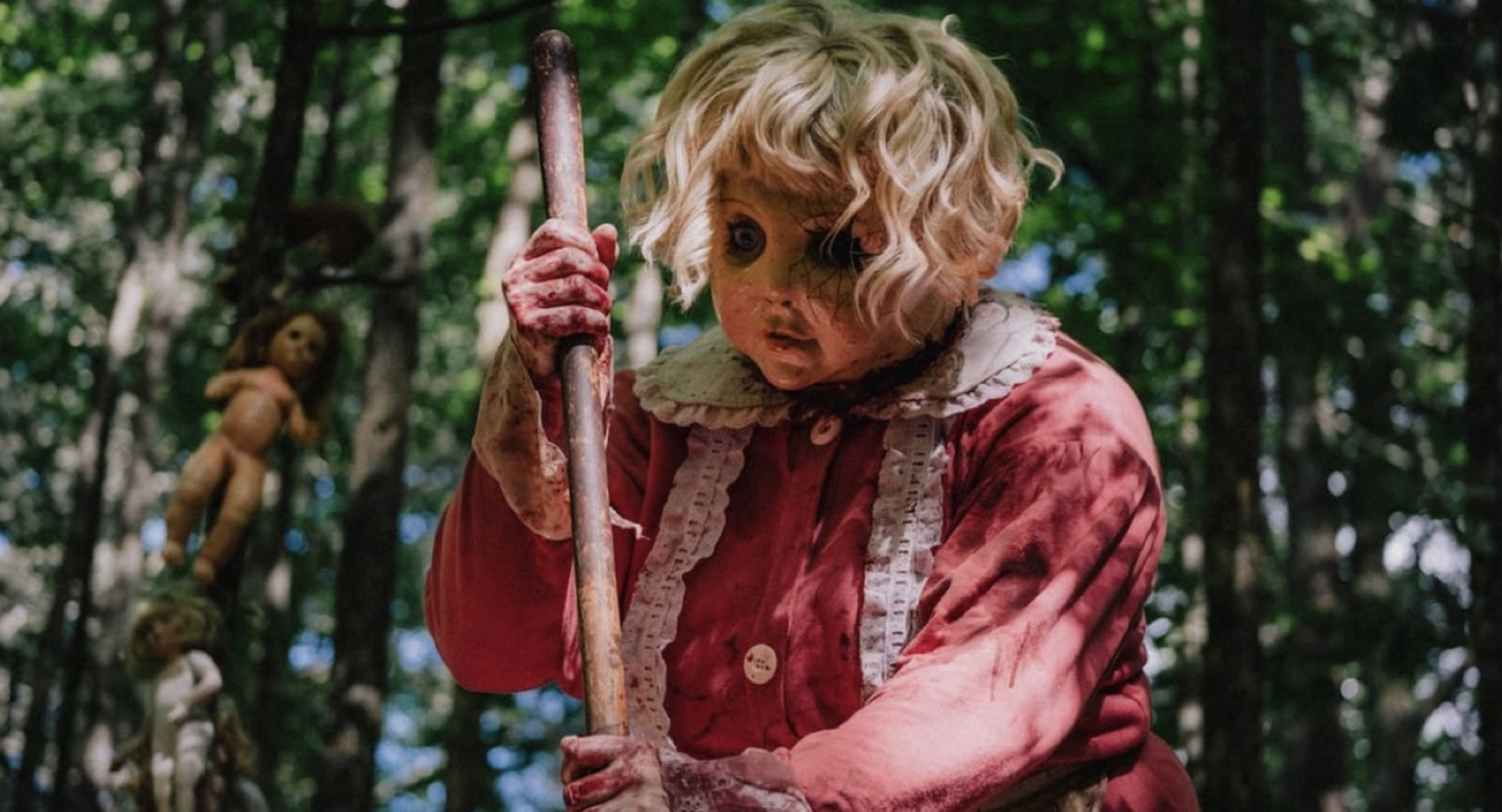
Horror films built around captivity often rely on atmosphere and psychological tension to sustain their stories, and Dolly certainly tries to lean into that tradition. Directed, written, and produced by Rod Blackhurst, the film expands on his 2022 short Babygirl, turning a brief nightmare scenario into a full-length feature. With a premise centered on a young woman abducted by a monstrous figure that intends to raise her as its child, the film blends body horror, psychological torment, and grotesque familial themes into a disturbing narrative. The result is a horror experience that has moments of effective dread and strange creativity, yet ultimately feels uneven and overly indebted to other genre standouts.
The film follows Macy, played by Fabianne Therese, whose life is violently upended when she is kidnapped by a mysterious creature known as Dolly. Portrayed by Max the Impaler, Dolly is a towering and deeply unsettling figure whose intentions are both horrifying and bizarrely maternal. Rather than simply tormenting or killing her victim, Dolly intends to keep Macy alive and mold her into a daughter-like figure. This twisted parental dynamic becomes the central engine of the film’s horror, creating a claustrophobic environment where Macy must navigate both physical captivity and psychological manipulation in order to survive.
Blackhurst demonstrates a clear understanding of how to create an unsettling mood. The film’s early sequences are particularly effective at establishing dread, as Macy’s ordinary life slowly gives way to an environment of confusion and terror. The abduction scene itself is shot with a disorienting intensity, placing viewers directly into Macy’s perspective as the world collapses around her. From there, the film transitions into a grim, confined setting that feels almost dreamlike in its grotesque details.
The production design plays a large role in crafting the film’s tone. Dolly’s domain is presented as a warped imitation of domestic life, with unsettling decorations, childlike objects, and improvised household elements that feel disturbingly out of place. These visual touches reinforce the idea that Dolly is attempting to replicate the structure of a family while fundamentally misunderstanding what that means. The result is a setting that is both grotesque and oddly tragic, adding a layer of psychological horror to the story.
Fabianne Therese delivers a committed performance as Macy, anchoring the film’s emotional perspective. Her portrayal captures the panic, confusion, and desperate resilience of someone trapped in an impossible situation. Therese manages to convey the character’s gradual shift from pure terror to calculated survival instincts, which helps keep the narrative engaging even when the plot begins to wander. Macy’s attempts to understand Dolly’s motivations and exploit moments of vulnerability provide some of the film’s most compelling sequences.
Opposite her, Max the Impaler gives a physically imposing performance as Dolly. The character relies heavily on body language and presence rather than traditional dialogue, making the performance feel almost creature-like. Dolly’s movements are deliberately awkward and unsettling, as though the character is mimicking human behavior without fully understanding it. This quality adds to the disturbing nature of the relationship between Dolly and Macy, as the monster alternates between threatening violence and distorted affection.
Supporting performances from actors like Ethan Suplee, Seann William Scott, Kate Cobb, Eve Blackhurst, Michalina Scorzelli, and Russ Tiller provide additional context to the story, though many of these characters feel somewhat underdeveloped. Their appearances often function more as narrative tools than as fully realized individuals, serving to expand the world around Macy’s ordeal or hint at the broader circumstances surrounding Dolly’s existence.
While the film has its share of strengths, it struggles to establish a fully original identity. Many viewers will immediately notice similarities to Barbarian, particularly in how the story reveals its horrors gradually and plays with audience expectations regarding captivity and monstrous caretakers. The influence of Incident in a Ghostland is also evident in the film’s focus on psychological trauma and twisted domestic scenarios. Unfortunately, Dolly sometimes feels too similar to these films, echoing their structure and themes without bringing enough fresh ideas to justify the comparison.
This sense of familiarity becomes more noticeable as the film progresses. The first act builds intrigue through ambiguity and tension, but later sections begin to rely on familiar horror beats that genre fans have seen many times before. Moments that should feel shocking or unpredictable occasionally come across as derivative, diminishing the impact of the story’s darker twists.
Another issue lies in the pacing. The film oscillates between slow, atmospheric scenes and sudden bursts of chaos, which can create an uneven rhythm. Some sequences linger long enough to build suspense effectively, while others feel padded, stretching relatively simple narrative developments across extended stretches of screen time. As a result, the middle portion of the film occasionally drifts, causing the tension to dissipate.
That said, Blackhurst deserves credit for committing fully to the film’s disturbing concept. The idea of a monster attempting to construct a family dynamic is inherently unsettling, and the film explores this premise with a certain level of commitment. Dolly’s warped version of nurturing introduces moments that are simultaneously horrifying and strangely pitiable, hinting at deeper psychological or symbolic themes about loneliness and the need for connection.
The film’s visual style also contributes significantly to its atmosphere. The cinematography favors dim lighting, narrow spaces, and uncomfortable close-ups that keep viewers locked into Macy’s experience. This approach heightens the sense of confinement and vulnerability, reinforcing the film’s survival-horror elements. Even when the story falters, the imagery remains consistently eerie.
Sound design plays a similarly important role. The film relies heavily on unsettling ambient noises and abrupt bursts of sound to maintain tension. Dolly’s presence is often announced through subtle auditory cues before the character even appears on screen, which helps build anticipation and dread. These techniques demonstrate a clear understanding of how sensory elements can enhance horror storytelling.
Despite these strengths, the film never quite reaches the emotional or narrative heights it seems to aim for. The themes of captivity, trauma, and distorted family structures are compelling on paper, but the screenplay does not fully explore them with the depth they deserve. Instead, the film often prioritizes shocking imagery and disturbing scenarios over character development or thematic clarity.
By the time the story reaches its climax, the narrative feels somewhat rushed. After spending so much time building tension and exploring Macy’s desperate situation, the resolution arrives with less impact than expected. The film attempts to deliver a dramatic payoff, yet the emotional weight of that moment does not entirely land.
Even so, Dolly remains an interesting entry in the modern horror landscape. Its premise is undeniably disturbing, and the performances from Fabianne Therese and Max the Impaler provide a strong foundation for the story. When the film focuses on the strange and terrifying dynamic between its two central characters, it manages to create genuinely unsettling moments.
Ultimately, Dolly is a horror film with intriguing ideas and a memorable central concept, but it struggles to step out from the shadow of the genre films that clearly inspired it. With stronger narrative focus and more originality, it could have been something truly distinctive. Instead, it lands somewhere in the middle: unsettling enough to hold attention, yet too derivative to fully stand on its own.
For horror fans curious about dark psychological captivity stories, Dolly offers enough eerie atmosphere and disturbing imagery to make it worth a watch. Just don’t expect it to break entirely new ground within the genre.