Slanted – Film Review
Published February 27, 2026

Movie Details

In her audacious feature, Amy Wang delivers a queasy, sharp-edged body horror-comedy that slices into assimilation anxiety with both surgical precision and dark humor. Slanted is the kind of film that provokes uneasy laughter before leaving a lingering sting, using genre extremity to examine the suffocating pressures of whiteness as social currency. It is messy in places, occasionally blunt in its messaging, but undeniably bold in vision and execution.
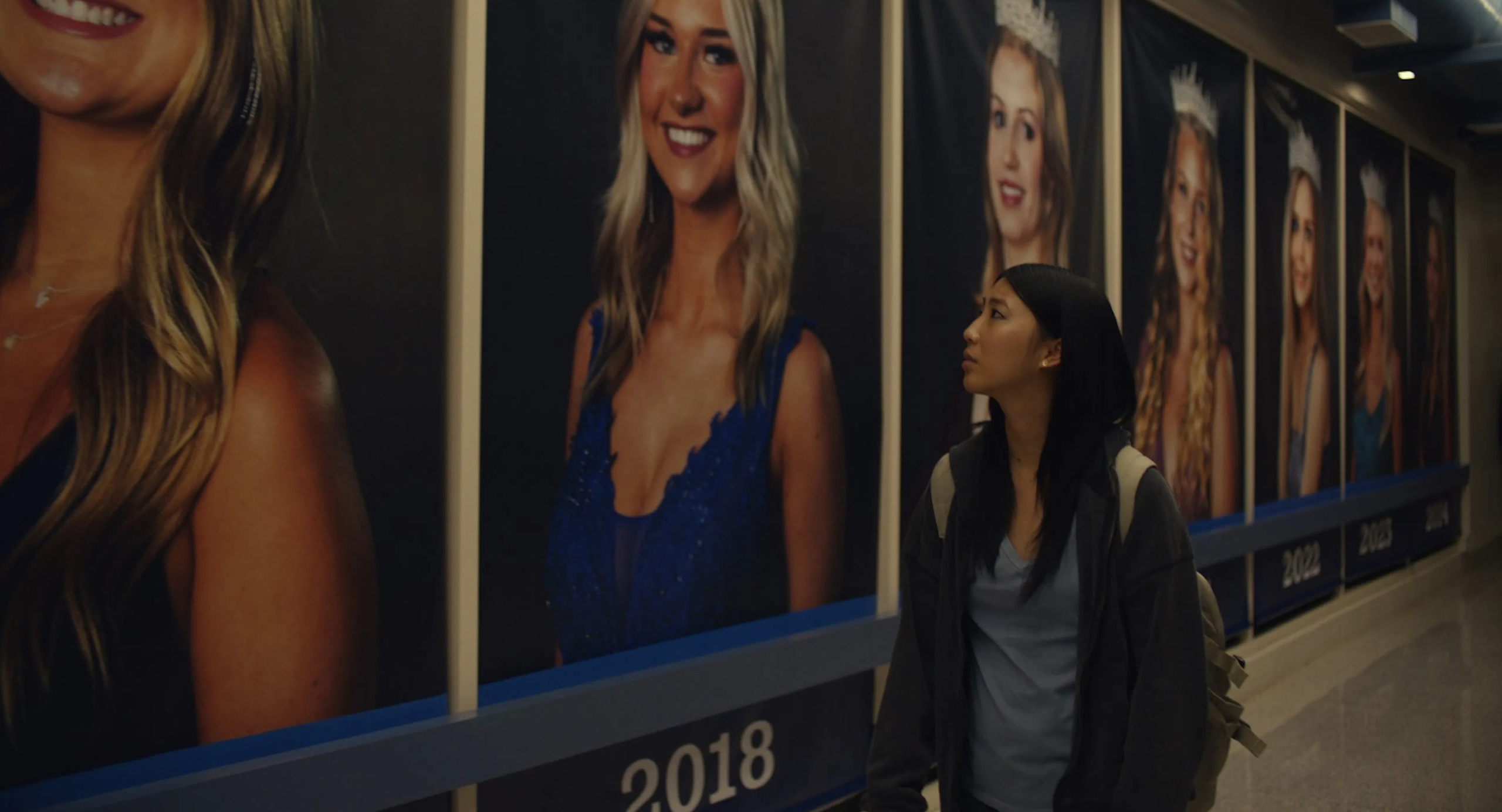
The film follows Joan Huang, played with aching vulnerability by Shirley Chen, a Chinese-American high school senior desperate to be crowned prom queen. In her suburban ecosystem, popularity feels synonymous with proximity to whiteness—beauty standards, speech patterns, even social mannerisms seem coded in a way that excludes her. In a move that catapults the film from teen satire into Cronenbergian nightmare, Joan undergoes an experimental “ethnic modification surgery” that transforms her into a white version of herself, reintroduced to the world as Jo Hunt. The premise is absurd, provocative, and intentionally grotesque, weaponizing the plasticity of body horror to literalize assimilation.
Chen shoulders the film’s first act with remarkable dexterity. Her Joan is neither caricature nor saint; she is painfully human. Chen conveys the internalized self-critique Joan has absorbed over years of microaggressions and cultural isolation. The performance avoids melodrama, instead leaning into awkward silences and glances that reveal Joan’s self-surveillance. When she disappears beneath surgical drapes, the transformation feels less like a plot gimmick and more like a tragedy in motion.
Once the surgery is complete, Mckenna Grace takes over as Jo Hunt, the white-presenting iteration of Joan. Grace brings a subtly uncanny quality to the role. She doesn’t play Jo as an entirely new person; instead, there are flickers of Joan’s insecurity beneath the polished exterior. The performance walks a careful line between satire and sincerity. Grace captures the thrill of immediate social acceptance—doors opening, smiles widening, boys noticing—while allowing unease to seep through the cracks.
Wang’s direction leans heavily into tonal duality. The high school setting is rendered in exaggerated, candy-colored pastels that border on parody. Pep rallies and hallway gossip feel heightened to the point of absurdity, emphasizing the performative nature of teenage popularity. But the surgical sequences are stark and clinical. The body horror isn’t gratuitous, yet it is viscerally uncomfortable: peeling skin metaphors, distorted reflections, and subtle physical glitches remind us that this transformation is neither natural nor consequence-free.
Supporting performances flesh out Joan’s fractured world. Fang Du plays Roger Huang, Joan’s father, with quiet devastation. His restrained confusion and hurt ground the film emotionally. Roger represents a generation that endured overt discrimination, only to watch his daughter voluntarily erase visible markers of their shared identity. His scenes are some of the film’s most affecting, particularly when language barriers amplify emotional distance.
Meanwhile, Maitreyi Ramakrishnan injects vibrant energy as Brindha, Joan’s friend who sees through the superficiality of their social hierarchy. Ramakrishnan balances comedic timing with genuine frustration, articulating the cost of assimilation not just to Joan, but to their broader community. Her performance acts as a counterweight to the film’s more surreal elements, anchoring the narrative in lived experience.
The screenplay oscillates between razor-sharp satire and more overt commentary. Some dialogue lands like a punchline wrapped in barbed wire, especially when it skewers the coded language of “exotic beauty” and “fitting in.” At other times, the messaging becomes heavy-handed, with characters voicing thematic ideas too directly. The metaphor is potent enough that it rarely needs spelling out; when the script trusts its imagery, it’s at its strongest.
Visually, Slanted thrives on contrast. Mirrors and reflective surfaces recur throughout, emphasizing identity fragmentation. Early scenes frame Joan off-center or partially obscured, visually reinforcing her feeling of marginalization. After the transformation, Jo is often centered in symmetrical compositions, bathed in flattering light. Yet Wang gradually destabilizes these images—camera angles tilt, lighting grows harsher—suggesting that external acceptance cannot quiet internal dissonance.
The body horror elements function less as gore showcases and more as psychological manifestations. Subtle physical malfunctions—skin tightening too much, expressions lagging half a second behind—create a sense that Jo’s new form is rejecting her. These moments are effective because they are restrained. Wang understands that the most disturbing horror is existential: the idea that in pursuing acceptance, Joan has severed herself from authenticity.
The prom queen storyline provides a familiar teen-movie spine, but Wang uses it to critique how institutions reward conformity. Campaign posters, popularity polls, and whispered endorsements become symbols of systemic bias. The film suggests that Joan’s surgery is extreme, yet it stems from an environment that quietly encourages self-erasure. The horror, then, is communal as much as individual.
Comedically, Slanted thrives on discomfort. Scenes in which Jo effortlessly navigates spaces that once excluded Joan are played with biting irony. Teachers suddenly mispronounce her name correctly. Classmates who once ignored her now seek her approval. The absurdity underscores how arbitrary social barriers can be. Wang’s humor is rarely broad; instead, it emerges from recognition—viewers laugh because the exaggeration feels uncomfortably plausible.
Where the film falters is in pacing. The middle act lingers on Jo’s ascent to popularity, occasionally repeating beats that the audience has already grasped. A tighter edit might have sharpened the escalation of consequences. Additionally, a few secondary characters remain thinly sketched, serving more as thematic mouthpieces than fully realized individuals.
Still, the emotional crescendo is effective. As Joan grapples with the widening gulf between who she was and who she appears to be, the film resists easy answers. It neither condemns her outright nor absolves her entirely. Instead, Wang frames assimilation as a survival strategy born from systemic exclusion. The horror lies in the cost of that strategy.
The film’s production design deserves special mention. From sterile operating rooms to over-decorated suburban homes, every space reflects Joan’s psychological state. Even wardrobe choices—muted tones pre-surgery, crisp neutrals post-surgery—reinforce transformation as both empowerment and alienation. The aesthetic coherence strengthens the thematic throughline.
Ultimately, Slanted dares to literalize a metaphor many films approach cautiously. It may not always balance its tones seamlessly, and its allegory occasionally overwhelms nuance, but its ambition is undeniable. Chen and Grace deliver complementary performances that capture the fracture of identity from two angles, while Wang demonstrates a confident, provocative directorial voice.
In a cinematic landscape often hesitant to confront assimilation narratives with genre extremity, Slanted feels bracingly original. It’s uncomfortable, sometimes uneven, but persistently thought-provoking—a high school horror story where the monster isn’t simply transformation, but the social machinery that makes such transformation feel necessary.