Goat – Film Review
Published February 13, 2026

Movie Details

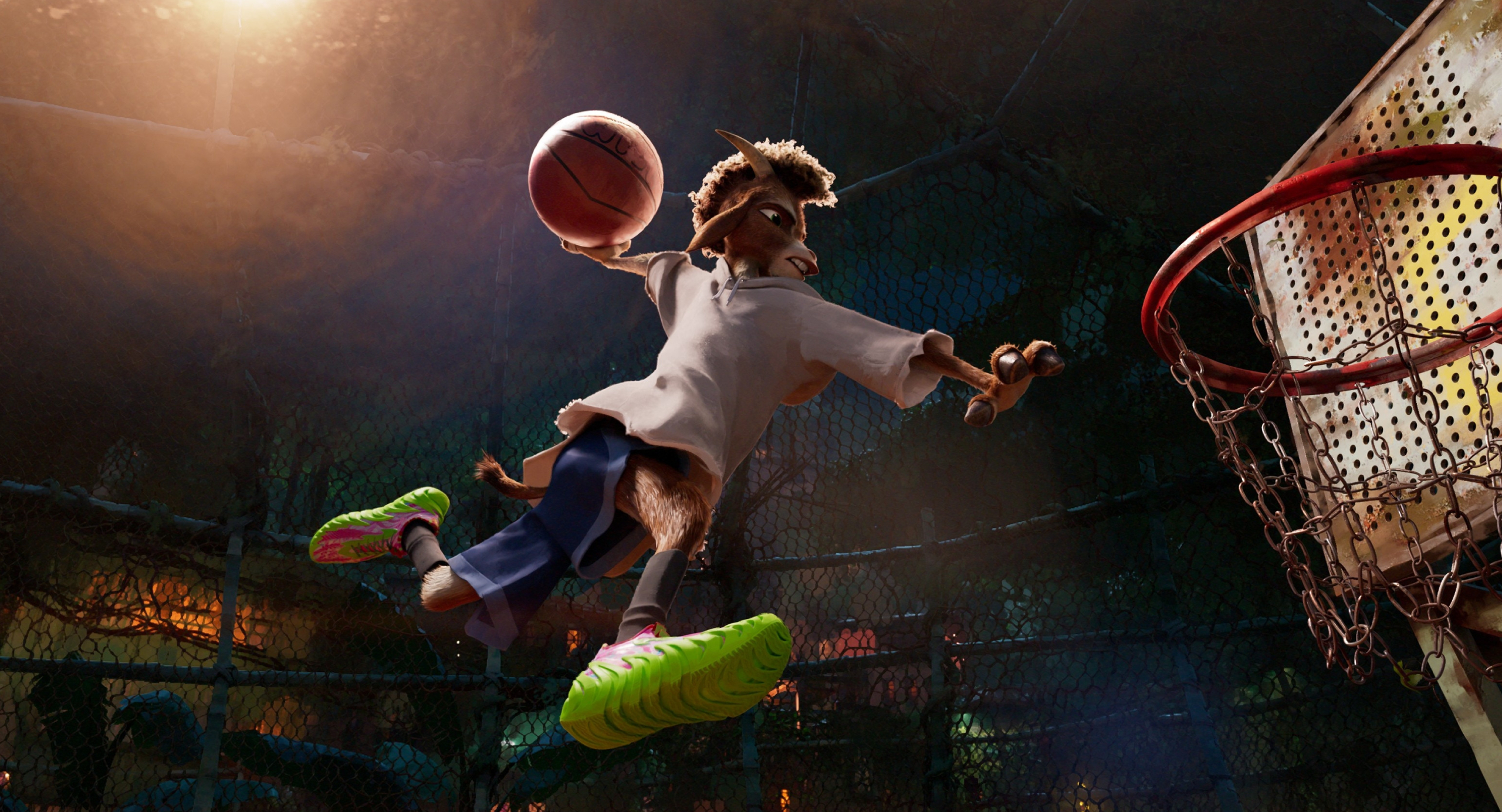
In an era where animated sports films are striving to balance heart, humor, and high-energy spectacle, Goat arrives with a pun-heavy premise and an impressive voice cast. Directed by Tyree Dillihay and written by Aaron Buchsbaum and Teddy Riley, the film follows Will Harris (Caleb McLaughlin), a young anthropomorphic goat chasing greatness in the roarball league. The concept alone — a goat striving to become the “G.O.A.T.” — is playful enough to sell tickets, and with producer Stephen Curry lending his credibility (and voice) to the project, the film seems primed for slam-dunk success.
While Goat delivers plenty of laughs and kinetic sports action, it struggles to elevate itself beyond familiar underdog territory. The result is an entertaining but uneven animated feature that shines in bursts without fully dominating the court.
The film takes place in Vineland, a bustling metropolis populated entirely by anthropomorphic animals. Visually, the world-building is one of the film’s strongest assets. The animation style is colorful and fluid, blending exaggerated cartoon physics with grounded sports choreography. Roarball, the fictional basketball-like sport at the center of the story, feels convincingly realized, complete with roaring crowds, dramatic lighting, and stylized slam-dunks that emphasize each character’s animal traits.
From the sleek black panther superstar Jett Fillmore (Gabrielle Union) to the intimidating lion Mane Attraction (Aaron Pierre), the character designs cleverly integrate athleticism with species-specific flair. The Lava Court Magmas, in particular, boast fiery aesthetics and bold color palettes that contrast sharply with the more grounded Vineland Thorns. The matches are staged with cinematic flair, featuring swooping camera movements and slow-motion plays that heighten tension.
However, while the visual world pops, the broader setting of Vineland lacks deeper exploration. We see glimpses of class divides and financial struggles through Will’s eviction and hustle, but the film never digs deeply into its socioeconomic subtext. The backdrop is vibrant, yet narratively underdeveloped.
Caleb McLaughlin delivers a spirited performance as Will Harris, infusing the character with warmth, optimism, and youthful determination. Will’s dream of becoming the greatest roarball player is tied to his late mother’s encouragement to “dream big,” giving the character emotional motivation that grounds the comedy. McLaughlin’s vocal performance captures both Will’s swagger on the court and his vulnerability off it, particularly in quieter scenes reflecting on loss and ambition.
Gabrielle Union brings gravitas and subtle insecurity to Jett Fillmore, the seasoned panther whose glory days may be slipping away. Jett’s arc — navigating ego, fear of obsolescence, and leadership — provides some of the film’s strongest character work. Union balances confidence with fragility, making Jett more than just a stereotypical star athlete resistant to change.
Aaron Pierre’s Mane Attraction serves as a charismatic antagonist, exuding cool menace without becoming cartoonishly evil. His rivalry with Will crackles with competitive tension, and Pierre’s performance gives Mane a commanding presence whenever he steps onto the court.
The supporting cast, which includes Nicola Coughlan as Olivia Burke and David Harbour as Archie Everhardt, adds texture but often feels underutilized. With so many recognizable names — from Nick Kroll and Jenifer Lewis to Patton Oswalt and Jennifer Hudson — the film occasionally spreads its ensemble too thin. Several characters feel more like archetypes than fully realized teammates.
As a sports comedy, Goat leans heavily into wordplay and physical humor. There are plenty of animal puns, exaggerated sports antics, and fast-talking exchanges that will land well with younger audiences. The viral video sequence that launches Will into the spotlight is one of the film’s comedic high points, capturing the chaotic energy of internet fame with sharp editing and clever sight gags.
That said, the humor can be inconsistent. Some jokes rely too heavily on obvious animal-based punchlines, and a few gags feel stretched beyond their welcome. The script’s attempts at edgier humor — often delivered through characters like Daryl or certain teammates — don’t always mesh tonally with the film’s more heartfelt moments.
Still, the comedic pacing during roarball games is strong. The action sequences often double as punchlines, using slapstick timing and visual exaggeration to keep the energy high. When the film commits fully to its absurdity, it’s genuinely funny.
Where Goat falters most is in its narrative predictability. The underdog sports formula is well-worn territory: the overlooked rookie joins a struggling team, clashes with a prideful veteran, learns about teamwork, and fights for a championship. The film hits nearly every expected beat, from locker-room tension to motivational speeches before the big game.
While there’s nothing inherently wrong with a classic sports arc, Goat rarely subverts expectations or introduces surprising twists. Even emotional conflicts resolve in relatively straightforward ways. The stakes surrounding team ownership and relocation add tension, but they’re handled quickly and without much nuance.
The rivalry between Will and Jett initially promises a deeper exploration of generational conflict in professional sports — youth versus legacy, hunger versus reputation. Yet the resolution feels somewhat rushed, smoothing over complex emotions in favor of a clean, crowd-pleasing finish.
Despite its formulaic structure, the film does succeed in delivering emotional resonance. Will’s memories of his mother and his connection to his old diner job provide grounded, relatable motivation. The scenes between Will and Jett away from the court are some of the strongest in the film, focusing less on spectacle and more on vulnerability.
The message about teamwork over individual glory is clear without being overly preachy. There’s a genuine warmth in the way the Thorns gradually come together, especially as they learn to trust one another. While the character development may not be groundbreaking, it’s sincere.
The climactic championship game is staged with appropriate intensity, featuring dynamic animation and swelling music. Even if viewers can predict the outcome, the sequence delivers adrenaline and emotional payoff. The crowd reactions, character expressions, and physical choreography all come together in a satisfying final act.
This is a fun, family-friendly sports comedy that offers energetic animation and strong voice performances but doesn’t quite ascend to greatness. Caleb McLaughlin’s engaging lead turn and Gabrielle Union’s layered portrayal of Jett elevate the material, and the roarball sequences are consistently entertaining. However, a predictable script and underdeveloped supporting characters prevent the film from reaching the emotional heights of the best animated sports stories.
It’s easy to imagine younger audiences being inspired by Will’s determination and amused by the film’s barrage of animal-themed humor. Adults may appreciate the performances and slick animation but wish for sharper writing and more narrative risks.
In the end, Goat plays a solid game. It hustles, it entertains, and it occasionally dazzles — but it never quite earns the title it so boldly references. As a lighthearted underdog tale with heart and humor, it’s worth a watch. Just don’t expect it to redefine the animated sports genre.