Dust Bunny – Film Review
Published December 17, 2025

Movie Details

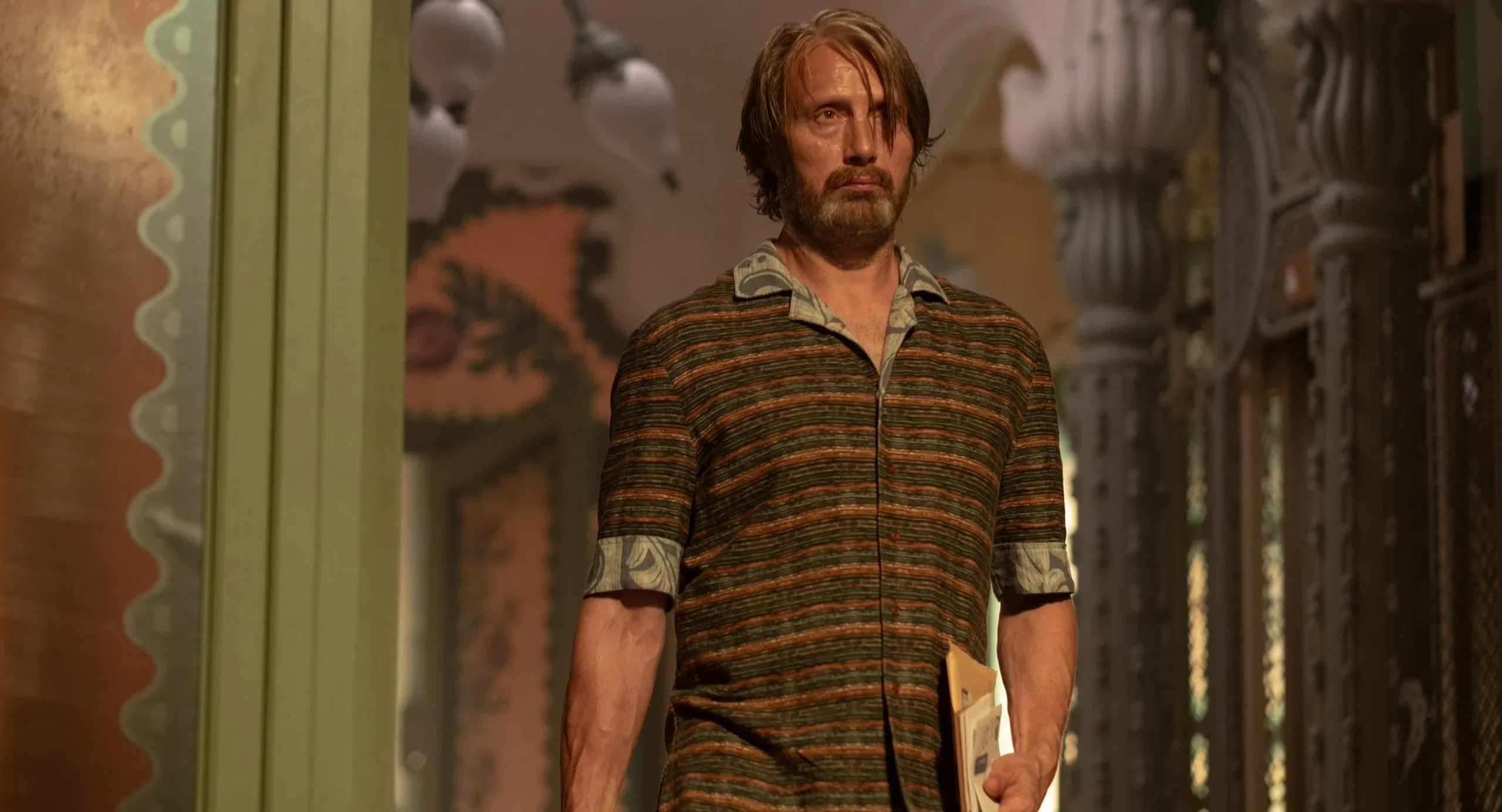
With Dust Bunny, Bryan Fuller makes a striking leap into feature filmmaking, delivering an off-kilter action thriller that fuses fairy-tale logic, brutal violence, and childlike terror into something that feels both familiar and utterly strange. Best known for his television work, Fuller brings his ornate visual sensibility and macabre whimsy to the big screen with confidence, crafting a film that oscillates between intimate character study and surreal genre spectacle. The result is a movie that doesn’t always cohere cleanly, but rarely stops being compelling.
Anchoring the film is Mads Mikkelsen—here cast against type yet perfectly at home—as Resident 5B, a taciturn hitman whose nocturnal routines catch the attention of Aurora, an eight-year-old girl played with startling presence by Sophie Sloan. When Aurora believes that a monster under her bed has destroyed her family, she turns not to the police or social workers, but to the man she witnessed performing what she interprets as heroic feats. This childlike misreading of violence becomes the film’s central tension: Dust Bunny exists in the gap between what a child sees and what an adult understands.
Fuller’s script carefully avoids reducing Aurora to a mere plot device. Instead, she is positioned as the emotional lens through which the film unfolds. Sophie Sloan’s performance is exceptional—never cute, never cloying, and often unsettling in its emotional clarity. Aurora’s belief in monsters isn’t presented as naïveté, but as a form of intuitive truth-telling. In her worldview, danger has a shape, a personality, and rules. That belief clashes sharply with 5B’s world of contracts, handlers, and disposable lives, forcing the film to interrogate whether the “real” monsters are any less fantastical.
Mikkelsen plays 5B with his signature economy of movement and expression. He is a man shaped by violence but no longer animated by it, and the film finds quiet power in his restraint. Fuller resists the temptation to over-explain his past, allowing gesture and implication to do the work. This makes the character’s evolving sense of responsibility toward Aurora feel earned rather than sentimental. Their relationship, while unconventional, avoids exploitation; the film is keenly aware of the moral tightrope it walks and rarely slips into indulgence.
Visually, Dust Bunny is unmistakably a Bryan Fuller project. Production design leans heavily into storybook surrealism—shadowy hallways, glowing cityscapes, and environments that feel slightly too theatrical to be real. The cinematography bathes nighttime sequences in deep blues and sickly neons, giving the city an almost dreamlike hostility. Action scenes are staged with clarity but also flourish, often blurring the line between reality and imagination. Violence is frequent and sometimes shocking, but it is rarely glorified; instead, it is framed as chaotic, ugly, and emotionally costly.
The supporting cast adds texture and weight to the film’s genre mechanics. Sigourney Weaver brings steel and intelligence to Laverne, a handler whose calm authority masks deeply transactional morality. Weaver understands exactly how much to withhold, making her presence feel ominous even in quieter scenes. Sheila Atim is equally compelling as Brenda, a figure who initially appears procedural but gradually becomes one of the film’s moral anchors. Her performance grounds the film whenever it threatens to drift too far into fantasy. David Dastmalchian, though used sparingly, injects an unnerving unpredictability that reinforces the sense that no one in this world is entirely stable.
Tonally, Dust Bunny walks a razor’s edge. It is simultaneously an action thriller, a dark fairy tale, and a meditation on childhood trauma. Fuller’s greatest strength—and occasional weakness—is his refusal to choose just one. Some viewers may find the tonal shifts jarring, particularly when moments of grim brutality collide with whimsical or symbolic imagery. Yet that friction feels intentional. The film is less interested in comfort than in disorientation, mirroring Aurora’s own attempts to make sense of loss through myth.
The monster imagery, which the marketing wisely keeps vague, is emblematic of the film’s approach. Rather than serving as a simple horror element, it functions as metaphor, manifestation, and narrative catalyst all at once. Fuller uses it sparingly but effectively, ensuring that its presence retains symbolic weight. The film’s refusal to over-rationalize this aspect will likely divide audiences, but it aligns with the story’s thematic commitment to subjective truth over literal explanation.
Where Dust Bunny occasionally falters is in its pacing. The middle act, dense with character introductions and shifting alliances, can feel overstuffed. Fuller’s ambition sometimes leads him to linger on ideas that might have benefited from sharper editing. Still, even these moments are rich with atmosphere and character detail, and the film never loses its emotional throughline.
What ultimately elevates Dust Bunny above standard action fare is its empathy. The film treats childhood fear not as something to be outgrown or dismissed, but as a valid response to a violent, incomprehensible world. It suggests that monsters are not simply imagined excuses, but emotional tools—ways to name and confront trauma when language fails. That idea lingers long after the credits roll.
As a feature debut, Dust Bunny is remarkably assured. Bryan Fuller demonstrates a clear authorial voice, unafraid of risk or tonal complexity. The film may not appeal to viewers seeking clean genre boundaries or straightforward thrills, but for those open to a stranger, more emotionally resonant experience, it offers something genuinely distinctive.
Dust Bunny is a bold, uneven, and often mesmerizing action thriller—one that trades neat answers for unsettling questions, and in doing so, leaves a lasting impression.